April 26, 2017
Murphy Award: Haley Oliver
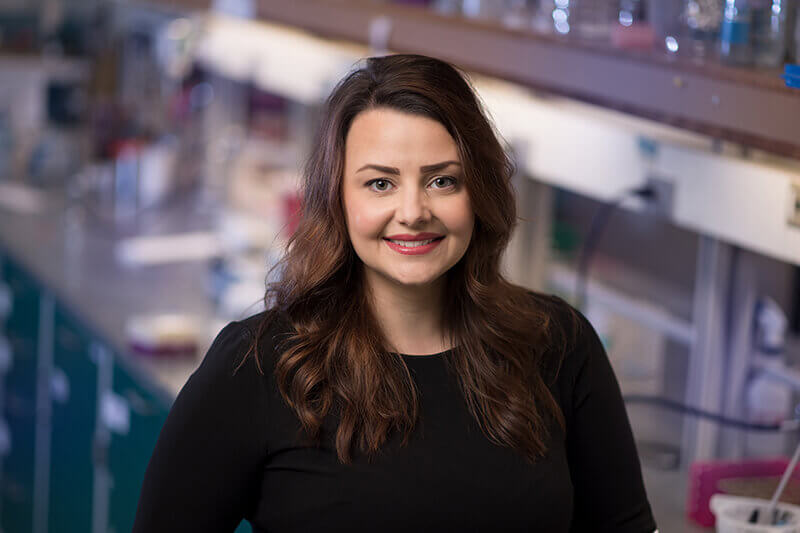 Haley Oliver, associate professor of food science. (Purdue University photo/John Underwood)
Download image
Haley Oliver, associate professor of food science. (Purdue University photo/John Underwood)
Download image
Five teachers have received the 2018 Outstanding Undergraduate Teaching Award in Memory of Charles B. Murphy. This week, Purdue Today will feature Q&A's on each of the recipients. This profile focuses on Haley Oliver, associate professor of food science.
Years at Purdue: 8.
Teaching interests: Food microbiology, specifically food safety.
On what inspired her to teach: I honestly never had a vision of teaching, or even becoming a faculty member. I applied for my current position in 2010 as I thought it was the right time to investigate a research and teaching career. Eight years later, I couldn’t dream of a more rewarding and challenging career. As teaching was a major part of my position description, I embraced pedagogy as a new area of research.
On receiving the Murphy Award: The College of Agriculture nominates two faculty from among 300 talented faculty, which means being nominated for the Murphy Award in and of itself is a big honor. It was a huge surprise to be honored with the award on March 19. As I’m not teaching this semester, my department crafted a “fake” meeting, which was actually productive, to make sure I was in a findable place for the surprise.
On what makes an engaging lecture: I think stories and real-world applications help bring students along to answering the “why” question. Also, people like to do things. Case studies are a great way to get students to problem solve and see processes.
On flipping FS 361: Frankly, flipping FS 361 was not pretty at first. My teaching scores took a significant hit because I did a poor job helping students transition to a different instruction model. However, in the long run, the flipped model gave students defined group work time, which reduced scheduling conflicts. It also allows me to cover more material in a one-credit course. It more closely simulates real-world situations where people work in teams without a prescription for solving a problem or meeting an objective.
On teaching in Afghanistan: Universities in Afghanistan have a very different teaching and education philosophy compared to what our students experience at Purdue. There is very little hands-on/active learning in Afghan classrooms. Afghan students typically experience lecture formats and rarely, if ever, laboratories. In our effort to build a Food Technology Department at Herat University in Herat, Afghanistan, we are introducing labs and hands-on experience to engage students and reinforce lecture concepts.
What her students say: “I love the class so much. The instructor manages to explain all the details that we need to know in an enjoyable way. She always teaches us to understand the topic in the simplest way. She also never failed to make us updated with the current issues related to the course. She also prompts us to learn how to obtain information from paper and the internet that will help us in the future.”
“Dr. Oliver did a great job of explaining mechanisms of the most important microbes if the food industry, and world, period. She was very engaging and made class interesting by tying real life foodborne illness outbreaks to the microbe of discussion. This helped us understand certain microbes' characteristics. Awesome professor.”