
Online Master’s Degrees In Aerospace Engineering
Online Master’s Degrees In Aerospace Engineering
Earn your master’s degree and explore new heights and horizons
Purdue University’s online aerospace engineering master’s programs give professionals in aerospace, defense and space exploration dynamic skills in areas such as aerodynamics, propulsion, systems design and space applications that they can use to move their industries forward. These boundary-pushing programs offer the same academic rigor and career-enhancing connections as our on-campus programs, and they are taught by the same expert Purdue faculty.
MASTER OF SCIENCE IN AERONAUTICS AND ASTRONAUTICS
Purdue University’s online Master of Science in Aeronautics and Astronautics provides students with a world-class education, led by the same esteemed faculty who teach on campus.
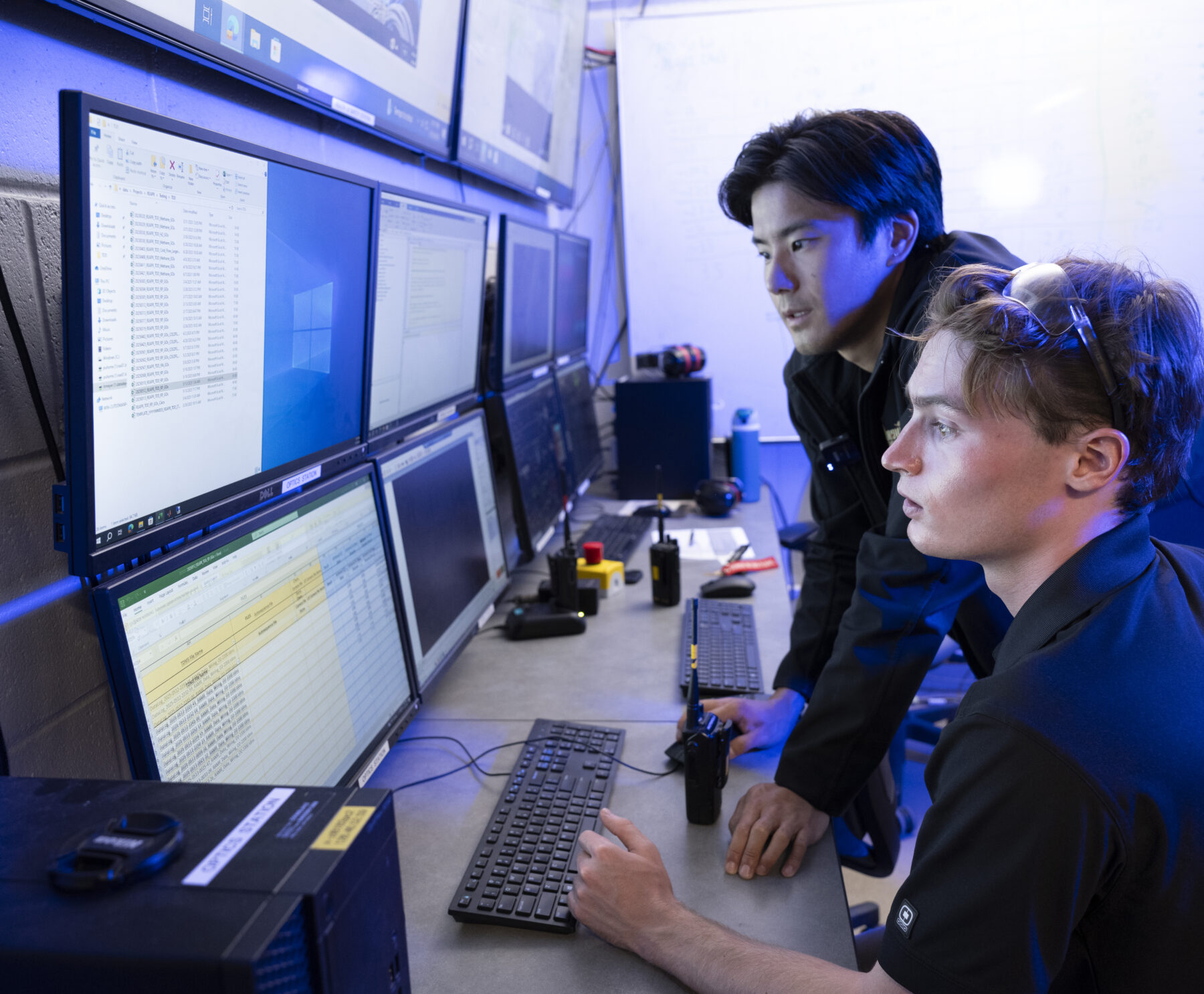
MASTER OF SCIENCE IN SPACE SYSTEMS ENGINEERING
Purdue University’s online Master of Science in Space Systems Engineering, provides students with the opportunity to study and gain skills in the tools, methods and processes of designing, analyzing, controlling and improving complex engineered space systems.

Request Information
Complete the form below to learn more about Purdue’s online Master’s Degrees In Aerospace Engineering.
The form below will be shared with a Purdue Enrollment Specialist.

Master of Science in Aeronautics and Astronautics
Purdue University’s online Master of Science in Aeronautics and Astronautics provides students with a world-class education, led by the same esteemed faculty who teach on campus. The program covers aerodynamics, aerospace systems, astrodynamics and space applications, autonomy and control, propulsion, structures and materials and more, allowing students to specialize in key areas that align with their career goals.
- Early to mid-level career engineers working in aerospace or related fields
- Engineers seeking career advancement or leadership roles
There are 30 credits required for completion. The following are the criteria for admission:
- Math Background: We recommend a background in: Calculus 1, 2 and 3; Differential Equations; Linear Algebra; Partial Differential Equations; Statistics; and Physics 1 and 2.
- Undergraduate Degree: No formal prerequisites, but a BS in engineering or science disciplines is typical. We prefer the following engineering disciplines: Aerospace, Mechanical, Electrical/Computer, Chemical or Materials. Degrees in Math or Physics are also well suited.
- Test Scores: Valid GRE score unless a waiver applies.
- Deep Technical Expertise in Core Aerospace Disciplines
- Multidisciplinary Systems Thinking
- Applied Problem Solving and Innovation
- Leadership and Professional Development
- Aerospace Engineer
- Propulsion Engineer
- Flight Controls or Autonomy Engineer
- Structural or Materials Engineer
- Systems Engineer
- Astrodynamics Analyst or Satellite Engineer
- Engineering Project Manager or Technical Lead

Master of Science in Space Systems Engineering
Purdue University’s online Master of Science in Space Systems Engineering, provides students with the opportunity to study and gain skills in the tools, methods and processes of designing, analyzing, controlling and improving complex engineered space systems. The program is designed to produce students with firm grounding in space systems engineering and well prepared to lead and execute transdisciplinary processes that result in space systems that are responsive to stakeholder’s needs.
- Early to mid-level career engineers working in aerospace or defense
- Professionals seeking a career shift into space systems
- Government or military personnel working in space operations
There are 30 credits required for completion. The following are the criteria for admission:
- Math Background: We recommend a background in: Calculus 1, 2 and 3; Differential Equations; Linear Algebra; Partial Differential Equations; Statistics; and Physics 1 and 2.
- Undergraduate Degree: No formal prerequisites, but a BS in engineering or science disciplines is typical. We prefer the following engineering disciplines: Aerospace, Mechanical, Electrical/Computer, Chemical or Materials. Degrees in Math or Physics are also well suited.
- Test Scores: Valid GRE score unless a waiver applies.
- Systems-Level Thinking and Integration
- Advanced Technical Proficiency in Space Engineering
- Leadership in Transdisciplinary Projects
- Innovation and Problem Solving and Space Challenges
- Space Systems Engineer
- Mission Architect
- Satellite Systems Analyst
- Program Manager
- Systems Integration Lead
- Aerospace Consultant
- Commercial Space Strategist
