April 18, 2016
Purdue professor receives multimillion dollar funding to establish Station Q Purdue, become part of elite Microsoft team
 |
|
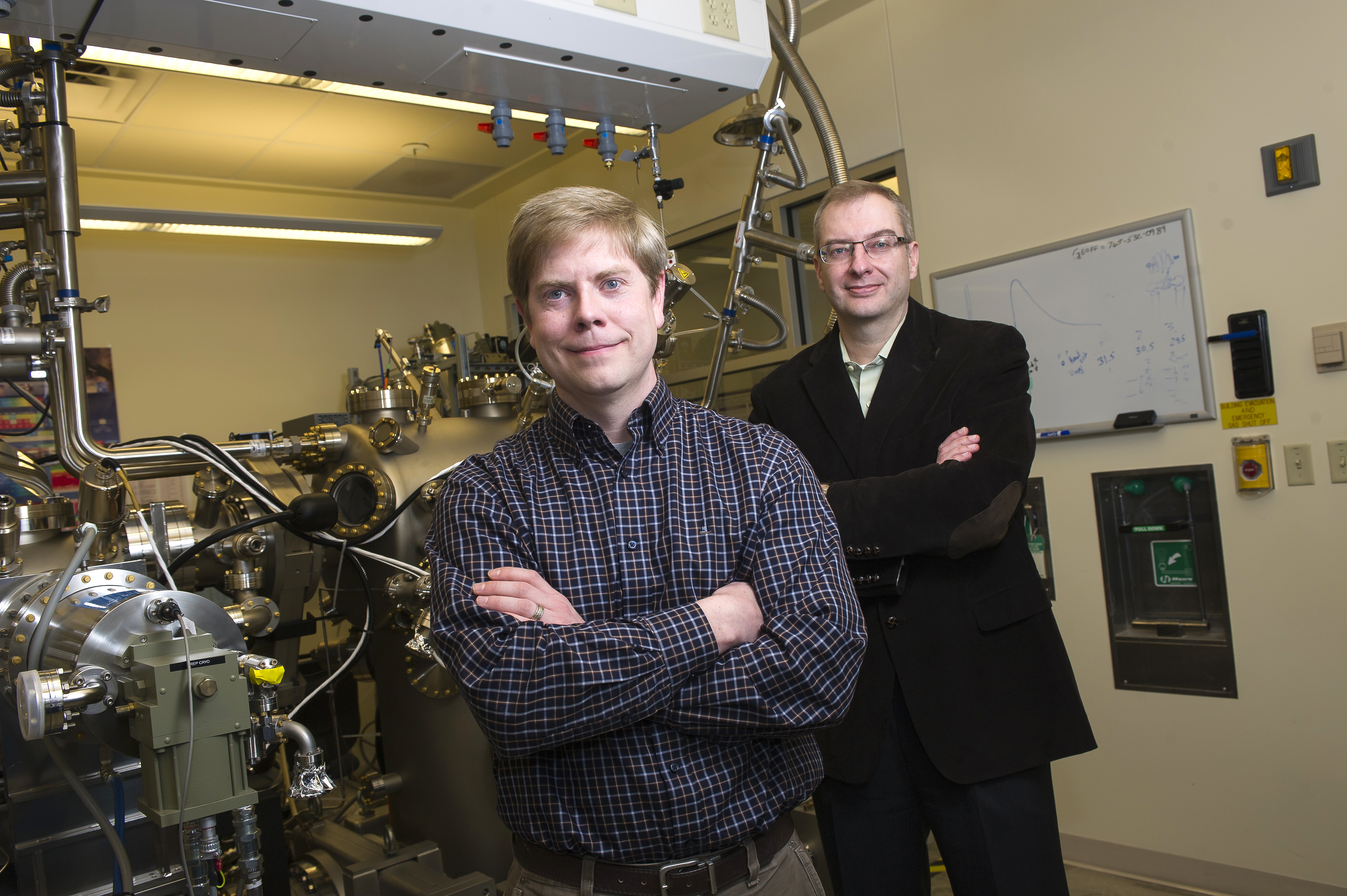
Purdue research engineer and graduate student Geoff Gardner (front) and professor Michael Manfra stand next to a molecular beam epitaxy system in the Manfra laboratories at Discovery Park. Manfra leads Station Q Purdue, an experimental research team collaborating with Microsoft Station Q to pursue a path to quantum computing. (Purdue University photo/Rebecca Wilcox) |
WEST LAFAYETTE, Ind. —A Purdue University professor has been selected to lead Station Q Purdue, part of an elite team assembled by Microsoft’s Station Q to pursue a path to quantum computing.
Google, IBM, Intel and Microsoft have put resources into research teams striving to discover a path to quantum computing. At Microsoft the quantum computing research effort is spearheaded by Microsoft Station Q.
Mathematician and Fields Medal winner Michael Freedman leads Microsoft Station Q, which includes an internal team of theorists coupled to four satellite Station Q experimental groups and two satellite Station Q theory teams working in close collaboration.
Station Q Purdue, directed by professor Michael Manfra, is poised to become a leading element of a grand international collaboration spanning engineering, physics, and computer science, whose goal is to establish the foundations for a new quantum technology, Freedman said.
"Microsoft is in the quantum game for the long run; we are investing in the scientific and engineering foundations," he said. "Mike Manfra comes from the world’s finest tradition in materials growth - having early training at Bell Labs - but what really makes him stand out is that he is also a transport physicist and truly understands what will happen downstream to the samples he grows. This gives him a rare insight."
 |
|
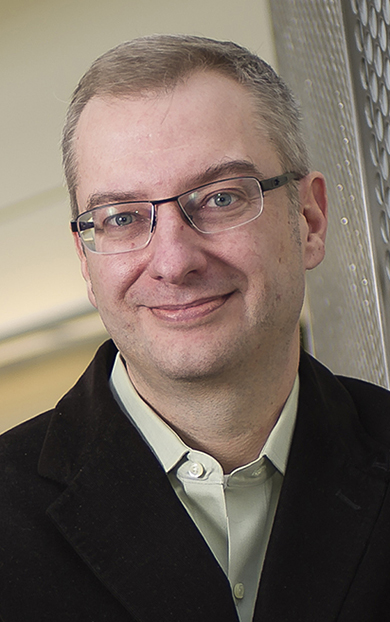
Michael Manfra (Purdue University photo/Rebecca Wilcox) |
Manfra's team has received multimillion-dollar funding for this fundamental research.
"With literally the entire world of individual talent and institutional partners to pick from, Microsoft chose Purdue and these brilliant researchers," said Purdue President Mitch Daniels. "Thanks to them, when one day ultra fast quantum computing becomes real, Purdue will be a part of that historic moment."
Quantum computing - an advanced architecture for computing that uses the quantum mechanical behavior of electrons to store and process information – is thought to be able to solve certain classes of problems much faster than a classical computer and open the door to scientific advances that would impact a range of fields including cyber security and renewable energy.
Manfra, the Bill and Dee O'Brian Professor of Physics and Astronomy, and professor in the School of Materials Engineering, and the School of Electrical and Computer Engineering, focuses on the creation and study of new materials with the potential to be used in quantum computers.
Classical computing carries information in binary code made up of ones and zeroes corresponding to on and off states of silicon transistors. Quantum computing is based on manipulation of information encoded in quantum state variables, for example the spin of an electron. The fundamental unit of information for quantum computing is the quantum bit or qubit, but how a practical quantum computer will ultimately be built is unknown.
With Microsoft support, Manfra and his team will use molecular beam epitaxy to create new platforms for topological qubits. A news release explaining the research project is available at http://www.purdue.edu/newsroom/releases/2016/Q2/purdue-professor-receives-multimillion-dollar-funding-to-establish-station-q-purdue,-become-part-of-elite-microsoft-team.html.
"Professor Manfra is one of our brightest research stars and is leading the charge to bring scientists and engineers together to solve some of humankind's most challenging technical problems," said Jeffrey T. Roberts, the Frederick L. Hovde Dean of Purdue's College of Science. "He is an extraordinarily effective collaborator within and outside of Purdue, and I am so pleased at his role in making Purdue part of Microsoft’s Station Q."
Writer: Elizabeth K. Gardner, 765-494-2081, ekgardner@purdue.edu
Sources: Michael Manfra, 765-494-3016, mmanfra@purdue.edu
Mitch Daniels, president@purdue.edu
Jeffrey Roberts, 765-494-1730, jtrob@purdue.edu
Michael Freedman, michaelf@microsoft.com
Video:
YouTube video https://youtu.be/LBdqTvHMrNM