
Purdue professor to take on four ultra marathons
May 16, 2013
 |
|
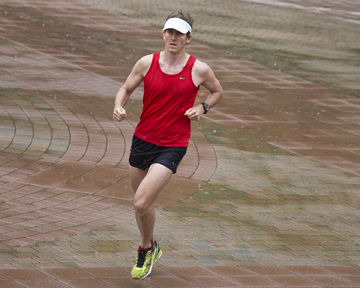
Bryce Carlson, assistant
professor of anthropology, is training to run four 100-mile ultra marathons in
the Midwest Grand Slam of Ultrarunning race series this summer. (Purdue
University photo/Mark Simons)
|
This summer, Bryce Carlson will tackle what he calls one of the biggest challenges of his life. Carlson, assistant professor of anthropology, will run four 100-mile ultra marathons in the Midwest Grand Slam of Ultrarunning race series.
The series involves races across several Midwestern states, including Ohio, Michigan and Wisconsin. Carlson is hoping to complete each race in 24 hours or less. He will not sleep during the races and will take as few breaks as possible. Carlson will consume no food for the first several hours, light snacks when he is hungry and then something more substantial as needed after the first 12 hours.
While Carlson is excited and focused on these races, he is also using them to gain more experience in preparation for another attempt at one of the most challenging ultra marathons in the world, Spartathlon. Spartathlon is a 153-mile race held each year in Greece retracing Phidippides' heroic journey from Athens to Sparta in 490 B.C. to solicit military aid.
"I made an ill-fated attempt in 2010 to complete this journey, and am eager to return," Carlson says.
Carlson, who has been running competitively since high school, says there is much to love in the sport and he has come to embrace what he calls the self-transformative nature of ultrarunning in particular.
"For each race, I find it a great mental exercise to create a training plan that will prepare my body and mind for the upcoming challenge," Carlson says. "In the process of training and then completing the event itself, one comes to understand his or her own body, how it responds to stress, what it's capable of, where the limits are and how to get around them."
Carlson's current training plan includes up to 15 hours of running each week, which equates to about 110 miles. He takes one day off from running each week for recovery, but also includes cross training for strength and stability. Carlson also notes, "Recovery is just as important as the training itself, and I aim to do whatever I can through healthy eating and plenty of sleep to aid in that process."
Carlson sees connections between his work as a professor at Purdue and his running. Carlson's research and teaching center on the relationships among nutrition, human evolution and health.
"I think a lot of my training relies on principles of biological and cultural adaptation. My research engages similar questions with regard to dietary intake and evolutionary processes," Carlson says. "The principles are similar in training and evolutionary change, but obviously operate on different scales of time and differ in some of the details.
"My teaching and research allow me to take on intellectual challenges and pursue personal growth, just as I do with running. On campus I strive to make an increasingly positive impact on students' lives in the classroom, and on society as a whole through my research and published scholarship. At the same time, my running allows me to take on physical and existential challenges that enrich my personal life in a different but complementary way."
Writer: Chris Adam, 49-42082, cadam@purdue.edu