33 students capture competitive NSF research fellowships; 13 achieve honorable mentions
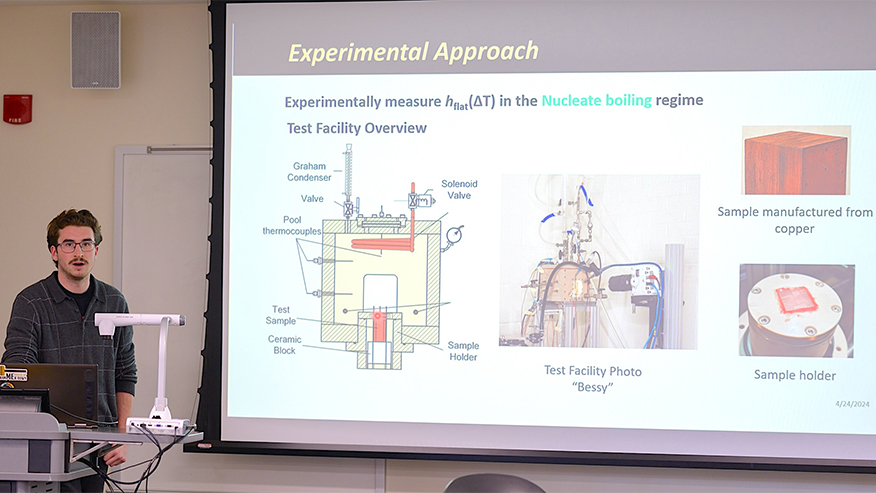
Purdue graduate student W. Grant Dierking points to Purdue’s strong and supportive community of friends, colleagues and mentors in shaping his education and research — and changing the course of his career. (Photo provided)
As a Purdue mechanical engineering undergraduate, W. Grant Dierking thought a master’s degree would be the ticket to advance his studies on the control and optimization of energy systems. But he admittedly wasn’t considering a PhD. That is, until he was encouraged to apply for the Graduate Research Fellowship Program (GRFP) through the National Science Foundation.
And now, Dierking is among 33 current or former Boilermaker students taking their next giant leaps as 2026 winners of the coveted five-year fellowships.
“Now, through my PhD, I look forward to working directly in the space between academia and industry, joining others in building a bridge that connects the two more effectively — work that would have been virtually impossible without the support of the NSF that drove me to choose this degree path,” says Dierking, a native of New Albany in southeastern Indiana. “Being very new to the world of research, I am extremely humbled to have received this award.”
As primary catalysts for Purdue’s research and teaching missions, Boilermaker students continued their impressive run of success: 23 graduate and undergraduate students captured NSF GRFP awards for 2026. Ten recent Purdue alumni received program awards to complete their doctoral studies at other institutions. Another nine current grad and undergrad students and four undergrad alumni achieved honorable mention recognition.
“We are proud of these Boilermakers for earning recognition through such a prestigious fellowship program. Their success reflects their hard work, talent and the strength of the research community here at Purdue,” says Lauren Trondsen, director of fellowships for Purdue’s Office of the Vice Provost for Graduate Students and Postdoctoral Scholars.
Entering its 75th year as the oldest graduate research fellowship of its kind, the NSF GRFP ranks among the nation’s most esteemed for supporting those in the science, technology, engineering and math (STEM) fields. This year, 2,500 program awards were announced, along with 1,470 honorable mention recipients, selected from a highly competitive pool of nearly 14,000 applicants nationwide. The year also marked the highest number of awards since 2023 and is a significant jump from the 1,504 fellowships awarded in 2025.
List of Purdue 2026 awardees of NSF Graduate Research Fellowship Program
Based on overall counts for awarded fellowships, Purdue ranked No. 29 among over 500 public and private universities participating in the program this year. The fellowships are available to incoming and first-year graduate students in STEM fields. The five-year program provides an annual stipend of $37,000 for three years and $16,000 per year for three years toward tuition and fees, subsidizing what their principal investigator or academic department might have to provide.
“This group of Purdue NSF GRFP recipients represents a remarkable group of students who have already distinguished themselves through their curiosity, persistence and commitment to their work,” Trondsen says.
Driven undergrad rewarded for parents’ sacrifice
Undergraduate awardee Amber Wang has gained invaluable experience as a Purdue undergraduate, working with the research team led by Jeffrey Dick, the Richard B. Wetherill Associate Professor of Chemistry. Winning the NSF graduate fellowship is more than a confirmation of her efforts as a biochemistry student planning to pursue a PhD at Purdue and kick-starting her goal to someday work in a national research laboratory.
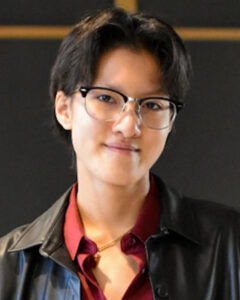
“Receiving the NSF GRFP as a senior undergraduate is incredibly meaningful to me, not only as recognition of my work but as a reflection of the sacrifices my parents made to create these opportunities,” says Wang, a native of Carmel, an Indianapolis suburb. “Their journey to the U.S. and the support they have given me throughout my education have shaped who I am, and this award feels like a way to honor everything they have worked for.”
Being close to home was a factor in choosing Purdue as an undergrad. And Wang plans to remain a Boilermaker for her doctoral studies, furthering her research developing electroanalytical sensors and their applications for healthcare.
“What ultimately led me to continue my PhD at Purdue is that I did not feel ready to leave,” Wang says. “The research environment, especially in Professor Dick’s lab, is highly collaborative, welcoming and aligned with my interests in electroanalytical chemistry. I have found a community here that supports both my growth as a scientist and my passion for integrating research with education.”
Initially, Wang was drawn to Purdue because of its strong reputation in STEM, coupled with its successes in equipping students for both industry and advanced education. She wanted a program that would provide a solid foundation for her future career plans while still allowing flexibility to explore her interests.
“Purdue provided that through opportunities like my psychology minor and the Learning Beyond the Classroom certificate, which allowed me to pursue passions outside of chemistry and shape a more interdisciplinary education,” she says.
Aero-astro student: If at first you don’t succeed …

For Katie Hart, a first-year PhD candidate studying aeronautics and astronautics, the second time was the charm in her success in pursuing an NSF graduate research fellowship. The San Antonio native was named an honorable mention when she applied for a fellowship in 2024. Falling just short after graduating from Rice University in Houston, she deferred graduate studies to live and serve overseas with Cru, a Christian religious ministry.
“Living and serving overseas with Cru was an experience that changed my life profoundly. Now, as a first-year graduate student, I am beyond thrilled to receive the full NSF GRFP award,” Hart says. “The financial support from this award allows me the freedom to devote my effort to pursue research topics that I find relevant and interesting. Additionally, I am hopeful that the prestige of this award will open up doors for me in the future.”
Hart, who dreams of becoming a professor, was drawn to Purdue because of the state-of-the-art capabilities at the Maurice J. Zucrow Laboratories. She will conduct her PhD research examining additive manufacturing of energetic materials under Monique McClain, an assistant professor of mechanical engineering. Hart also knew the professional and personal support for Purdue graduate students would create an academic environment in which she could thrive.
“The feedback and guidance I received in this fellowship application is evidence of that. More than just the university, I was also excited to live in Greater Lafayette; and I love being involved in different communities around Purdue,” Hart says.
Continuing family’s Boilermaker legacy
Dierking describes himself as a “third-generation Purdue engineer of sorts,” noting his grandfather was the biggest Boilermaker fan around after earning a bachelor’s degree in chemical engineering when the Wilmeth Active Learning Center was still a coal-fired power plant in the center of campus. His uncle, Todd Reger, studied mechanical engineering at Purdue and was taught by one of Dierking’s favorite instructors, Charles Krousgrill, the Tebbe Family 150th Anniversary Professor of Mechanical Engineering, who also happens to be from New Albany.
“Now I’m here finding out in person where their Boilermaker pride stems from,” Dierking says. “I am continually amazed by the level of collaboration that occurs between peers, students and faculty, and research groups that drive innovation here at Purdue and create a truly special community in which to learn and grow.”
Dierking also points to a strong and supportive community of friends, colleagues and mentors at Purdue in shaping his education and research — and changing the course of his career. To advance his research on energy systems — from production to consumption, small scale to hyperscale and component to asset portfolio-level analysis — he will study under mechanical engineering professors Kevin Kircher and Davide Ziviani at Purdue’s world-class Ray W. Herrick Laboratories.
“With the support of NSF and the newfound freedom to pursue research that truly excites me, I am looking forward to using my PhD to gain insight into the cutting-edge research findings in academia, especially here at Purdue,” he adds. “It inspires a great deal of respect in the NSF to see firsthand that they prioritize passion and motivation to make an impact through research over a carefully cultivated résumé. Sometimes the most valuable contributors to the fields of science have very unconventional backgrounds.”
What’s next?
The 2026-27 cycle for the National Science Foundation’s Graduate Research Fellowship Program is expected to open for applications in September. Students interested in applying can reach out to trainee-funding@purdue.edu for access to resources such as workshops on preparing a strong application, individual coaching and feedback on application materials, and examples of previously successful applications.
More Purdue News
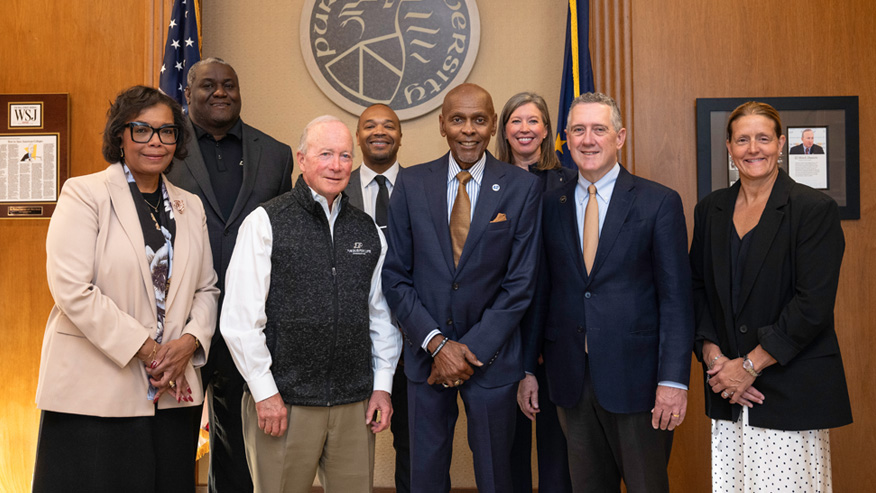
Longtime Purdue benefactor Parrish commits $42M to name new Daniels School building
October 9, 2026

Earhart expedition update: Crew at sea, expected to arrive on Nikumaroro in 72 hours
October 9, 2026
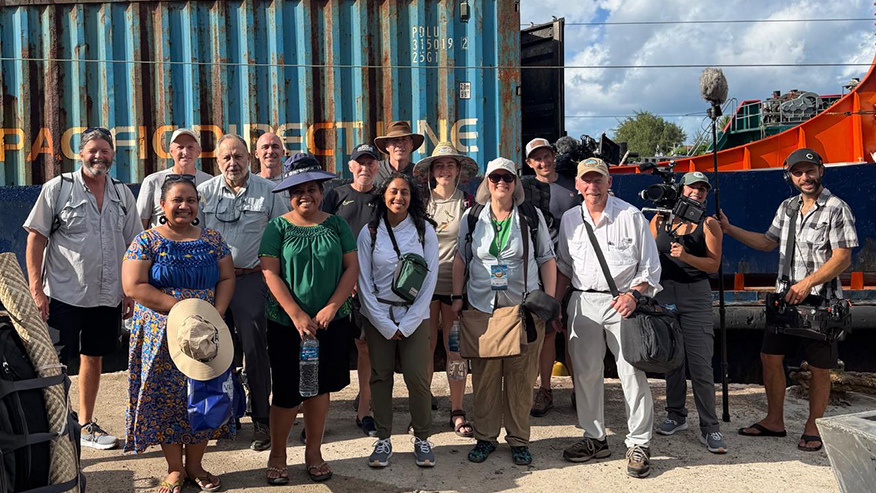
Earhart expedition update: Crew begins 6-day sea voyage to South Pacific atoll Nikumaroro
October 7, 2026
Purdue, Elanco, partners celebrate One Health Research Institute groundbreaking
October 7, 2026