Aime presents ‘The Coffee Leaf Rust Fungus: Unraveling the Origins and Causes behind One of Earth’s Most Notorious Agricultural Pathogens’ at Westwood Lecture Series
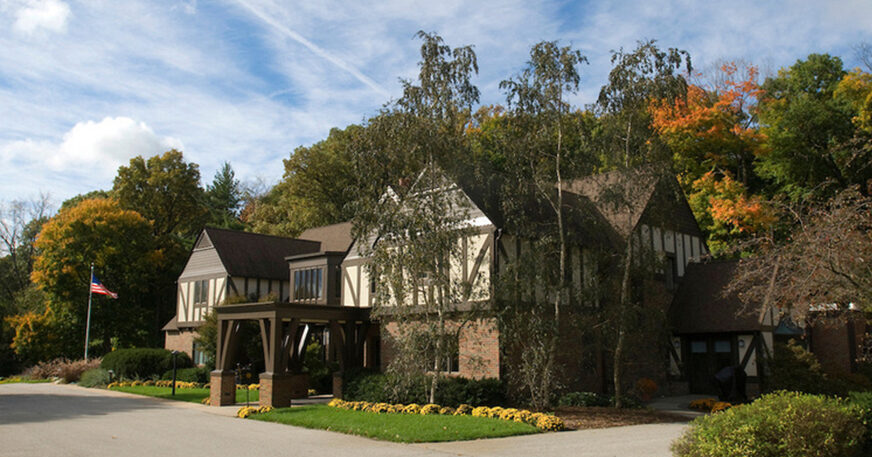
Exterior of Westwood building.
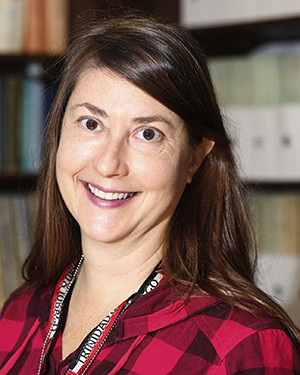
Cathie Aime, professor of botany and plant pathology in the College of Agriculture, presented “The Coffee Leaf Rust Fungus: Unraveling the Origins and Causes behind One of Earth’s Most Notorious Agricultural Pathogens” at the Westwood Lecture Series on Oct. 21.
“The Coffee Leaf Rust Fungus: Unraveling the Origins and Causes behind One of Earth’s Most Notorious Agricultural Pathogens”
Abstract: Coffee is the world’s single most traded agricultural commodity, the production of which supports approximately 125 million people, primarily small shareholders living in low-income economies. Coffee leaf rust (CLR), which is caused by the Hemileia vastatrix pathogen, is the most important limiting factor to global coffee production and has been responsible for notorious epidemics both historically and in modern times with profound impacts on human societies. In this lecture, Aime will discuss her innovative research on CLR to aid in disease resistance efforts. Using a One Health framework, the Aime lab has applied multiple approaches to trace the path of H. vastatrix — from its emergence in the 1860s to its present-day range — and to understand the drivers of epidemic outbreaks and the consequences for growers.
Bio: Cathie Aime leads a pioneering research lab that uses a One Health framework to study the systematics, biodiversity and evolution of fungi to better understand their broader impact on ecosystems. She also directs the Purdue University Herbaria — comprised of the Arthur Fungarium and the Kriebel Herbarium — which houses and studies some of the world’s most important rust fungal specimens, as well as macrofungi, lichens and nonvascular plants.
Aime’s research combines expeditionary fieldwork in remote tropical forests with molecular genetics and multi-omics approaches to understand fungal diversity and evolution. She specializes in tropical basidiomycetes, early diverging basidiomycete lineages (including smuts and yeasts), evolution of rust fungi, and epidemiology of tropical tree diseases.
Aime previously held positions at the U.S. Department of Agriculture and Louisiana State University and recently completed a rotation as a program officer at the U.S. National Science Foundation. She is a fellow of the Mycological Society of America, the American Association for the Advancement of Science, The Explorers Club and The Linnean Society of London. Aime currently serves as president of the International Commission on the Taxonomy of Fungi and is president-elect of the International Mycological Association, which represents approximately 30,000 fungal biologists. She has also served as president of the Mycological Society of America and a managing editor of the journal Mycologia. In 2023, she received the Josef Adolf von Arx Award from the Westerdijk Fungal Biodiversity Institute and Royal Netherlands Academy of Arts and Sciences in recognition of her outstanding contributions to fungal science. She earned a PhD in biology at Virginia Polytechnic Institute and State University and was a postdoctoral researcher in molecular genetics at the University of Oxford.