Purdue research: Ice caps on Mars may reveal planet’s climate history
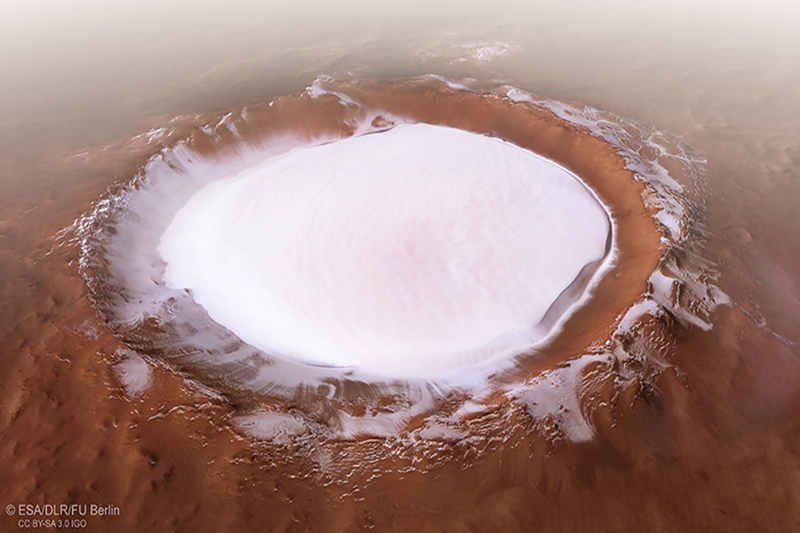
This image from ESA’s Mars Express shows Korolev crater, an 82-kilometer-across feature found in the northern lowlands of Mars. (ESA/DLR/FU Berlin, CC BY-SA 3.0 IGO.)
A team of scientists, led by Purdue University’s Department of Earth, Atmospheric, and Planetary Sciences professors Ali Bramson and Michael Sori, set out to unlock the hidden, historic secrets within ice caps on Mars and published their findings in the Journal of Geophysical Research: Planets.
Article Title
Varied histories of outlier polar ice deposits on Mars
Author(s)
Ali Bramson, assistant professor, Earth, Atmospheric, and Planetary Sciences
Riley McGlasson, PhD candidate, Earth, Atmospheric, and Planetary Sciences
Gareth Morgan, senior scientist, Planetary Science Institute
Michael Sori, assistant professor, Earth, Atmospheric, and Planetary Sciences
Journal
Journal of Geophysical Research: Planets, 2023
Full Article
Article Summary
Much like the Earth’s, Mars’ poles are cold and icy. The Martian ice caps have neighboring craters, formed from impacts by meteors, like the craters you might see on Earth’s moon. Near the poles, many of these craters are filled with ice. How did that ice get there? Was it all deposited at the same time? These questions are what a team of scientists working with Professors Bramson and Sori at Purdue University’s Department of Earth, Atmospheric, and Planetary Sciences have set out to answer. They use radar data collected by a spacecraft orbiting Mars to unlock these icy time capsules’ hidden, historic secrets.
Mars has two large ice caps at its poles, which combined contain a similar volume of ice as Greenland on Earth. Near these large ice caps are craters that are filled with ice, referred to as outlying crater ice deposits. These outlying crater ice deposits may or may not have formed at the same time as the polar caps. Just as scientists on Earth use ice cores to analyze how our climate has changed over time, radar observations of ice on Mars can penetrate deep into the ice and act as digital ice cores, recording changes to the ice deposited over time. Purdue researchers use these radar observations to analyze the history of the outlying crater deposits and find that the northern deposits may have had a similar history to the north polar cap, while the southern deposits may have a more varied history.
Research News

Purdue wearable AI device aims to improve epinephrine injections to treat anaphylaxis
October 14, 2026

‘Movies’ of interaction between light and matter help advance quantum tech
October 6, 2026
Purdue expands partnership with Rittal, Eplan with launch of engineering technology labs
September 16, 2026

Provost announces leadership appointments, promotions
September 14, 2026