Purdue wearable AI device aims to improve epinephrine injections to treat anaphylaxis
Patent-pending device seeks to administer drug rapidly by monitoring, acting on physiological indicators

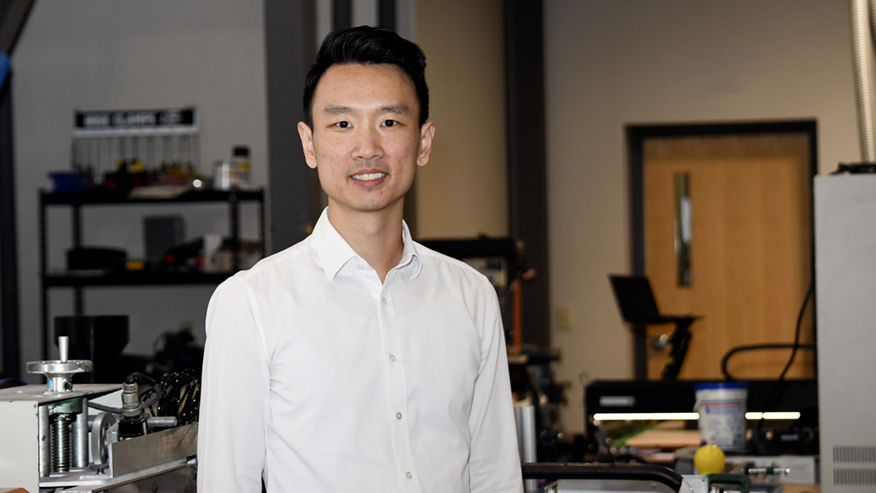
Muhammad Hussain, a researcher in Purdue University’s College of Engineering, leads a team developing a wearable AI device to shrink the gap between the start of an anaphylactic event and the administration of epinephrine to treat it. (Purdue University photo)
WEST LAFAYETTE, Ind. — A Purdue University electrical and computer engineer is conducting research and developing technology to answer whether wearable devices can recognize a life-threatening event, make an intelligent and safe decision, and intervene when the wearer cannot.
Muhammad Hussain, a professor in the Elmore Family School of Electrical and Computer Engineering, leads a team using AI to design a patent-pending device to improve the timeliness of epinephrine injections to treat anaphylaxis, an allergic reaction that can be sudden and potentially life-threatening.
The device integrates advanced sensors, AI-driven decision-making and automated drug delivery with the goal of ensuring rapid epinephrine administration. The researchers are also focused on the device’s manufacturability, security and integration for scalability.
Hussain said the research aims to shrink the potentially dangerous gap between the start of an anaphylactic event and the administration of epinephrine to treat it.
“Epinephrine is effective in treating the event, but the patient or someone nearby must recognize that anaphylaxis is occurring, locate the injector, correctly decide to use it and physically administer it,” he said. “A person experiencing a severe reaction may be alone, confused, physically impaired, unconscious or simply unable to act quickly enough.”
Hussain disclosed the device to the Purdue Innovates Office of Technology Commercialization, which has applied for a nonprovisional patent application to protect the intellectual property.
Industry partners interested in developing or commercializing the system should contact Parag Vasekar, business development and licensing manager-physical sciences, at psvasekar@prf.org about track code 70551.
Using AI to ‘sense, understand, decide and intervene’
Hussain said the envisioned wearable device monitors multiple physiological indicators associated with anaphylaxis.
“Because no single physiological signal necessarily provides sufficient information, multimodal sensing is important,” he said.
Hussain said the AI component is intended to analyze the different signals, learn the wearer’s physiological baseline, identify abnormal combinations consistent with an anaphylactic event, and distinguish a true emergency from normal physiological variations or false alarms.
“Once sufficient confidence is established, the system could alert the wearer and caregivers and ultimately initiate automated epinephrine delivery if appropriate safeguards are satisfied,” he said.
Hussain said beyond anaphylaxis monitoring, the broader scientific idea behind the device interests him.
“Most wearable healthcare devices today primarily sense and report,” he said. “We are asking whether future wearables can sense, understand, decide and intervene. In that sense, this work is a step toward autonomous robotic systems for healthcare.”
Device validation and next development steps
Hussain said the device is being validated through sensor optimization, AI-driven decision-making and automated drug delivery testing.
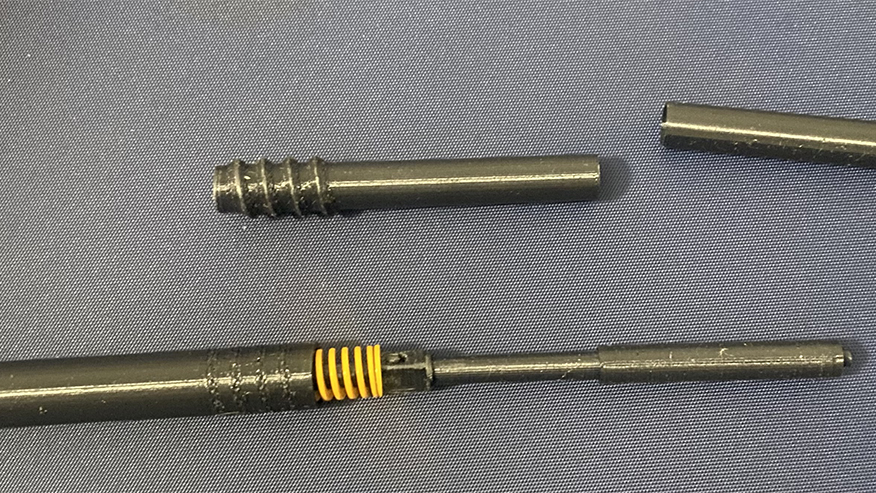
“We are testing microfluidic and spring-based injection systems, integrated power-efficient components and ensured data security using encrypted communication networks,” he said. “Functionality, reliability and safety are being assessed through real-world simulations, industry collaboration and a figure-of-merit evaluation to optimize scalability and affordability.”
Hussain and his team have been developing and prototyping elements of the mechanical injection system and associated electronics. He said the next major challenge is integration.
“We need to bring together the physiological sensors, signal-conditioning electronics, the edge-AI decision system – which processes data and makes decisions directly on the wearable device rather than relying on a remote computer or cloud – power management and the injection mechanism into progressively more integrated prototypes,” he said.
Hussain said further development steps include validating reliability, documenting false-positive and false-negative rates, and understanding the appropriate regulatory and clinical validation pathways.
Completing the loop to achieve actuation
Hussain said the broader idea behind the device reflects a direction his research group has been pursuing for future wearable and intelligent electronic systems.
“Most wearable healthcare devices today primarily sense, process and report information,” he said. “We believe that is only part of what a truly intelligent wearable system should do. The next frontier is actuation. After sensing what is happening and intelligently determining what it means, the system should be capable of safely doing something about it.”
Hussain’s research has increasingly focused on the transition from passive monitoring toward closed-loop systems that integrate sensing, computation, decision-making and physical action. Applications could include drug delivery, electrical or mechanical stimulation, thermal intervention, microfluidic control or other physical responses.
“We are interested in completing the loop,” Hussain said. “A sensor gives a system awareness. Artificial intelligence can give it the ability to interpret and decide. But actuation gives it the ability to interact with the physical world. Bringing sensing, intelligence and actuation together can transform a wearable device from a monitor into an autonomous system.”
The epinephrine project provides a particularly demanding example because the actuation is not merely informational. The system must make a highly consequential decision and physically deliver a therapeutic intervention. This requires reliability, fail-safe operation, low false-positive and false-negative rates, power efficiency, security and appropriate safeguards.
“In that sense, we are not simply developing another wearable sensor,” Hussain said. “We are exploring the architecture of autonomous, closed-loop wearable systems that can sense, understand, decide and act. We believe this convergence of multimodal sensing, edge intelligence and actuation will be an important direction for the next generation of wearable and healthcare electronics.”
About Purdue Innovates Office of Technology Commercialization
The Purdue Innovates Office of Technology Commercialization operates one of the most comprehensive technology transfer programs among leading research universities in the U.S. Services provided by this office support the economic development initiatives of Purdue University and benefit the university’s academic activities through commercializing, licensing and protecting Purdue intellectual property. In fiscal year 2025, the office reported 161 deals executed with 269 technologies licensed, 479 invention disclosures received, and 267 U.S. and international patents received. The office is managed by the Purdue Research Foundation, a private, nonprofit foundation created to advance the mission of Purdue University. Contact otcip@prf.org for more information.
About Purdue University
Purdue University is a research institution ranked among the top 10 public universities in the United States. More than 111,000 students study at Purdue across multiple campuses, including more than 57,000 at our main campus locations in West Lafayette and Indianapolis. As a land-grant university committed to affordability and accessibility, Purdue’s main campus has frozen tuition 14 years in a row, enabling more students than ever to graduate debt-free.
Media contact: Steve Martin, sgmartin@prf.org
Purdue Research Foundation News

Innovative solutions abound at Moonshot Pitch Challenge
September 17, 2026

SK hynix breaks ground on $4 billion advanced packaging production facility in Purdue Research Park
August 27, 2026

Purdue’s new underwater robot could make ocean missions more reliable
August 26, 2026
AnalySwift receives NASA award to enable long-duration space missions
August 25, 2026