Purdue’s new underwater robot could make ocean missions more reliable
Prototype is able to adapt to needs of mission, acting as drifter, glider and thruster

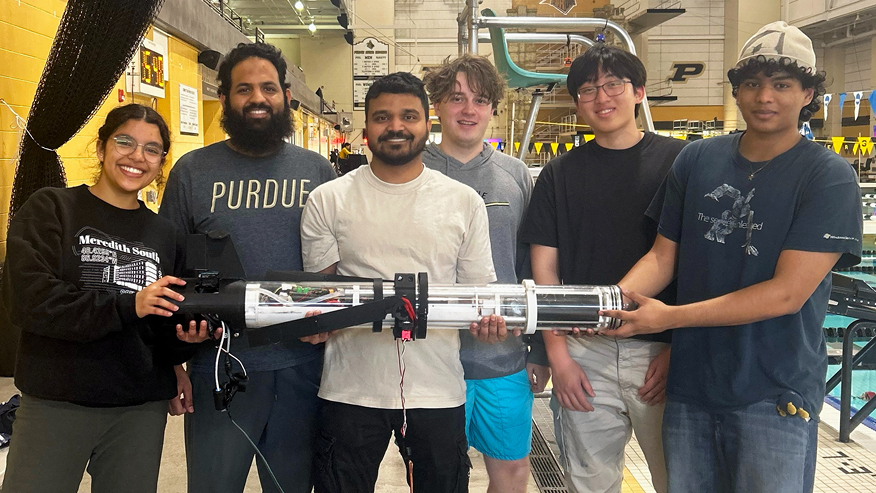
Yu She, an assistant professor at Purdue University, leads a team that has developed an underwater robot that adapts how it moves during missions. Further research will focus on developing more advanced closed-loop control and autonomous mode-selection algorithms. (Photo provided)
WEST LAFAYETTE, Ind. — A new, patent-pending underwater robot developed at Purdue University’s College of Engineering could improve ocean research, underwater infrastructure inspection and search-and-rescue efforts by adapting to the needs of the mission in real time, acting as drifter, glider or thruster when necessary.
Yu She, assistant professor in the Edwardson School of Industrial Engineering, has developed underwater robot technology that can adapt how it moves during a mission.
“It changes how it moves depending on what the mission needs: to conserve energy, travel farther, follow currents, actively reposition or escape from a constrained region,” he said.
Yu She said a major challenge in underwater robotics is that different mission phases require different locomotion: passive drifting, buoyancy-driven gliding and thruster-driven propulsion. Each has strengths and drawbacks.
“Our technology integrates all three locomotion modes into a single compact underwater platform,” he said. “The robot chooses the appropriate mode depending on the mission requirement or environmental condition rather than being locked into one.”
The technology is especially relevant for missions during which an underwater robot must operate over long durations, move through constrained or uncertain environments, and adapt its mobility strategy during a single deployment. Examples include ocean and lake monitoring, current and flow mapping, inspection of underwater structures, exploration beneath ice shelves, environmental sensing, and distributed underwater data collection.
Yu She disclosed the innovation to the Purdue Innovates Office of Technology Commercialization, which applied for a patent to protect the intellectual property. Industry partners interested in developing or commercializing the work should contact Parag Vasekar, business development and licensing manager, at psvasekar@prf.org about track code 71679.
The research has been supported in part by an award from the National Science Foundation.
Drawbacks of traditional underwater robotics
If underwater robots cannot adapt their locomotion strategy, missions may become less efficient and reliable, or fail, Yu She said.
“A purely drifting platform may be carried by currents but unable to actively navigate to a target or recover from an undesirable path,” he said. “A purely gliding platform may have good endurance but may struggle in confined or complex environments. A purely thruster-driven vehicle may maneuver well but may consume power quickly, limiting mission duration.”
Yu She said these limitations could lead to problems for end users, including higher operational costs, shorter mission times, reduced data coverage, increased risks of losing or trapping the robot, and the need to deploy multiple specialized vehicles instead of a single platform.
“In scientific applications such as polar or oceanographic monitoring, these limitations can also reduce the quality and quantity of data available for understanding important environmental processes,” he said.
Development, validation and next steps
Yu She’s integrated robot architecture coordinates buoyancy regulation, internal mass shifting, foldable wings and propulsion so the robot can transition among multiple locomotion states during a single underwater deployment.
“It can drift with surrounding flow when energy efficiency or environmental tracking is desired, glide when longer-range, low-power travel is needed, and use thruster-driven propulsion when active maneuvering, station keeping or escaping from confined conditions is required,” he said.
The robot behaves like three vehicles in one: a drifter, a glider and a powered vehicle. Switching the locomotion currently is done manually, but future work will explore autonomous switching modes.
“As a drifter, it adjusts buoyancy and moves with the surrounding water flow,” he said. “As a glider, it changes buoyancy, shifts an internal mass to adjust pitch and deploys hydrodynamic wings so that vertical motion is converted into forward motion. When active control is needed, it can use a thruster and steering mechanism to maneuver more directly.”
Prototype proof-of-concept validation in underwater pool testing demonstrated several key functions: underwater operation of the foldable wing mechanism, buoyancy-regulated descent and ascent, thruster-assisted translation, and glider-mode motion through coordinated buoyancy adjustment, pitch control and wing deployment.
“The tests confirmed that the main subsystems can operate together in water and that the robot can demonstrate the intended trimodal locomotion behaviors,” Yu She said. “Future work will focus on quantitative metrics such as energy efficiency, endurance, maneuverability, mode-transition time, control accuracy and field robustness.”
The next steps to develop the robot architecture include rigorous performance characterization and field readiness, Yu She said.
“Specifically, we would like to quantify energy consumption, endurance, maneuverability, gliding efficiency, mode-transition performance and robustness under more realistic underwater conditions,” he said. “We also will develop more advanced closed-loop control and autonomous mode-selection algorithms so the robot can decide when to drift, glide or use propulsion based on mission goals and environmental feedback.”
About Purdue Innovates Office of Technology Commercialization
The Purdue Innovates Office of Technology Commercialization operates one of the most comprehensive technology transfer programs among leading research universities in the U.S. Services provided by this office support the economic development initiatives of Purdue University and benefit the university’s academic activities through commercializing, licensing and protecting Purdue intellectual property. In fiscal year 2025, the office reported 161 deals executed with 269 technologies licensed, 479 invention disclosures received, and 267 U.S. and international patents received. The office is managed by the Purdue Research Foundation, a private, nonprofit foundation created to advance the mission of Purdue University. Contact otcip@prf.org for more information.
About Purdue University
Purdue University is a research institution ranked among the top 10 public universities in the United States. More than 106,000 students study at Purdue across multiple campuses, including more than 57,000 at our main campus locations in West Lafayette and Indianapolis. As a land-grant university committed to affordability and accessibility, Purdue’s main campus has frozen tuition 14 years in a row, enabling more students than ever to graduate debt-free.
Media contact: Steve Martin, sgmartin@prf.org
Purdue Research Foundation News

Purdue wearable AI device aims to improve epinephrine injections to treat anaphylaxis
October 14, 2026
Innovative solutions abound at Moonshot Pitch Challenge
September 17, 2026
SK hynix breaks ground on $4 billion advanced packaging production facility in Purdue Research Park
August 27, 2026
AnalySwift receives NASA award to enable long-duration space missions
August 25, 2026