Earhart expedition update: Weather prevents shore work for third straight day; crew to extend trip
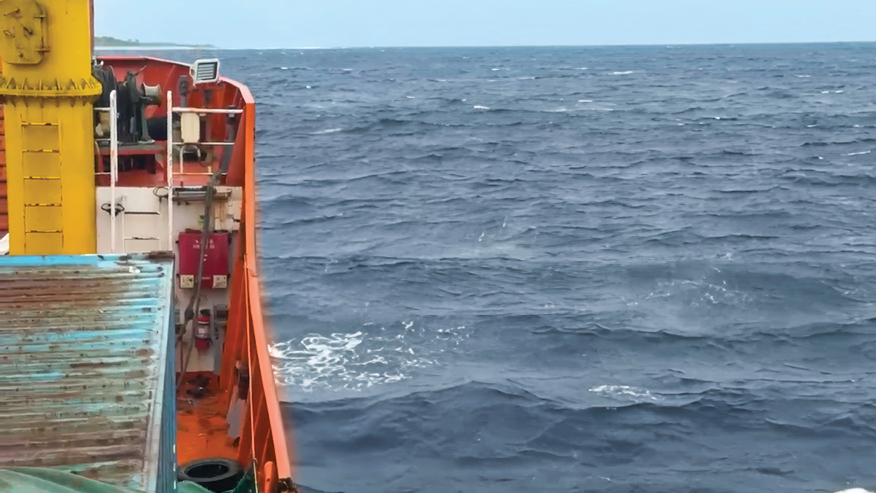
Severe weather continues to prevent the Taraia Object expedition team from conducting exploratory shore work in the search for what could be Amelia Earhart’s missing Lockheed Electra 10-E. Choppy seas and high surf have made it unsafe for team members to travel between the Marin Mainiku vessel and the South Pacific island of Nikumaroro. (Photo provided)
NIKUMARORO, Kiribati — The Taraia Object expedition team remains in a holding pattern as severe weather prevented the team from conducting exploratory shore work for the third straight day in the search for what could be Amelia Earhart’s missing Lockheed Electra 10-E.
Identification of the Taraia Object will not be known until the expedition team can safely complete at least two more days of field operations. The Archaeological Legacy Institute, Purdue Research Foundation (PRF) and Purdue University expedition team is examining the Taraia Object, a visual anomaly in the lagoon of Nikumaroro, an uninhabited South Pacific atoll. The object was first spotted on satellite imagery in 2020 and is thought to be the possible remains of Earhart’s plane.
Earhart came to Purdue in 1935 and spent two years at the university as a women’s career counselor and advisor in the aeronautics department. PRF originally funded Earhart’s Lockheed Electra, the “Flying Laboratory” she used on her round-the-world flight attempt in 1937, through the Amelia Earhart Fund for Aeronautical Research. She intended for the aircraft to be returned to Purdue following completion of her historic flight.
El Niño conditions in the South Pacific complicate the ever-present challenge of getting through Nikumaroro’s imposing reef to gain access to the island. Even under normal conditions, it is not a risk-free proposition. The crew and expedition team must take a transport boat from the larger Marin Mainiku vessel, idling up to a mile away on the leeward side of the island, and navigate around to the “blasted channel,” a passage on the island’s southwestern side created by the British to evacuate settlers in 1963 — the last time Nikumaroro was inhabited. Once there, the transport boat must effectively “shoot the rapids” to reach the beach in a final burst through crashing waves on each side of the narrow channel.
Rough seas and squalls with prevailing winds of up to 20 knots, or about 23 mph, and gusts up to 27 knots, or 31 mph, render it unsafe for the crew both to board the transport boat alongside the Marin Mainiku and to take the smaller boat through the ”blasted channel.”
However, the upcoming forecast for Sunday and Monday looks promising, and the crew has decided to extend its journey to the island until the fieldwork can be completed. There is enough fuel and food aboard the Marin Maniku for the extended stay. Nikumaroro is 17 hours ahead of Eastern time in the U.S.
“We know many people around the world are watching and awaiting updates,” said Rick Pettigrew, executive director of the Archaeological Legacy Institute. “We are committed to sharing information as soon as we are able, while ensuring it is accurate and appropriate to release. Above all, the safety of our team and the ship’s crew is our No. 1 priority.”
The expedition team’s marine archaeologists from RECON Offshore completed their initial underwater survey of the research area in the lagoon on Wednesday (Oct. 14), using various detection methods including a magnetometer and sonar technologies. Other members of the team performed terrestrial archaeology work and completed the setup of the solar-power tech system, which will remain on the island to provide ongoing information on weather and tidal conditions.
When it is safe to return to the Taraia Peninsula on Nikumaroro, Phase 2 of the maritime archaeological work will take a more focused approach with a hydroprobe, a tool used to contact objects directly to determine their depth, orientation and surface composition. A water induction dredge will be used to remove sediment for visual inspection of objects identified in the initial survey work.
Nikumaroro is known for its high and treacherous reef. In 1929, a storm caused the SS Norwich City, a British merchant vessel bound for Vancouver, to run aground on the reef, resulting in the deaths of 11 men. The expedition team can see remnants of the ship on the reef as they make their way around the island to the “blasted channel.”
The Norwich City also figures into one of the more compelling pieces of evidence for the castaway hypothesis. Betty Klenck, then a 15-year-old girl living in St. Petersburg, Florida, reported hearing Earhart on her father’s shortwave radio shortly after Earhart’s July 2, 1937, disappearance. Contemporaneous entries in Klenck’s diary from that day, which were explained by Klenck in an interview with The International Group for Historic Aircraft Recovery in the early 2000s, report hearing Earhart repeatedly saying, “New York City … New York City.” Proponents of the castaway hypothesis believe Earhart was actually saying, “Norwich City … Norwich City” as she attempted to explain where she was — on a beach looking upon the wreck of the Norwich City.
Radio bearings recorded from Earhart’s transmissions at the time by the U.S. Navy, the U.S. Coast Guard and Pan American World Airways converge on Nikumaroro. Earhart’s radio was tested before she took off from Lae, Papua New Guinea, bound for Howland Island. While her transmissions were received by waiting vessels like the USS Itasca, her communications — including the message “Been unable to reach you by radio” — suggest Earhart was not hearing replies.
About Archaeological Legacy Institute
Archaeological Legacy Institute is a 501(c)(3) nonprofit based in Eugene, Oregon, and organized to share the human cultural heritage widely through the use of cutting-edge media technology. ALI’s core project is The Archaeology Channel (http://www.archaeologychannel.org), a free streaming-media website featuring video and audio programs on archaeology, indigenous peoples and cultural heritage. This combines with news site Archaeologica.org, the social media site ArchaeoSeek.com, and subscription video-on-demand platform Heritage Broadcasting Service (heritagetac.org) to form a unique constellation of online services and resources for those keen to learn about and enjoy cultural-heritage information, events, programming and discussions. Through The Archaeology Channel Tours, ALI also organizes in-person group visits to significant cultural heritage sites worldwide, which have included Stonehenge, Machu Picchu, Chichén Itzá, Uxmal, Newgrange, Persepolis, Carnac, the Ness of Brodgar, the Malta prehistoric temples and many others.
About Purdue University and Purdue Research Foundation
Purdue University is a research institution ranked among the top 10 public universities in the United States. The Purdue Research Foundation (PRF) is a private nonprofit operating as a separate entity to advance the university’s mission. Purdue is committed to affordability and accessibility with more than 111,000 students studying at Purdue across multiple campuses. PRF operates Purdue Innovates, including the Office of Technology Commercialization, Incubator and Ventures, as well as managing Purdue Research Park, Discovery Park District at Purdue, Purdue Technology Centers and the Purdue for Life Foundation.
Related coverage
- Earhart expedition update: Weather prevents shore work Thursday; ID update expected in next 48 hours
- Earhart expedition update: Underwater survey of Taraia Object begins
- Earhart expedition update: Crew arrives onshore, sets up operations on Nikumaroro
- Earhart expedition update: Crew arrives at Nikumaroro, launches critical phase of Amelia Earhart plane search
- Earhart expedition update: Crew at sea, expected to arrive on Nikumaroro in 72 hours
- Earhart expedition update: Crew begins 6-day sea voyage to South Pacific atoll Nikumaroro
- Earhart expedition update: Crew arrives at Tarawa, prepares for departure
- Earhart expedition update: Crew departs from Purdue University Airport
- 1 week out: Countdown to the search for Amelia Earhart’s plane begins
- ‘This Is Purdue’ four-part miniseries ‘Finding Amelia’
Media contact: Trevor Peters, peter237@purdue.edu
Note to journalists:
Additional Amelia Earhart expedition photos and video are available in the media kit.
More Purdue News
Purdue receives Gold Standard designation for fostering a campus culture of free expression
October 29, 2026
Purdue leads on affordability with frozen tuition, accelerated degree pathways
October 29, 2026
Purdue, GlobalFoundries expand partnership with master research agreement
October 23, 2026
Purdue’s online cybersecurity degree, AI graduate certificate prepare professionals for emerging digital threats
October 22, 2026