Earhart expedition update: Crew begins 6-day sea voyage to South Pacific atoll Nikumaroro

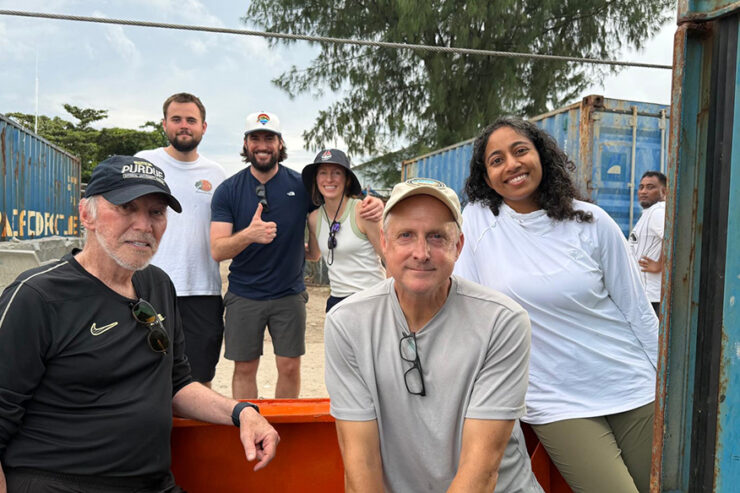
Members of the Taraia Object expedition team, including representatives from the Archaeological Legacy Institute, Purdue University and the Republic of Kiribati, gather at Betio Port on Tarawa, Kiribati, before departing for Nikumaroro. (Photo provided)
TARAWA, Kiribati — The Taraia Object expedition team began the next leg of its journey — and its first seaborne one — departing Tarawa, Kiribati, on Wednesday aboard a Kiribati National Shipping Line vessel en route to Nikumaroro, the remote Pacific atoll where the team will search for evidence of Amelia Earhart’s missing Lockheed Electra 10-E.
The 17-person expedition team includes representatives from the Archaeological Legacy Institute (ALI), Purdue Research Foundation, Purdue University, RECON Offshore and the Republic of Kiribati. The Purdue Research Foundation originally funded the Lockheed Electra “Flying Laboratory” through the Amelia Earhart Fund for Aeronautical Research as part of Purdue’s pioneering efforts in aviation.
Earhart was attempting to become the first person to circumnavigate the globe at the equator. She had completed 22,000 miles of a 29,000-mile route in July 1937 when she and her navigator, Fred Noonan, vanished en route to Howland Island, about 400 miles north of Nikumaroro.
Following the loading of equipment and a safety briefing, the expedition team and 17-person boat crew departed Tarawa aboard the Marin Mainiku at about 7:30 p.m. local time Wednesday. Tarawa is 16 hours ahead of Eastern time in the United States.
Over the next six days, the Marin Mainiku will travel approximately 830 nautical miles at an average speed of 8 knots, or about 9 miles per hour, before reaching Nikumaroro around Monday, Oct. 12.
Early reports from the expedition team indicate the vessel encountered heavy seas upon leaving Tarawa’s large lagoon. The prevailing sea state and tide effects of El Niño are anticipated to be a key consideration during the voyage, including upon arrival at Nikumaroro. That is when the Marin Mainiku’s landing craft will need to navigate a narrow passage known as the “blasted channel,” a gap in the island’s high reef created by the British government during its evacuation of colonists in 1963 — the last time the island had inhabitants.
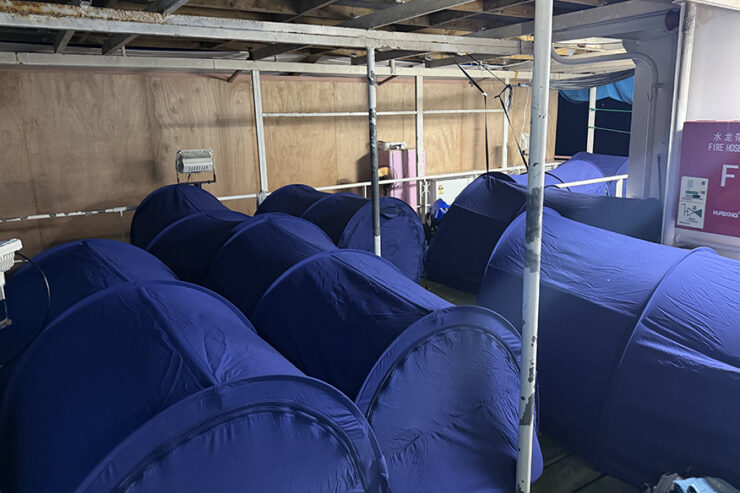
On board the Marin Mainiku, the team had its first meal of chicken stew. Each crew member has a designated sleeping pod equipped with a mattress and pillow, along with space for personal belongings.
Earhart team departs
The expedition team includes three Boilermakers (from front left): Marc Hagle, Steve Schultz and Sirisha Bandla.
Earhart team departs
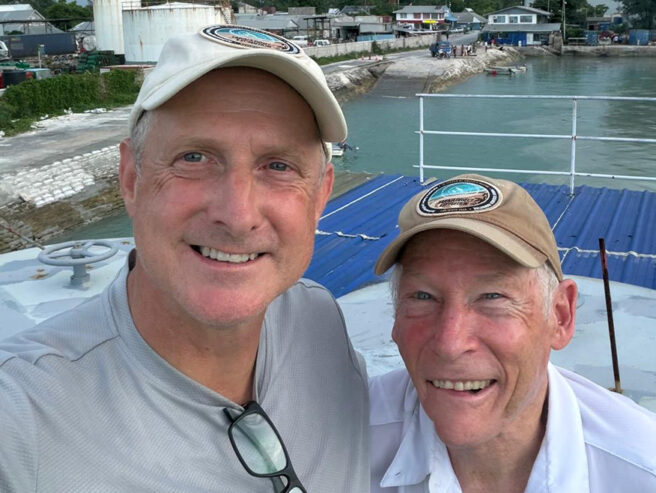
Expedition team members Steve Schultz and Rick Pettigrew pose for a selfie.
Earhart team departs
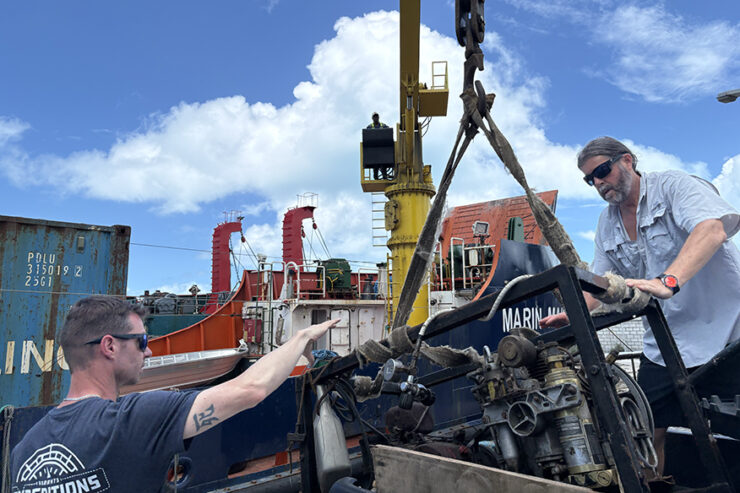
Equipment was shipped from multiple points in the United States and loaded onto the boat in Tarawa.
Earhart team departs
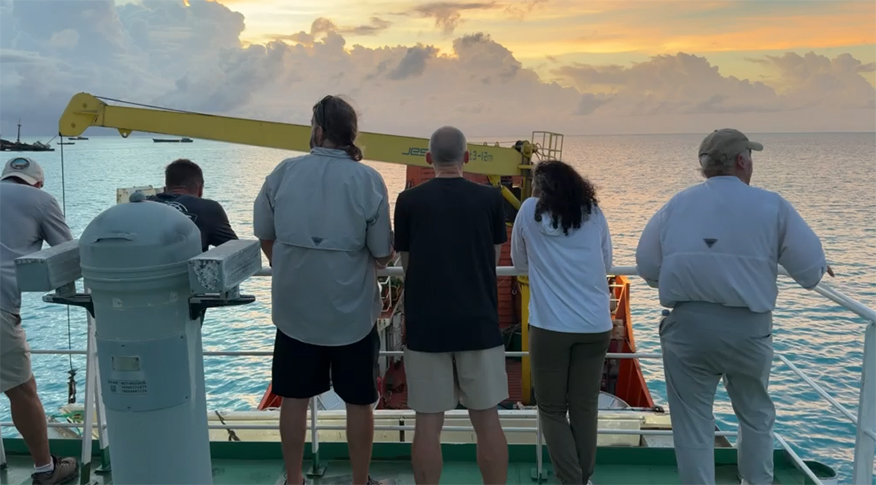
The expedition team enjoys a sunset departure from Tarawa.
Earhart team departs
Each crew member has a designated sleeping pod equipped with a mattress and pillow.
Earhart team departs
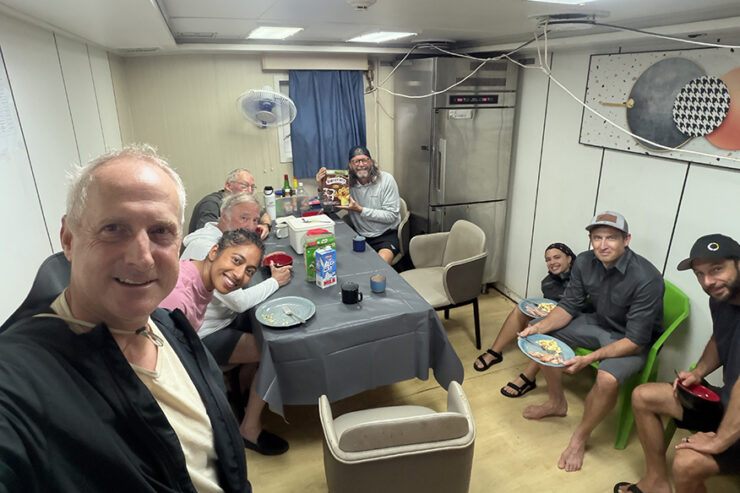
The team enjoys its first breakfast on the Marin Mainiku.
“It doesn’t have all the creature comforts we’re accustomed to, but the Marin Mainiku has everything we need,” said Steve Schultz, the university’s senior vice president and general counsel who serves as the Purdue team lead for the expedition. “This isn’t a pleasure cruise. But it’s our home for the next three weeks, and we’re happy to be aboard and underway. The members of the ship’s crew are seasoned professionals, and we’re in good hands for this passage.”
The expedition team’s top priority during its first full day at sea will be to inventory and test the equipment shipped from multiple points in the U.S. — including Eugene, Oregon, and Pensacola, Florida. Since the team will be wholly self-sufficient on the island, the group needs to ensure they have the power necessary to conduct planned work, making a workable solar array and solar power station a mission-critical concern. Detection tools they will be using include a side-scan sonar, a magnetometer and a hydraulic dredge, together with a range of other equipment designed not only to identify the Taraia Object, but also to gather tidal and environmental baseline data for Kiribati.
“We might as well be going to the moon,” said Sirisha Bandla, one of the expedition’s technology specialists and member of Purdue’s Cradle of Astronauts. “Having left Betio Port, we’re now on our own, but grateful to be in the hands of the ship’s capable crew, at least for now. When we get to Nikumaroro, though, we’re going to need to rely on the equipment we designed and deployed for this purpose. I’m looking forward to moving it from storage to working mode and confirming that it all works. I’m confident it will, but if we need to make adjustments, well, that’s exactly what Boilermakers are for.”
Related coverage
The expedition is being supported by Columbia Sportswear, DHL Express, Fiji Airways, Kiribati National Shipping Line, the Niswonger Foundation, Bulova and RECON Offshore, along with additional organizations providing financial, operational, logistical, technical, philanthropic, diplomatic and in-kind support, including Alvantor, Arrants Expeditions, Brownie’s Third Lung, Forestry Suppliers, GreenGood Labs, The Museum of Flight, the Naval Aviation Museum Foundation, Randolph USA and Tricor.
The Taraia Object expedition team includes:
- Rick Pettigrew, ALI, project director
- Steve Schultz, Purdue general counsel, field assistant
- Laura Kennedy, ALI, technology specialist
- Philippa Jorissen, ALI, terrestrial archaeologist
- Ren LaRocca, ALI, assistant
- Sirisha Bandla, Purdue alumna, technology specialist
- Marc Hagle, Purdue alumnus, field assistant
- Meere Kenana, curator, Kiribati Culture and Museum, Kiribati representative
- Agnes Naare, Ministry of Line and Phoenix Islands Development, Kiribati representative
- Heidi Boraia-Tangata, Ministry of Line and Phoenix Islands Development, Kiribati representative
- Michael Krivor, RECON Offshore, maritime archaeologist
- William Wilson, RECON Offshore, maritime archaeologist
- Aaron Arrants, medic and safety officer
- Helmut Schleppi, filmmaker
- Ella Van Cleave, filmmaker
- David Pearson, filmmaker
- Matt Maddaloni, filmmaker
About Archaeological Legacy Institute
Archaeological Legacy Institute is a 501(c)(3) nonprofit based in Eugene, Oregon, and organized to share the human cultural heritage widely through the use of cutting-edge media technology. ALI’s core project is The Archaeology Channel (http://www.archaeologychannel.org), a free streaming-media website featuring video and audio programs on archaeology, indigenous peoples and cultural heritage. This combines with news site Archaeologica.org, the social media site ArchaeoSeek.com, and subscription video-on-demand platform Heritage Broadcasting Service (heritagetac.org) to form a unique constellation of online services and resources for those keen to learn about and enjoy cultural-heritage information, events, programming and discussions. Through The Archaeology Channel Tours, ALI also organizes in-person group visits to significant cultural heritage sites worldwide, which have included Stonehenge, Machu Picchu, Chichén Itzá, Uxmal, Newgrange, Persepolis, Carnac, the Ness of Brodgar, the Malta prehistoric temples and many others.
About Purdue University and Purdue Research Foundation
Purdue University is a research institution ranked among the top 10 public universities in the United States. The Purdue Research Foundation (PRF) is a private nonprofit operating as a separate entity to advance the university’s mission. Purdue is committed to affordability and accessibility with more than 111,000 students studying at Purdue across multiple campuses. PRF operates Purdue Innovates, including the Office of Technology Commercialization, Incubator and Ventures, as well as managing Purdue Research Park, Discovery Park District at Purdue, Purdue Technology Centers and the Purdue for Life Foundation.
Media contact: Trevor Peters, peter237@purdue.edu
Note to journalists:
Photos, video and sound are available via Google Drive. Additional Amelia Earhart expedition photos and video are available in the media kit.
More Purdue News
Purdue, Elanco, partners celebrate One Health Research Institute groundbreaking
October 7, 2026
Earhart expedition update: Crew arrives at Tarawa, prepares for departure
October 6, 2026
Earhart expedition update: Crew departs from Purdue University Airport
October 2, 2026
Purdue’s Degas collection will find new life across campuses
September 29, 2026