Purdue innovation enhances multiomics workflow, eliminates sample preparation
Patent-pending automated STEi method provides a chemical heat map of small molecules and proteins of irregular surfaces
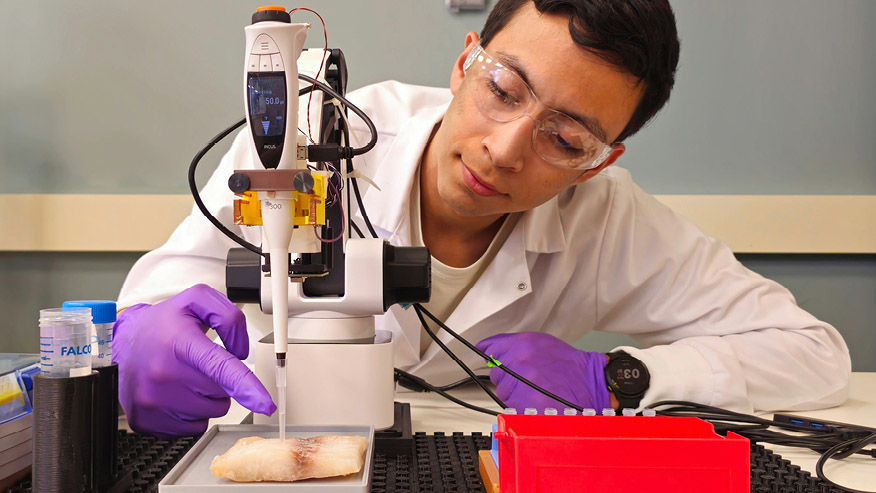
Jesus Ladino, a visiting scholar with the Undergraduate Research Experience Purdue-Colombia program through the Colombia Purdue Partnership, develops software for an automated surface touch extraction prototype at Purdue University’s Bindley Bioscience Center. Using the robotic system, researchers are testing different probes to evaluate their ability to recover lipids and proteins from samples like the grocery store tilapia fillet pictured. (Purdue University photo/Karen Chibana)
WEST LAFAYETTE, Ind. — A patent-pending method developed and tested for multiple applications at Purdue University eliminates sample preparation, a bottleneck that currently dominates a laboratory scientist’s time and budget, and is amenable with spatial analysis using liquid chromatography-tandem mass spectrometry (LC-MS/MS).
The surface touch extraction imaging (STEi) method could benefit food scientists, toxicologists and other laboratory scientists when spatially analyzing samples with irregular surfaces for metabolites, lipids, environmental compounds and proteins using diverse instrumentation to generate multiomics data.
Christina Ferreira, research assistant professor at Purdue’s Bindley Bioscience Center with a courtesy appointment in the Department of Food Science, and Ryan Hilger, assistant director of the Jonathan Amy Facility for Chemical Instrumentation in the James Tarpo Jr. and Margaret Tarpo Department of Chemistry, lead the team that created STEi.
Ferreira said sample preparation for traditional LC-MS/MS analysis requires several steps including weighing, mixing, centrifuging, transferring and drying.
“That destroys the sample and throws away spatial information about where a chemical was found in the sample,” she said. “Also, if scientists want to spatially analyze an irregular surface such as a piece of liver tissue or a fish fillet, they must section it and make it flat to be able to extract the chemicals before the analysis.”
Research team members are Devender Arora and Venkatesh Thirumalaikumar from Bindley Bioscience Center; Jesus Ladino, an Undergraduate Research Experience Purdue-Colombia (UREP-C) visiting scholar at Bindley Bioscience Center; and Weicang Wang from the College of Agriculture. Students in the Elmore Family School of Electrical and Computer Engineering professional master’s program helped develop the imaging processing and control unit.
Ferreira disclosed the STEi innovation to the Purdue Innovates Office of Technology Commercialization, which applied for a patent to protect the intellectual property.
Industry partners interested in developing or commercializing STEi should contact Dipak Narula, lead technology development liaison and assistant director of business development and licensing — physical sciences, at dnarula@prf.org.
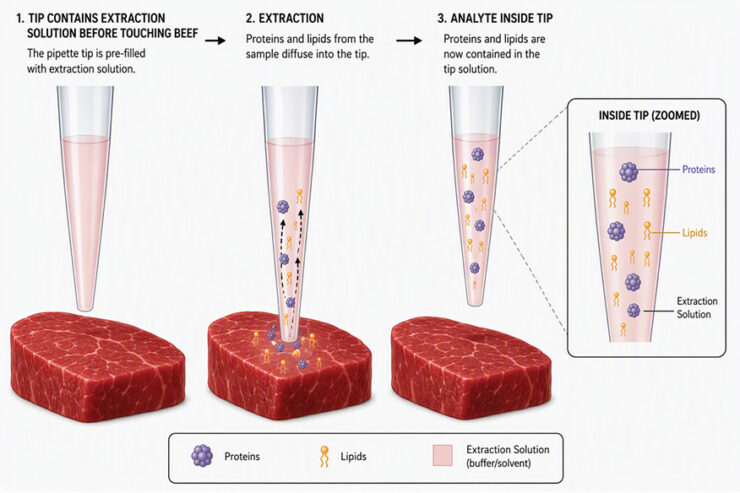
How STEi works
“The STEi concept workflow essentially allows the user to load a sample, press ‘Run’ and create a spatially resolved chemical portrait of their sample based on an instrumentation input, without ever having to cut, grind or destroy it,” Ferreira said.
The workflow begins with the user placing an intact, unprocessed sample such as a tissue biopsy, food item or piece of packaging on the instrument stage. No flattening or grinding is required.
The instrument’s integrated camera/imaging module scans the sample’s surface. Software computes a path across the surface to determine where the extraction probe should touch and in what sequence.
A fine probe tip descends into each programming point on the surface, making contact between the sample and the solvent, which could be water, acetonitrile or a mixture. The force/pressure sensor ensures the probe makes consistent, controlled contact regardless of surface shape.
Ferreira said the pressure-controlled probe’s ability to sample uneven surfaces is a critical differentiator over flat-surface methods.
The software then registers the molecular data back to the original surface coordinates, generating spatial heat maps showing where specific lipids, contaminants, proteins or metabolites are concentrated across the sample.
STEi benefits
Ferreira said STEi improves upon traditional workflow several ways:
- The process is faster. “Sampling takes a few seconds (usually 5-15 seconds) through the contact of a pressure-sensitive probe and the surface of the sample, allowing extraction through a liquid bridge,” she said.
- The collected samples can be analyzed by different instruments. “This approach paves the way for imaging the surface of samples using a high-performance liquid chromatography autosampler and performing imaging experiments with liquid chromatography coupled to tandem mass spectrometry,” she said.
- Samples remain largely intact since only the surface is sampled. “Scientists can resample the same piece of food or tissue repeatedly over time,” she said.
- Spatial context is preserved. “Instead of a single blended answer, the scientist gets a chemical heat map showing, for example, where in the tissue or food product a contaminant is concentrated using the analytical method of choice,” she said.
- No expertise in sample preparation is required. Because STEi is automated and pressure-controlled, less experienced staff members can reliably run samples through the process. “For a food safety scientist, this means going from a half-day destructive assay to a few minutes of automated scanning,” Ferreira said. “For a toxicologist, it means understanding drug distribution across an organ rather than just knowing the average concentration.”
STEi applications
Ferreira said STEi’s applications begin with food safety.
“The technology was designed to detect contaminants on food surfaces and packaging, and food quality and lipid profiling, such as cattle-breed lipid fingerprinting,” she said. “It also could be used to monitor food spoilage by repeated nondestructive sampling of fresh produce, poultry, dairy and fish over time to track molecular changes. That’s a capability gap, not just an improvement on existing methods.”
Other applications of the STEi technology are drug development and the life sciences.
“In the preclinical toxicology arena, STEi coupled to mass spectrometry tools could map the metabolic impact of drugs, chemicals and proteins across liver, kidney, brain and intestinal tissues from animal models,” she said. “It would show tissue-specific accumulation patterns and also sample proteins as these can be extracted.”
Ferreira and the research team are looking for partners to test STEi across several applications. The team is evaluating the recovery of lipids and proteins using different probe configurations.
Besides lipids, they have recovered about 2,000 different proteins from bovine muscle using manual STEi, Thirumalaikumar said. The proteins were functionally classified across contractile, metabolic, antioxidant and structural categories.
Funding milestones and next development steps
Ferreira and the research team received funding from Purdue Innovates’ Trask Innovation Fund to develop STEi.
Ferreira said the team is seeking partners to work on hardware optimization; software integration for 3D path planning; and running more validation experiments including food spoilage monitoring, food packaging contamination detection and additional toxicology applications.
“We also will explore regulatory alignment with the U.S. Food and Drug Administration and the U.S. Environmental Protection Agency analytical frameworks for selected applications,” she said.
About Purdue Innovates Office of Technology Commercialization
The Purdue Innovates Office of Technology Commercialization operates one of the most comprehensive technology transfer programs among leading research universities in the U.S. Services provided by this office support the economic development initiatives of Purdue University and benefit the university’s academic activities through commercializing, licensing and protecting Purdue intellectual property. In fiscal year 2025, the office reported 161 deals executed with 269 technologies licensed, 479 invention disclosures received, and 267 U.S. and international patents received. The office is managed by the Purdue Research Foundation, a private, nonprofit foundation created to advance the mission of Purdue University. Contact otcip@prf.org for more information.
About Purdue University
Purdue University is a research institution ranked among the top 10 public universities in the United States. More than 106,000 students study at Purdue across multiple campuses, including more than 57,000 at our main campus locations in West Lafayette and Indianapolis. As a land-grant university committed to affordability and accessibility, Purdue’s main campus has frozen tuition 14 years in a row, enabling more students than ever to graduate debt-free.
Media contact: Steve Martin, sgmartin@prf.org
Purdue Research Foundation News

Purdue wearable AI device aims to improve epinephrine injections to treat anaphylaxis
October 14, 2026
Innovative solutions abound at Moonshot Pitch Challenge
September 17, 2026
SK hynix breaks ground on $4 billion advanced packaging production facility in Purdue Research Park
August 27, 2026
Purdue’s new underwater robot could make ocean missions more reliable
August 26, 2026