Keys to future human exploration, past planetary conditions hide under surface of moon, Mars
Purdue scientist searching underground for resources to shape future crewed missions
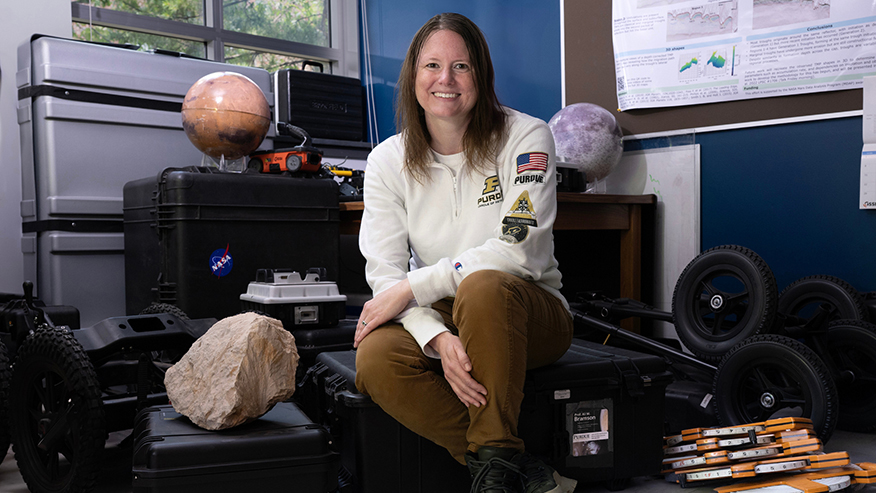
Ali Bramson, an associate professor of planetary science at Purdue University, is ready to travel for her research, with studies taking her from Hawaii to Iceland. (Purdue University photo/John Underwood)
WEST LAFAYETTE, Ind. — Researching other planets requires a lot of earthbound travel, taking Ali Bramson, an associate professor in Purdue University’s College of Science, from snowy slopes in Iceland to a volcano in Hawaii.
The environments give Bramson a hands-on opportunity to examine geologic features similar to those found on the moon or Mars. The work reveals both the potential benefits and hazards that will be encountered by future missions when exploring and looking at the potential for establishing human habitats there.
Bramson, a planetary scientist in the Department of Earth, Atmospheric, and Planetary Sciences, said she thinks of planets as an interconnected system. What is visible on a planet’s surface is only the beginning when it comes to exploring these worlds.
“I find planets’ subsurfaces really fascinating because it’s harder to understand what is there,” Bramson said. “You must use additional kinds of techniques and data to see what is buried underground, rather than regular images for observing how the surface is behaving.
“The surface of a planet and what features you can see are very interconnected with what important geology is happening below the surface, as well as the processes occurring above the surface,” she said. “That interconnected system determines, for example, why ice is stable there or how a volcano once erupted there or why a crater has a specific shape and size.”
Bramson studies the processes that affect the surfaces of planets in the solar system. She uses remote-sensing observations, such as those collected with radar systems aboard spacecraft, in combination with theoretical modeling. That research is supplemented by her field work at places like the Iceland and the volcano in Hawaii.
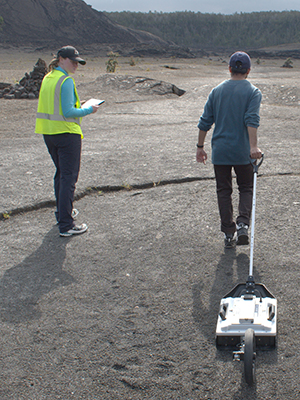
Much of Bramson’s work has focused on locating potential buried ice deposits on Mars as part of NASA’s Subsurface Water Ice Mapping project. She also conducts research around the world using radar systems from her lab at Purdue to find comparable ice deposits underground. She has uncovered volcanic rocks cemented together by ice that could be a vital analog for Martian and lunar ice.
Bramson’s Icelandic research was featured in a NASA video issued earlier this year.
Using radar data taken from spacecraft orbiting these other worlds, she maps subsurface ice that has the potential to help sustain future human explorers. Additionally, the ice deposits may have been the product of past snowfalls on Mars, offering new insight into ancient geologic and atmospheric processes on the red planet.
“If we’re going to send humans to Mars one day, we need to understand what is beneath the surface,” Bramson said. “You see the surface of Mars, and in many areas, it looks flat and dusty. But if we can use these techniques and figure out what’s going on below, you can find even more about the ice, its potential as a resource to enable future exploration and what it tells us about Mars’ geologic history.”
Recent research goals have moved Bramson a little closer to Earth with an expanding interest in modern seismicity and past volcanic activity on the moon. Lava flows from the earliest volcanic eruptions on the moon can inform researchers on how much heat planets start with, and how fast they cool and when a planet can support volcanoes erupting onto its surface. These most ancient rock records are generally lost from Earth because of how actively terrestrial rocks are recycled, modifying them from their original state.
Moonquakes still occur today, with NASA estimating the quakes reaching 5.5 on the Richter scale and lasting up to 10 minutes at times. The moonquakes can originate from miles below the surface due to the moon losing its heat as it slowly shrinks. This subsurface activity, much like the ice deposits on Mars, could provide beneficial information for future NASA missions.
“It’s important to understand how active the moon is to still get moonquakes from the deep interior versus moonquakes that are happening at the surface due to day-night thermal cycles,” Bramson said. “If habitats are established, how often do you get these little quakes, and could those trigger a landslide nearby?”
Bramson has been a prominent Purdue voice trumpeting the importance of space research. In April, she participated in the NASA Science Showcase on Capitol Hill, speaking to staff from many congressional offices and highlighting how NASA-funded science research across disciplines strengthens America’s leadership, benefits local economies and fuels the broader space program.
In March, she was named a winner of the 2026 Harold C. Urey Prize from the American Astronomical Society’s Division for Planetary Sciences. The honor recognizes outstanding achievements in planetary science by an early-career scientist.
About Purdue University
Purdue University is a research institution ranked among the top 10 public universities in the United States. More than 106,000 students study at Purdue across multiple campuses, including more than 57,000 at our main campus locations in West Lafayette and Indianapolis. As a land-grant university committed to affordability and accessibility, Purdue’s main campus has frozen tuition 14 years in a row, enabling more students than ever to graduate debt-free.
Media contact: Brian Huchel, bhuchel@purdue.edu
Space News

Purdue 1 essay competition invites Indiana fifth graders to imagine the future of space exploration
September 30, 2026
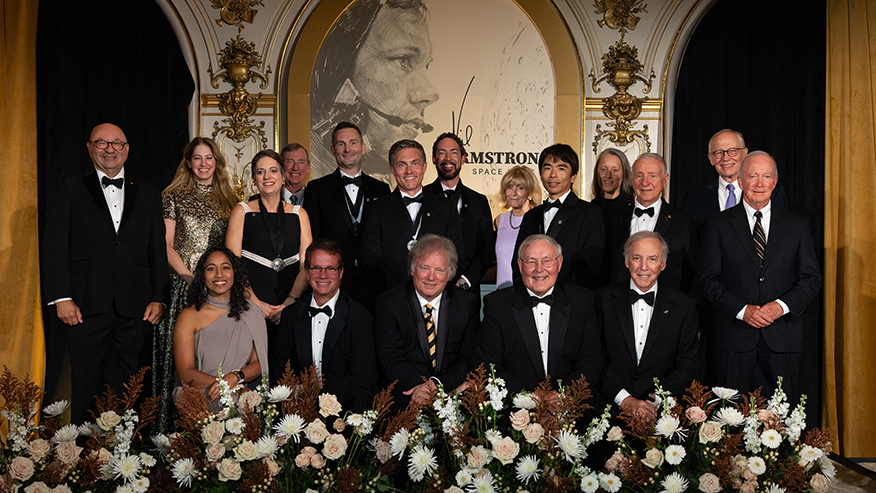
Falcon 9 Booster Landing Team receives first Neil Armstrong Space Prize for reusable rocket research
September 16, 2026
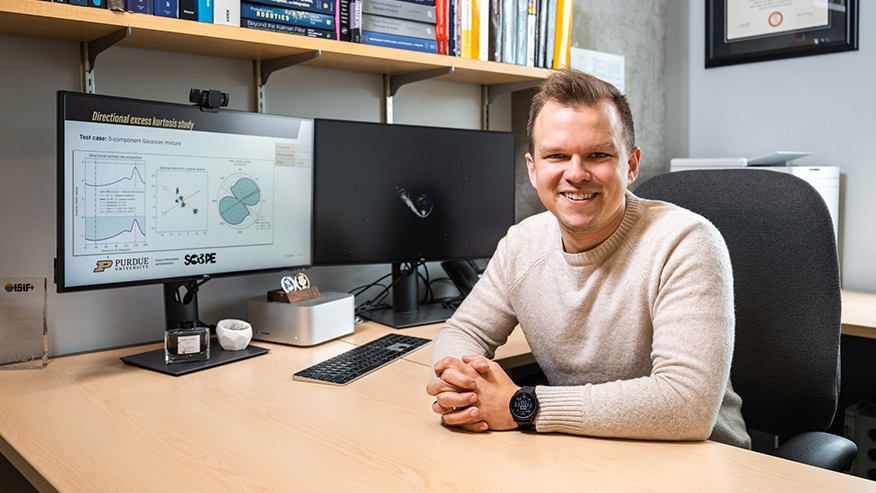
A smarter way to track satellites beyond Earth’s orbit
August 11, 2026

Purdue’s space work is featured at NASA Science Showcase
April 28, 2026