A smarter way to track satellites beyond Earth’s orbit
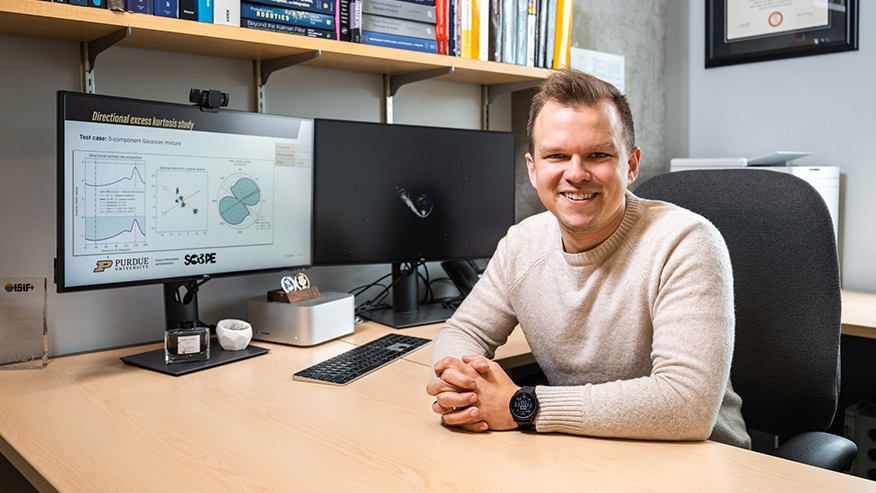
Keith LeGrand, assistant professor in Purdue’s School of Aeronautics and Astronautics, develops methods to accurately and efficiently track objects in cislunar space for space situational awareness and safety of flight. (Purdue University photo/Kelsey Lefever)
WEST LAFAYETTE, Ind. — Most current space activities operate close to Earth in what is called near-Earth orbit. However, as more satellites and other infrastructure begin to extend beyond that region, maintaining situational awareness of those objects will be crucial.
Purdue University engineer Keith LeGrand is developing methods to track the location and movement of objects in cislunar space — the area around Earth extending to just beyond the moon’s orbit, which encompasses upwards of 300,000 miles, or roughly 12 times around the Earth’s equator. His work will help to secure and defend U.S. national and economic interests in space.
Although there are far fewer objects in the cislunar region compared to near-Earth orbit, a variety of factors make it difficult to operate and maintain awareness of objects in cislunar space. These factors include poor visibility from contrast and glare, extreme distances and difficult-to-predict orbital behavior from the sun-Earth-moon system — what is known as a restricted four-body problem.
“Increasing numbers of small satellites are launched into cislunar space, and given the area’s complex and chaotic environment, it can be difficult to keep track of them,” said LeGrand, assistant professor in Purdue’s School of Aeronautics and Astronautics. “We need to develop the right tools and infrastructure to ensure that these objects don’t get lost in space.”
LeGrand specializes in space situational awareness, enabling intelligent sensing and decision-making in complex orbital environments. His research focuses on better characterizing when an object in cislunar space may have moved or altered course and what that move looks like. His team develops algorithms that determine how uncertainty about an object’s position evolves over time.
Predicting motion in cislunar space
Imagine you just blew on a dandelion and released its seeds from the stem. At that moment, you know the approximate location of those seeds, but you want to try to predict where they’ll end up tomorrow. You know the wind will push them around, but the wind’s direction isn’t always predictable. As time passes, your guess about the location of the seeds will become less certain.
LeGrand’s algorithms capture this problem in the complex gravity environment between the Earth and the moon.
“What we’re really capturing is how confidence fades over time,” LeGrand said. “By understanding exactly how and when uncertainty grows in these complex environments, we can make better predictions, respond earlier to potential risks, and ultimately operate more safely and efficiently in space.”
The method LeGrand uses to determine uncertainty is called Gaussian mixture approximation. Traditional Gaussian models are typically used to describe data that often clusters around an average and spreads out smoothly on both sides, like a bell-shaped curve. These models use this data to help make predictions, recognize patterns, model measurement errors, or filter noise from signals like GPS or sensors. Gaussian models work well for linear systems — ones that behave predictably and scale proportionally. But most engineering systems, including orbital mechanics and satellite motion, are nonlinear.
“Nonlinear systems don’t follow proportional cause-and-effect relationships,” LeGrand said. “Small uncertainties don’t stay small, and tiny differences can grow dramatically over time. This produces chaotic behavior and uncertainty patterns that might look more like bananas or spirals rather than neat bell curves.”
Other approaches used to predict this uncertainty have been either efficient but not accurate, or highly accurate but expensive and time-consuming. LeGrand says neither of those options work for the types of systems that are launched into cislunar space.
“These smaller satellites are essentially running on a processor with the same capabilities as an older video game system. They don’t have the performance that we’re used to even on our laptops,” LeGrand said. “Therefore, we need to dedicate computational power where it matters most to be able to generate algorithms that stand a chance at running both quickly and efficiently while in space.”
LeGrand’s new method uses Gaussian mixtures — collections of bell-curve distributions — to represent uncertainty and splits them into multiple, smaller distributions when they are no longer accurate enough.
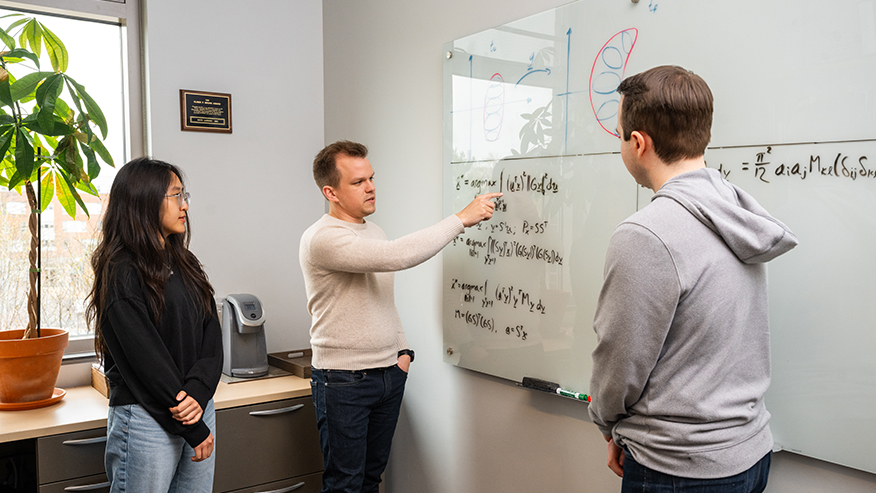
The challenge is ensuring that the distribution is split as efficiently as possible while retaining accuracy. Efficient splitting and minimizing the number of smaller distributions are critical as too many mixture components can make computation slow or impossible.
“Think of splitting as adding detail only where needed,” LeGrand said. “As uncertainty evolves in chaotic environments, it gets stretched and distorted. By splitting one distribution into smaller Gaussian pieces, each piece can be tracked more accurately, and simpler equations that take less computational power work much better on those smaller parts.”
Modeling uncertainty with efficiency and accuracy
LeGrand has developed a framework for splitting these distributions to ensure that the results are more accurate and faster to compute.
First, the framework includes a splitting method that preserves the overall average and spread of uncertainty. In other words, the method ensures that, even after the distribution is broken into smaller pieces, the big picture doesn’t change. It also introduces new methods for choosing the best way to split based on how the system behaves.
Additionally, LeGrand has created an algorithm, Higher-Order Tensor-Based Deferral of Gaussian Splitting (HOTDOGS), which takes that framework into account and creates rules for when to split a distribution.
Instead of immediately breaking up a distribution into many small pieces, HOTDOGS starts with only a few splits and watches how they change over time. It will then only split when it starts to stretch or distort too intensely. In other words, the algorithm waits until splitting is necessary and then follows each smaller piece separately to stay accurate while remaining efficient.
“The key idea behind HOTDOGS is not doing more work than necessary,” LeGrand said. “By letting uncertainty evolve and the algorithm only stepping in when it truly starts to break down, we get the same level of accuracy with far less computation. That balance is essential if we want reliable predictions without slowing everything down.”
Rather than treating uncertainty as a static problem, LeGrand’s approaches adapt as conditions change, adding detail only where it is truly needed and directly supporting safer space navigation, improved situational awareness and better decision-making.
“The goal of our work is to make uncertainty prediction both smarter and more efficient,” LeGrand said. “As cislunar space grows more crowded and complex, we hope we can provide a clearer picture of all the activities happening throughout the region.”
LeGrand’s research is sponsored by the Air Force Research Laboratory (AFRL) Regional Network — Midwest, a science and technology ecosystem in which partners from universities, industry and government help the AFRL drive innovation, and the Air Force Office of Scientific Research’s Young Investigator Program.
About Purdue University
Purdue University is a research institution ranked among the top 10 public universities in the United States. More than 106,000 students study at Purdue across multiple campuses, including more than 57,000 at our main campus locations in West Lafayette and Indianapolis. As a land-grant university committed to affordability and accessibility, Purdue’s main campus has frozen tuition 14 years in a row, enabling more students than ever to graduate debt-free.
Papers
Nonlinearity- and Uncertainty-Informed Moment-Matching Gaussian Mixture Splitting
IEEE Transactions on Aerospace and Electronic Systems
DOI: 10.1109/TAES.2025.3632242
Higher-Order Tensor-Based Deferral of Gaussian Splitting for Orbit Uncertainty Propagation
IEEE Transactions on Aerospace and Electronic Systems
DOI: 10.1109/TAES.2026.3662318
Media contact: Lindsey Macdonald, macdonl@purdue.edu
Space News

Purdue 1 essay competition invites Indiana fifth graders to imagine the future of space exploration
September 30, 2026
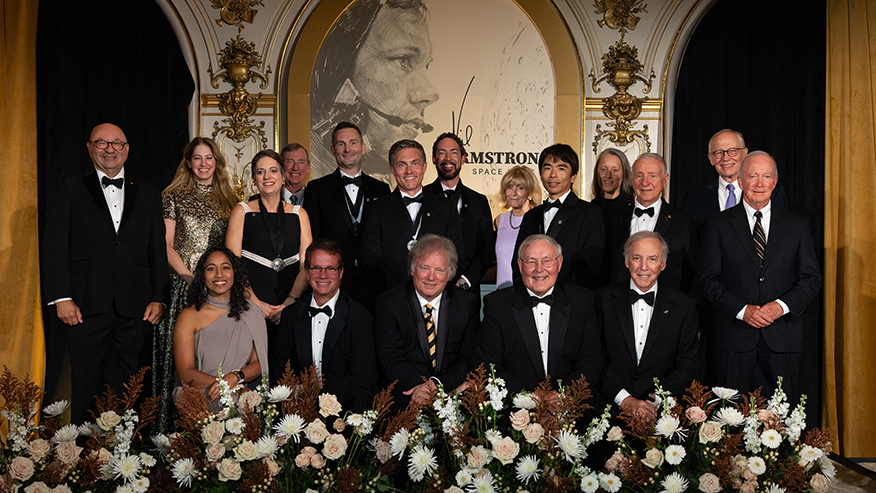
Falcon 9 Booster Landing Team receives first Neil Armstrong Space Prize for reusable rocket research
September 16, 2026
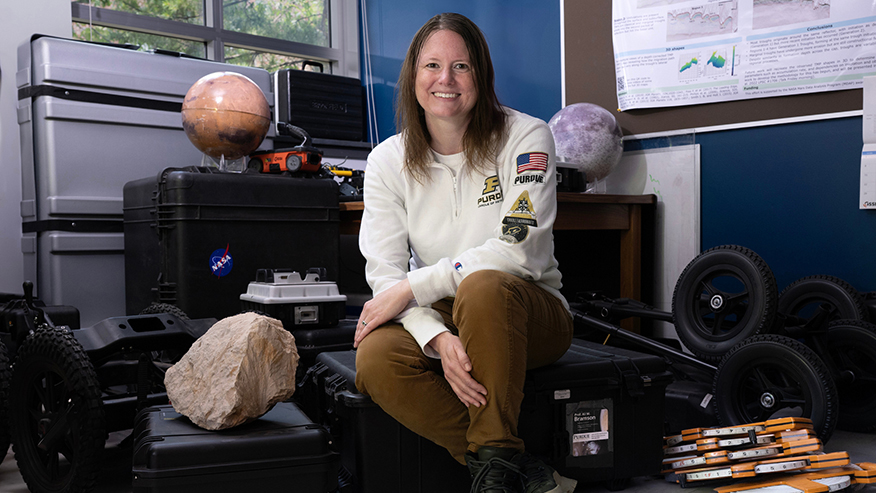
Keys to future human exploration, past planetary conditions hide under surface of moon, Mars
July 29, 2026

Purdue’s space work is featured at NASA Science Showcase
April 28, 2026