Purdue University professor Zubin Jacob earns prestigious Guggenheim fellowship

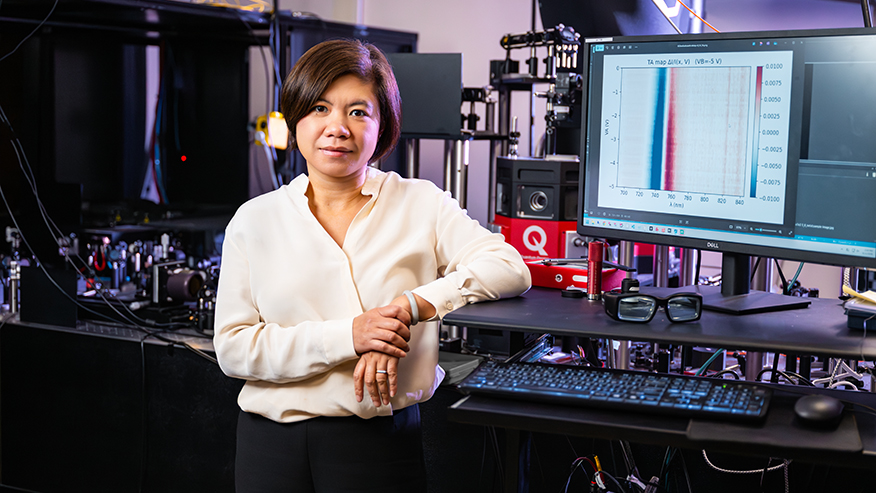
Zubin Jacob, whose research seeks to dissolve the perceived limits of resolution in microscopy, thermal vision and space telescopy has been named a 2026 Guggenheim fellow. (Purdue University photo/Vincent Walter)
WEST LAFAYETTE, Ind. — Zubin Jacob, the Elmore Professor of Electrical and Computer Engineering in the Elmore Family School of Electrical and Computer Engineering, has been named a 2026 Guggenheim fellow, a program that champions the talents of the exceptional scholars and artists whose passions often have broad and immediate social impact.
Jacob’s research seeks to dissolve the perceived limits of resolution in microscopy, thermal vision and space telescopy. The fellowship supports his work on a project to overcome the fundamental limits of thermal imaging.
As a doctoral student, Jacob proposed the optical hyperlens, a device based on hyperbolic metamaterials that enables subwavelength imaging in the far field. This was the first theoretical proposal of its kind, and his paper became one of the top 10 most cited in the journal Optics Express’ 20-year history. It launched a field that now produces more than 1,000 publications annually on hyperbolic photonics.
Since joining the Purdue faculty, Jacob has addressed a major limitation in human and robotic vision: perception under low-light and nighttime conditions. Traditional thermal imaging fails to capture texture and detail due to the inherent noise in infrared data.
To overcome this noise limit, he led the development of patented heat-assisted detection and ranging (HADAR), a new framework combining infrared optics, thermal physics and machine learning. His group’s work, published in Nature, demonstrated that nighttime thermal scenes can carry as much recoverable information as daylight. His work has broad implications for autonomous navigation, defense, environmental sensing and planetary exploration. HADAR has received international recognition and has even been featured in science fiction literature for young readers.
Jacob disclosed HADAR to the Purdue Innovates Office of Technology Commercialization, which applied for a patent from the U.S. Patent and Trademark Office to protect the intellectual property.
Most recently, Jacob has focused his attention on imaging the cosmos. For more than a century, telescope resolution has been fundamentally limited by the Rayleigh criterion, which ties resolving power to aperture size. This constraint has remained especially rigid in astronomy, where targets like exoplanets near stars are inherently faint and inaccessible.
Jacob founded Zetascope LLC in 2024, which is now collaborating with U.S. observatories to bring sub-Rayleigh imaging technologies to the field of astrophysics, enabling the discovery of Earth-like exoplanets orbiting around distant stars.
He developed the online course Quantum Detectors and Sensors which is advancing global workforce development in quantum sensing and metrology with over 15,000 online learners, and is the founder of the Picoelectrodynamics Theory Network, a global initiative advancing workforce development in atomic-scale electrodynamics through open-source tools and an international seminar series.
Jacob is an Optica fellow and recipient of the National Science Foundation CAREER Award, the Defense Advanced Research Projects Agency (DARPA) Young Faculty Award and DARPA Director’s fellowship. His work has garnered more than 15,000 citations across 125 publications.
Jacob joins the following current Purdue faculty who have received Guggenheim fellowships:
- Alexandra Boltasseva, the Ron and Dotty Garvin Tonjes Distinguished Professor of Electrical and Computer Engineering
- Mung Chiang, president of Purdue University and the Roscoe H. George Distinguished Professor of Electrical and Computer Engineering
- Robin Stryker, Distinguished Professor of Sociology
- George Wodicka, the Reilly Professor of Biomedical Engineering
The Guggenheim fellowship is included on the National Research Council’s list of highly prestigious awards. Fellows are selected through a rigorous application and peer review process from a pool of nearly 5,000 applicants. The 2026 class was tapped based on prior career achievement and exceptional promise. The 101st class of fellows includes 223 distinguished individuals working across 55 disciplines. Only three recipients, including Jacob, hold engineering positions.
About Purdue University
Purdue University is a public research university leading with excellence at scale. Ranked among top 10 public universities in the United States, Purdue discovers, disseminates and deploys knowledge with a quality and at a scale second to none. More than 106,000 students study at Purdue across multiple campuses, locations and modalities, including more than 57,000 at our main campus locations in West Lafayette and Indianapolis. Committed to affordability and accessibility, Purdue’s main campus has frozen tuition 14 years in a row. See how Purdue never stops in the persistent pursuit of the next giant leap — including its integrated, comprehensive Indianapolis urban expansion; the Mitch Daniels School of Business; Purdue Computes; and the One Health initiative — at https://www.purdue.edu/president/strategic-initiatives.
Media contact: Mary Martialay, mmartial@purdue.edu
Research News

Purdue wearable AI device aims to improve epinephrine injections to treat anaphylaxis
October 14, 2026
‘Movies’ of interaction between light and matter help advance quantum tech
October 6, 2026
Purdue expands partnership with Rittal, Eplan with launch of engineering technology labs
September 16, 2026

Provost announces leadership appointments, promotions
September 14, 2026