Purdue engineers test, validate novel method to improve pharmaceutical R&D
Label-free, noninvasive framework enables robust, scalable classification of liposomal drug carriers

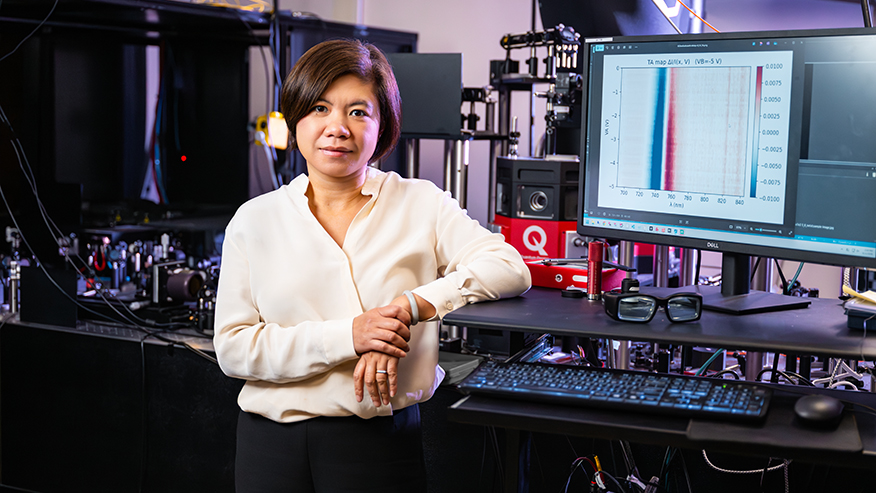
Arezoo Ardekani, a researcher in Purdue University’s College of Engineering, has created and validated a method that enables robust, scalable classification of liposomal drug carriers and lipid nanoparticles. (Purdue University photo/Will Cabral)
WEST LAFAYETTE, Ind. — A patent-pending innovation created and validated in Purdue University’s College of Engineering could strengthen pharmaceutical research and development in the areas of batch verification, encapsulation efficiency screening and regulatory compliance workflows.
Mechanical engineering professor Arezoo Ardekani and her doctoral student Kaeul Lim have leveraged hyperspectral imaging (HSI) and machine learning (ML) to develop a novel, label-free and noninvasive method to characterize nanoparticles.
The method enables robust, scalable classification of liposomal drug carriers and lipid nanoparticles.
“It provides real-time, nondestructive quality control during nanoparticle formulation and manufacturing,” Ardekani said. “Due to its noninvasive nature, it can be adapted into industrial high-throughput analytical platforms.”
Ardekani said the Purdue method’s classification accuracy for nanoparticle type approached 99% under optimal parameter conditions.
Ardekani’s research was published in the peer-reviewed International Journal of Pharmaceutics. She disclosed the innovation to the Purdue Innovates Office of Technology Commercialization, which applied for a patent from the U.S. Patent and Trademark Office to protect the intellectual property.
Industry partners interested in developing or commercializing the system should contact Dipak Narula, lead technology development liaison and assistant director of business development and licensing — physical sciences, at dnarula@prf.org about track code 70462.
Challenges of traditional analytical methods
Ardekani said label-free characterization of nanoscale drug-delivery systems remains a critical challenge in pharmaceutical research.
“Traditional analytical methods are labor-intensive, low-throughput or require labeling, which can interfere with nanoparticle functionality,” she said.
The Purdue method focuses on enhancing image quality within HSI data. Ardekani said its ML capabilities significantly reduce classification complexity and improve overall accuracy.
“Traditionally, HSI’s application to nanoparticle analysis is limited,” she said. “Data is often lost to noise and overlapping information.”
How the Purdue method works
Liposomal formulations are deposited onto precleaned glass microscope slides and imaged without further modification or staining.
“The HSI system captures scattered light spectra from a sample through line-by-line spatial scanning, where each pixel’s information represents the spectrum at that location,” Ardekani said. “Hyperspectral images are recorded by using an enhanced dark field illumination system attached to a microscope.”
Ardekani said following the image preprocessing phase, classification is performed using convolutional neural networks.
“The convolutional layers learn important features from the hyperspectral data,” she said. “Those features are then passed through the fully connected layer and the output layer to classify the nanoparticles.”
Funding milestones and next development steps
Ardekani’s research has been supported with funding from the Center for Bioanalytic Metrology, which is a partnership among Indiana University, Purdue University and the University of Notre Dame.
Ardekani said the next steps to prepare the innovation for the marketplace are applying the technology to a broader range of samples.
About Purdue Innovates Office of Technology Commercialization
The Purdue Innovates Office of Technology Commercialization operates one of the most comprehensive technology transfer programs among leading research universities in the U.S. Services provided by this office support the economic development initiatives of Purdue University and benefit the university’s academic activities through commercializing, licensing and protecting Purdue intellectual property. In fiscal year 2025, the office reported 161 deals executed with 269 technologies licensed, 479 invention disclosures received, and 267 U.S. and international patents received. The office is managed by the Purdue Research Foundation, a private, nonprofit foundation created to advance the mission of Purdue University. Contact otcip@prf.org for more information.
About Purdue University
Purdue University is a public research university leading with excellence at scale. Ranked among top 10 public universities in the United States, Purdue discovers, disseminates and deploys knowledge with a quality and at a scale second to none. More than 106,000 students study at Purdue across multiple campuses, locations and modalities, including more than 57,000 at our main campus locations in West Lafayette and Indianapolis. Committed to affordability and accessibility, Purdue’s main campus has frozen tuition 14 years in a row. See how Purdue never stops in the persistent pursuit of the next giant leap — including its integrated, comprehensive Indianapolis urban expansion; the Mitch Daniels School of Business; Purdue Computes; and the One Health initiative — at https://www.purdue.edu/president/strategic-initiatives.
Media contact: Steve Martin, sgmartin@prf.org
Research News

Purdue wearable AI device aims to improve epinephrine injections to treat anaphylaxis
October 14, 2026
‘Movies’ of interaction between light and matter help advance quantum tech
October 6, 2026
Purdue expands partnership with Rittal, Eplan with launch of engineering technology labs
September 16, 2026

Provost announces leadership appointments, promotions
September 14, 2026