Oyster cement: Scientists study shellfish to make stronger, faster-curing building material

Adhesives and materials expert Jonathan Wilker of Purdue University mimics the chemistry that oysters use to formulate better-performing and faster-curing cement recipes. (Purdue University photo/Kelsey Lefever)
WEST LAFAYETTE, Ind. — Building upon the chemistry that oysters use in mileslong reefs, scientists have found a way to create cement that is stronger and cures faster.
Jonathan Wilker, a professor of chemistry in Purdue University’s College of Science and an expert in adhesives and biomimetic materials innovation, has long been interested in formulating new, more sustainable and better materials. Recent work from his research group has included using nature as an inspiration for sustainable, affordable adhesives.
“Our lab studies materials that shellfish make,” Wilker said. “Oysters generate a natural cement. They use this material for attaching to each other when building reef structures. We have been working to understand what oyster cement is and what makes it such a strong adhesive. One of our goals is to develop materials that can replicate the strength and functionality of biological materials. We can then create systems with higher performance than what is currently available.”
Their patent-pending oyster-based cement research was published in Chemistry of Materials. Wilker disclosed his innovation to the Purdue Innovates Office of Technology Commercialization, which has applied for a patent from the United States Patent and Trademark Office to protect the intellectual property.
Sticking together
While the words are commonly confused, cement and concrete are not synonymous. Cement is the adhesive — the binding agent — and a component in concrete, a kind of artificial stone building material immediately recognizable to any modern human.
“Concrete is the single most produced man-made material,” Wilker said. “It’s everywhere. Traditional concrete is strong in compression, but it can be brittle and weak in other ways. By using technology from shellfish, we may be able to enhance performance and increase sustainability of cements and concretes.”
The oldest human concrete is nearly 7,000 years old, but oysters have been building with concrete for more than 200 million years. The small shellfish rely on the strength of their adhesive to preserve their lives and their communities.
A secret ingredient
When Wilker and his team began to analyze how oysters cling to one another and build reefs, they found something unexpected.
“The substance that oysters use to bind themselves together is predominantly inorganic in nature,” Wilker said. “It’s mostly calcium carbonate — what we would think of as chalk. Such inorganics are not typically adhesive. But the oysters have combined these inorganics with a modest percentage of organic materials to make a material with impressive properties, including an ability to stick in water.”
Most commercially available adhesives are organic. Rather than meaning that they were grown without pesticides, in the field of chemistry, “organic” means that they contain the elements hydrogen and carbon — the basic building blocks of life on Earth. Plastic, oil and fossil fuels are all organic, along with almost anything that is or was alive.
“Most of the adhesives that you see at the hardware store are made of organic compounds, derived from petroleum,” Wilker said. “Oyster cement has about 12 percent of organic compounds to help bind together the inorganics. So this oyster cement is quite unique. We have been working to figure out how this material functions and if we can develop high-performing mimics.”
Show of strength
To stay as true as possible to the oyster system, they bought bathroom tiles made of limestone — calcium carbonate like what oysters’ shells are made from — and began to experiment.
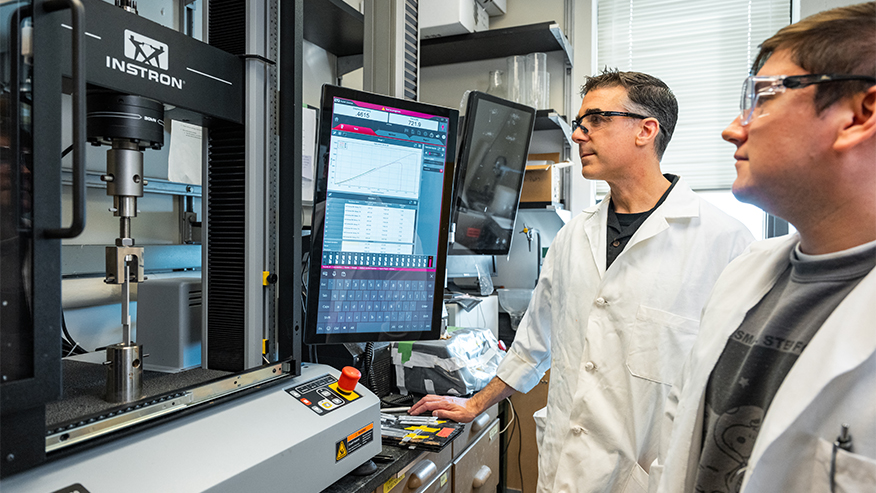
The team shaped sugar cube-sized blocks of cement and tested them to measure their compressive strength — how much pressure they could withstand before they shattered. Then they bound several of the bathroom tiles together with their biomimetic cement and tried to pull them apart, measuring the force it took to do so. In almost every test, the tile itself broke before the bond between tiles gave way.
Once they had a recipe they thought approximated the oysters’ winning formula, the team went to the local hardware store and picked up a bag of commercially available just-add-water concrete mix. When they added a polymer from their cement to the mix, the resulting material adhered 10 times more strongly, and the compressive strength doubled. And cured faster.
Wilker and his team hope to continue to improve the performance of their patent-pending cement as well as continue pursuing how to make this material more accessible, more sustainable, more carbon-neutral and more affordable.
“New cements like this one may be able to further enhance some of the mechanical properties of traditional cement,” Wilker said. “There is so much more that we can learn from nature and so many new materials that we can design.”
This research was supported by a grant from the National Science Foundation.
About Purdue University
Purdue University is a public research university leading with excellence at scale. Ranked among top 10 public universities in the United States, Purdue discovers, disseminates and deploys knowledge with a quality and at a scale second to none. More than 106,000 students study at Purdue across multiple campuses, locations and modalities, including more than 57,000 at our main campus locations in West Lafayette and Indianapolis. Committed to affordability and accessibility, Purdue’s main campus has frozen tuition 14 years in a row. See how Purdue never stops in the persistent pursuit of the next giant leap — including its integrated, comprehensive Indianapolis urban expansion; the Mitch Daniels School of Business; Purdue Computes; and the One Health initiative — at https://www.purdue.edu/president/strategic-initiatives.
Paper
Mimicking oyster reefs to generate cements with enhanced performance
Chemistry of Materials
DOI: 10.1021/acs.chemmater.5c03115
Media contact: Brittany Steff, bsteff@purdue.edu
Note to journalists:
A video link is available to media who have an Associated Press subscription. Photos and b-roll are available on Google Drive.
Research News

Purdue wearable AI device aims to improve epinephrine injections to treat anaphylaxis
October 14, 2026
‘Movies’ of interaction between light and matter help advance quantum tech
October 6, 2026
Purdue expands partnership with Rittal, Eplan with launch of engineering technology labs
September 16, 2026

Provost announces leadership appointments, promotions
September 14, 2026