Purdue pilots B2D7 — Bachelor’s to Doctorate in 7 Years — to enhance U.S. research talent pipeline
In response to the Genesis Mission led by the U.S. Department of Energy, Purdue innovates with a new option for students
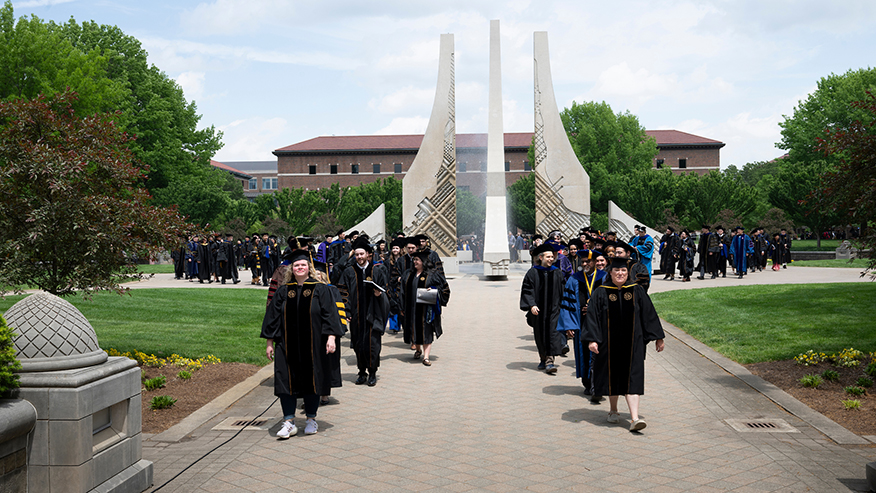
Purdue University doctorate students walk through the 2025 Spring Commencement. The Bachelor’s to Doctorate in 7 Years pilot program is intended to increase STEM doctorate program numbers in the College of Engineering, and potentially other colleges in the future, by providing a distinct timeline for graduation. (Purdue University photo)
WEST LAFAYETTE, Ind. — Inadequate numbers of domestic students in STEM doctorate programs has long been a bottleneck to research excellence and to reindustrialization workforce development in the United States. Domestic students in certain STEM fields have highly compensated industry job offers from the private sector at the time of baccalaureate graduation, and no realistic amount of additional stipends can make doctorate offers financially competitive if the duration of the doctoral path remains long and indefinite.
Purdue University is pioneering a new pathway. The B2D7: Bachelor’s to Doctorate in 7 Years program provides an additional option for students and faculty to choose from and to add one tool to a growing toolbox to tackle this bottleneck. By carefully fusing the undergraduate and graduate experiences, especially at a university with the recent “(bachelor’s) degree-in-3” innovation, this option will enable domestic talent to complete their doctorate at around the age of 25, thereby reducing the barriers of a long and uncertain timeline.
At the Feb. 18 kickoff event for the Genesis AI Mission, led by the U.S. Department of Energy, Purdue announced the pilot program of B2D7 as part of the discussion on U.S. technology talent development and the way DOE graduate fellowships should be allocated in the future to encourage new doctoral pathways for domestic students.
This pilot program, from Purdue’s College of Engineering, begins with identifying sophomores (and in some cases freshmen or juniors) with demonstrated academic and research aptitude, and presenting them with a personal option to explore B2D7. Those who choose to pursue B2D7 will be provided with dedicated coaching, undergraduate summer research opportunities, matching with doctoral dissertation advisors at the end of year three or beginning of year four, and smooth transition into a postgraduate program immediately after. The program will leverage shared-credit courses, intensive research opportunities in the industry or national labs, and a platform of strong mentorship to support student success. Quality remains the top consideration, and graduation is contingent upon successful doctoral research.
Several precedents are well-known in higher education:
- Co-term education of four-year Bachelor of Science/Master of Science or five-year Bachelor of Science/Master of Business Administration degrees
- Bachelor’s degree to Doctor of Medicine degree in seven years at some universities with medical schools
- Purdue has recently tripled the enrollment of its Military Research Institute, a program for some in active-duty service to pursue a PhD in three years with high-quality dissertations
Based on learnings from the pilot being initiated this semester, B2D7 may be expanded to include multiple colleges and departments and scale up to more than 100 domestic STEM doctoral students a year, substantially increasing the doctorate degree output in that demographic category. When scaled up across the country, the hope is to add 10,000 domestic STEM doctorate graduates each year.
Tamara Kinzer-Ursem, Purdue Engineering’s associate dean of graduate and professional education, said the program uses performance-based progression for students with early lab research involvement and shared-credit graduate courses. It creates strengthened industry and national lab connections for students.
“This is a rigorous program that elevates Purdue’s standard of excellence,” said Kinzer-Ursem, the Marta E. Gross Professor of Biomedical Engineering. “The expectations for these students are high, however, robust standards for research mentorship and career development support are in place to ensure they can successfully complete the program and earn their doctorate.”
She said B2D7 provides students with extra advising structures to ensure they’re taking the correct classes and following the program’s plan. Additionally, both students and industrial partners are aware of the importance of advanced, research-intensive technology positions available in the job market that require significant technical expertise and doctoral-level preparation; Purdue is moving quickly to provide pathways for students to earn the credentials necessary for them.
About Purdue University
Purdue University is a public research university leading with excellence at scale. Ranked among top 10 public universities in the United States, Purdue discovers, disseminates and deploys knowledge with a quality and at a scale second to none. More than 106,000 students study at Purdue across multiple campuses, locations and modalities, including more than 57,000 at our main campus locations in West Lafayette and Indianapolis. Committed to affordability and accessibility, Purdue’s main campus has frozen tuition 14 years in a row. See how Purdue never stops in the persistent pursuit of the next giant leap — including its integrated, comprehensive Indianapolis urban expansion; the Mitch Daniels School of Business; Purdue Computes; and the One Health initiative — at https://www.purdue.edu/president/strategic-initiatives.
Media contact: Brian Huchel, bhuchel@purdue.edu
Research News

Purdue wearable AI device aims to improve epinephrine injections to treat anaphylaxis
October 14, 2026
‘Movies’ of interaction between light and matter help advance quantum tech
October 6, 2026
Purdue expands partnership with Rittal, Eplan with launch of engineering technology labs
September 16, 2026

Provost announces leadership appointments, promotions
September 14, 2026