Top 5 stories from Purdue University
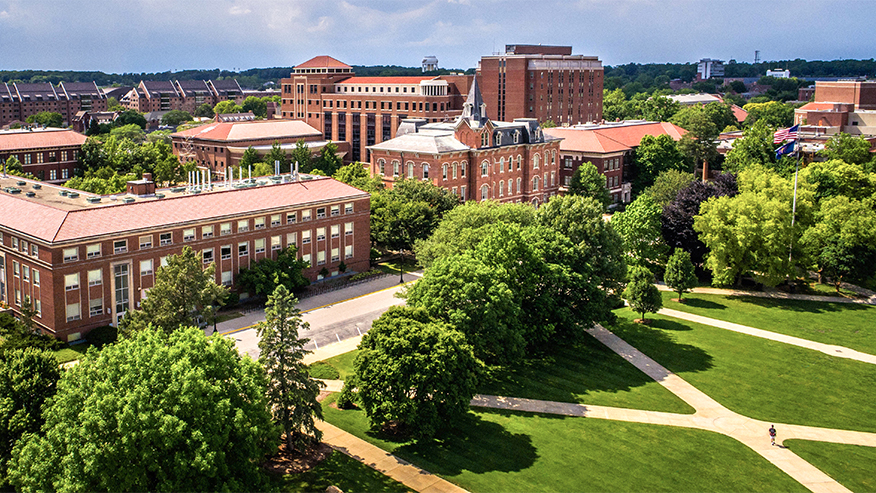
‘Purdue News Now’
Purdue researchers are exploring how targeting excess fat in the brain’s immune cells could reshape treatment for neurodegenerative diseases like Alzheimer’s. Trevor Peters has that story in this week’s edition of “Purdue News Now,” as well as a preview of Saturday’s football game honoring the 25th anniversary of the Rose Bowl team.
Plus, check out five good stories below you may have missed.
Purdue-led study shows how fat disables the brain’s immune shield in Alzheimer’s disease
It was long thought that fat in the brain played no role in neurodegenerative diseases, but Purdue University researchers are challenging that assumption. The research findings, published in Immunity, show that excess fat in the brain’s resident immune cells, called microglia, impairs their ability to combat disease. This insight opens a path to lipid biology-based neuroimmune therapies that could treat diseases like Alzheimer’s by enhancing microglial function and neuronal health. This work was led by Gaurav Chopra, the James Tarpo Jr. and Margaret Tarpo Professor of Chemistry and (by courtesy) of Computer Science at Purdue.
Media contact: Trevor Peters, peter237@purdue.edu
‘More than just an image’: Purdue tech extracts hyperspectral info from conventional photos
Professionals in agriculture, defense and security, environmental monitoring, food quality analysis, industrial quality control, and medical diagnostics could benefit from a patent-pending innovation that opens new possibilities of conventional photography for optical spectroscopy and hyperspectral imaging. Young Kim, Purdue University professor, University Faculty Scholar and Showalter Faculty Scholar, and postdoctoral research associate Semin Kwon of the Weldon School of Biomedical Engineering created an algorithm that recovers detailed spectral information from photographs taken by conventional cameras. The research combines computer vision, color science and optical spectroscopy.
Media contact: Trevor Peters, peter237@purdue.edu
Purdue’s SCALE and SCALE K-12 programs partner with Arm to form EducateAI Coalition
Purdue University’s Scalable Asymmetric Lifecycle Engagement and SCALE K-12 programs will continue to prepare America’s youth for careers in emerging technologies thanks to a new partnership with high-performing compute platform Arm to launch the Arm EducateAI Coalition. SCALE, led by Purdue, partners with universities, government and industry to prepare a highly skilled microelectronics workforce. The Arm EducateAI Coalition is a nationwide initiative focused on advancing AI literacy and providing students and educators with the knowledge and tools needed to succeed.
Media contact: Trevor Peters, peter237@purdue.edu
AP video — NASA rover: Potential biosignatures found on Mars
Roger Wiens is a professor of planetary science at Purdue University and leads the SuperCam instrument team on NASA’s Mars Perseverance rover. In this video, he explains the potential signs of ancient life that were discovered on Mars and why this new find is so significant. A sample collected by the Perseverance rover from Jezero Crater may contain signs of ancient microbial life. The rock sample contained small, bleach-white dots called reduction spots. On Earth, reduction spots are left behind by bacteria living on rocks, and these markings on Mars look to be very similar.
Media contact: Trevor Peters, peter237@purdue.edu
Consumers mostly support AI tools to improve food and agriculture
Consumers generally support using artificial intelligence to improve food and agricultural production, according to the August Consumer Food Insights Report (CFI). The survey-based report from Purdue University’s Center for Food Demand Analysis and Sustainability assesses food spending, consumer satisfaction and values, support of agricultural and food policies, and trust in information sources. The CFI first addressed AI in food and agriculture in June 2023, when ChatGPT was a relatively new tool. Since then, consumers have become more familiar with AI; many use it weekly or even daily. From June 2023 to August 2025, consumers were asked about their support, neutrality or opposition to six applications of AI to food and agriculture, such as reducing food waste on farms by determining how to breed plants for optimal production.
Media contact: Trevor Peters, peter237@purdue.edu
MORE: Recent AP video stories
The AP Newsroom (for AP members) and Purdue News YouTube channel (for all reporters) provide comments from Purdue experts on timely topics.
Watch them here
About Purdue University
Purdue University is a public research university leading with excellence at scale. Ranked among top 10 public universities in the United States, Purdue discovers, disseminates and deploys knowledge with a quality and at a scale second to none. More than 107,000 students study at Purdue across multiple campuses, locations and modalities, including more than 58,000 at our main campus locations in West Lafayette and Indianapolis. Committed to affordability and accessibility, Purdue’s main campus has frozen tuition 14 years in a row. See how Purdue never stops in the persistent pursuit of the next giant leap — including its integrated, comprehensive Indianapolis urban expansion; the Mitch Daniels School of Business; Purdue Computes; and the One Health initiative — at https://www.purdue.edu/president/strategic-initiatives.
More Purdue News
Purdue’s online cybersecurity degree, AI graduate certificate prepare professionals for emerging digital threats
October 22, 2026

Purdue professor to join Senate roundtable on veterans’ success and well-being
October 20, 2026
Purdue to host early and Election Day voting
October 19, 2026

Search for Amelia Earhart’s plane continues after Taraia Object expedition on Nikumaroro rules out latest hypothesis
October 18, 2026