Top 5 stories from Purdue University

‘Purdue News Now’
Some of the best stories from this week include Dean Katie Sermersheim’s welcome message to students and Chipshub winning a National Science Foundation award for a Chip Design Hub to help ease the national semiconductor workforce shortage. Trevor Peters has all the latest Boilermaker news in this week’s edition of “Purdue News Now.”
Plus, check out five good stories below you may have missed.
Putting the brakes on cancer
Researchers led by a team at Purdue University are exploring a molecular mechanism that curbs the breakneck cell division associated with cancer. Their work opens the door to developing drugs that capitalize on the mechanism’s effects. “We think this system evolved naturally in the context of cancer. It’s like a braking system. So now we’re asking, ‘How can we use this for drug discovery?’” said Danzhou Yang, the Martha and Fred Borch Chair in Cancer Therapeutics and Distinguished Professor of Medicinal Chemistry and Molecular Pharmacology in the College of Pharmacy’s Borch Department of Medicinal Chemistry and Molecular Pharmacology.
Media contact: Erin Murphy, ermurphy@purdue.edu
Planetary scientist decodes clues in Bennu’s surface composition to make sense of far-flung asteroids
New results from OSIRIS-REx, NASA’s first asteroid sample return mission, reveals why some gray asteroids reflect light at different wavelengths, like red or blue, more strongly. How these asteroids reflect light at red and blue wavelengths can give deeper insights into the evolution of rocky bodies in the solar system. It also enables future research. By having a better understanding and comparing what telemetry and telescope data say about an asteroid with what its actual surface particles say about it will enable future astronauts, scientists and explorers to navigate to and select asteroids for research or mining with greater certainty.
Media contact: Erin Murphy, ermurphy@purdue.edu
Purdue launching academic programs in Indianapolis to fill workforce needs
Entering its second year in Indianapolis, Purdue University is strategically focusing on creating a pipeline of job-ready talent in fields that meet the workforce needs of the capital city and state of Indiana. The launch of new academic programs and expansion of current offerings over the next two years is a major part of Purdue’s continued growth in Indianapolis.
Media contact: Derek Schultz, dcschultz@purdue.edu
MRI technology inspires quantum advancement with 2D materials
The same technology behind MRI images of injury or disease also powers nuclear magnetic resonance (NMR) spectroscopy, which is used to analyze biological molecules for research on diseases and therapeutics. While NMR spectroscopy produces valuable data about the structure of molecules, the resolution is too low to sense individual atoms. Now, quantum researchers at Purdue University are advancing an approach that could improve the resolution of NMR spectroscopy to the atomic scale and may also have applications in developing quantum computing and quantum communications.
Media contact: Erin Murphy, ermurphy@purdue.edu
AP video — Supersonic commercial flights explained
William Crossley is the head of aeronautics and astronautics in the College of Engineering at Purdue University. In this video, he explains what supersonic flight is and the challenges facing faster-than-sound commercial air travel.
Media contact: Trevor Peters, peter237@purdue.edu
MORE: Recent AP video stories
The AP Newsroom (for AP members) and Purdue News YouTube channel (for all reporters) provide comments from Purdue experts on timely topics.
Watch them here
About Purdue University
Purdue University is a public research university leading with excellence at scale. Ranked among top 10 public universities in the United States, Purdue discovers, disseminates and deploys knowledge with a quality and at a scale second to none. More than 107,000 students study at Purdue across multiple campuses, locations and modalities, including more than 58,000 at our main campus locations in West Lafayette and Indianapolis. Committed to affordability and accessibility, Purdue’s main campus has frozen tuition 14 years in a row. See how Purdue never stops in the persistent pursuit of the next giant leap — including its integrated, comprehensive Indianapolis urban expansion; the Mitch Daniels School of Business; Purdue Computes; and the One Health initiative — at https://www.purdue.edu/president/strategic-initiatives.
More Purdue News
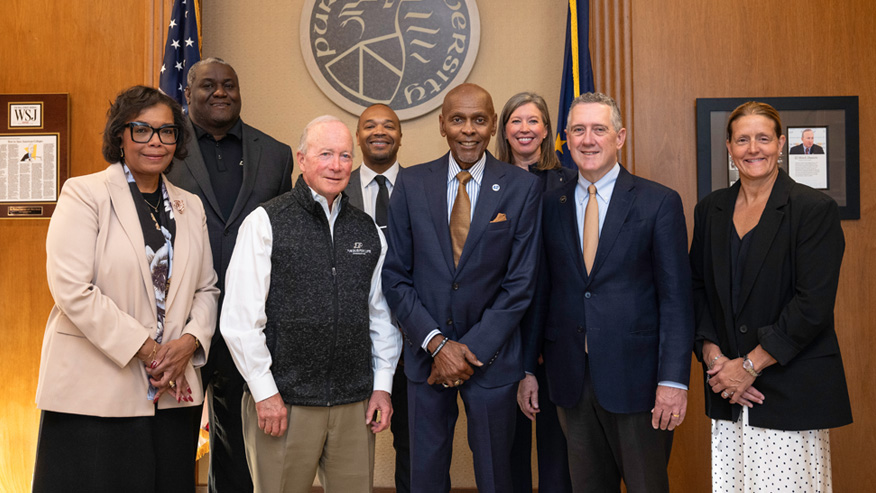
Longtime Purdue benefactor Parrish commits $42M to name new Daniels School building
October 9, 2026

Earhart expedition update: Crew at sea, expected to arrive on Nikumaroro in 72 hours
October 9, 2026
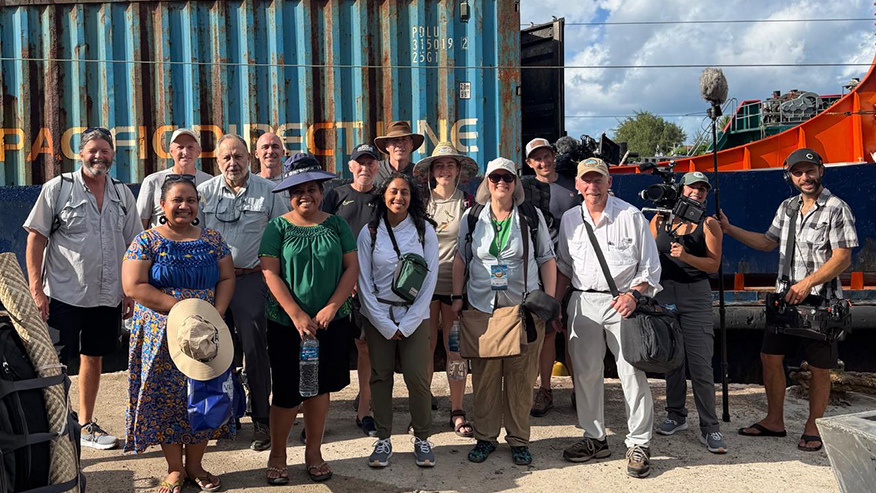
Earhart expedition update: Crew begins 6-day sea voyage to South Pacific atoll Nikumaroro
October 7, 2026
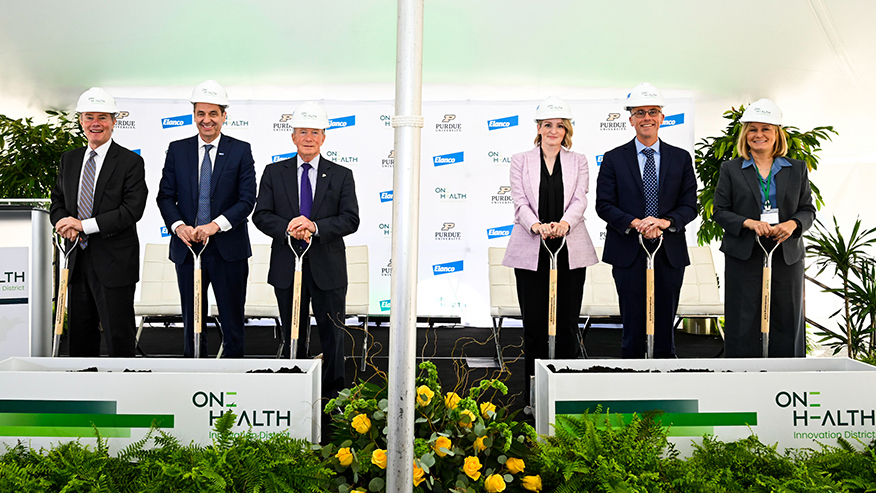
Purdue, Elanco, partners celebrate One Health Research Institute groundbreaking
October 7, 2026