America250: From Ferris Wheels to Fireworks – How Amusement Parks and Entertainment Destinations Shape America
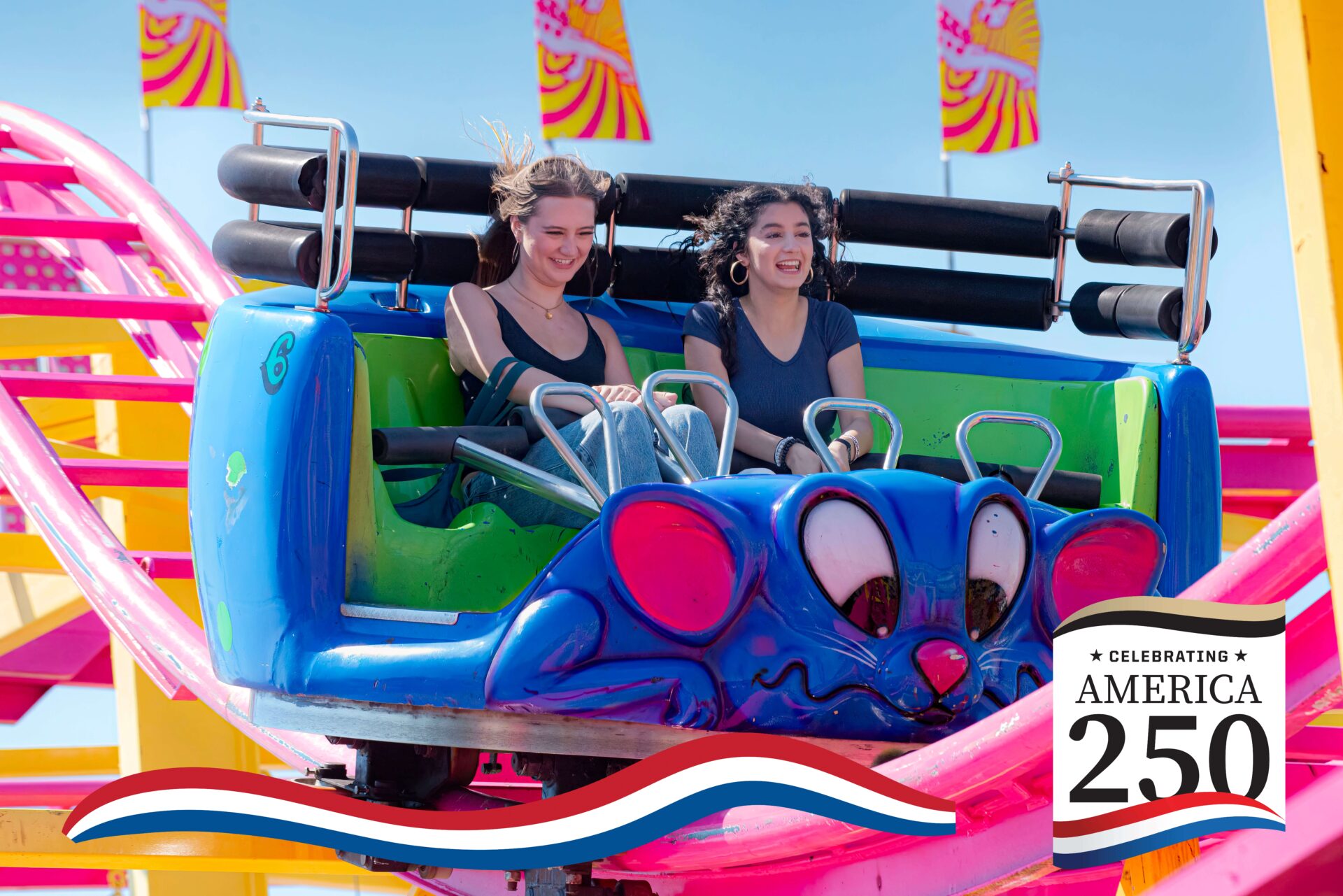
Bright colors, high-speed thrills, and shared moments of joy, amusement rides continue a long American tradition of bringing people together through experience, connection, and celebration. Photo courtesy of user @coldbeer via pexels.com.
Written by: Abby Lillpop, alillpop@purdue.edu
West Lafayette, Ind. – On a summer night somewhere in America, the experience still ends the same way it has for generations: lights dim, music swells, and families tilt their heads skyward as fireworks bloom overhead. For a moment, strangers stand shoulder to shoulder; parents with toddlers on their shoulders, teenagers clutching funnel cakes, grandparents remembering when they first came here decades ago. The rides may evolve, the technology may advance, but the ritual remains.
As the United States comes together to celebrate America250, amusement parks and entertainment destinations offer more than nostalgia, they provide a living blueprint of American culture itself. From the debut of the Ferris wheel at the 1893 World’s Columbian Exposition to today’s immersive, technology-infused theme parks and entertainment districts, these spaces trace a distinctly American pursuit: the blending of innovation, storytelling, and shared experience.
A Tradition Built on Gathering
Long before billion-dollar themed lands and digital queue systems, America’s early amusement spaces – boardwalks, fairgrounds, and regional parks – were designed with a simple goal: bring people together.

Christian Rogers, Assistant Dean for Purdue Polytechnic in Indianapolis
That impulse says Purdue Polytechnic Instiute’s Christian Rogers, Assistant Dean for Purdue Polytechnic in Indianapolis, remains unchanged. “The idea of creating environments for people to connect with one another, that’s been in the fiber of our country,” he explains.
What has changed is the scale and sophistication. Today’s destinations are no longer just collections of rides; they are fully realized environments. Rogers draws a distinction: while amusement parks provide attractions, themed environments are “driven by story at [their] core,” shaping everything from physical design to guest flow.
That emphasis on storytelling transforms parks into something more than entertainment, it makes them emotional landscapes. Even guests who don’t consciously engage with a narrative still feel its effects. “You might not understand the storyline,” Rogers says, “but you loved the experience.”
The Rise of the Experience Economy
If the early days of amusement parks were defined by spectacle, today’s industry is defined by experience.

Josh Seidell, Director of New Customer Acquisitions for Six Flags Entertainment Corporation and 2010 HTM alum.
At Six Flags Entertainment Corporation, Josh Seidell (HTM ’10) works at the intersection of pricing, data, and guest behavior; an area that reveals how deeply expectations have evolved. “Guests expect flexibility, personalization, and convenience,” he explains.
Behind the scenes, that expectation is powered by sophisticated data systems. Parks now analyze everything from weather patterns and booking curves to digital engagement and regional economic conditions. What once relied on seasonal trends has become a real-time, predictive operation.
“Pricing and forecasting aren’t isolated exercises,” Seidell says. “They help operational teams prepare staffing, food inventory, ride throughput; so, the experience feels seamless.”
The goal isn’t simply efficiency; it’s emotional impact. Every operational decision ultimately shapes how a guest feels: whether their day is stressful or seamless, transactional or memorable.
In this sense, modern parks function as what Seidell calls “mini cities,” balancing logistics, economics, and human experience on a massive scale.
Where Data Meets Magic
Yet even as data grows more powerful, the most successful innovations are often invisible.
Seidell points to tools like dynamic pricing, mobile ordering, and virtual queuing-systems that allow guests to customize their day without friction. “The most impactful innovations tend to be the ones guests barely notice,” he says, “because everything simply feels easier.”
Rogers echoes that idea from a design perspective. The future may include augmented reality and artificial intelligence, but technology will largely remain hidden. “When you wave a wand, you think it’s magic, you don’t think it’s technology,” he says, referencing immersive environments like the Wizarding World of Harry Potter.
Together, these perspectives highlight a central paradox in modern entertainment: the more advanced the systems become, the more invisible they must be. Technology is not the experience; it is the enabler of it.
The Human Element
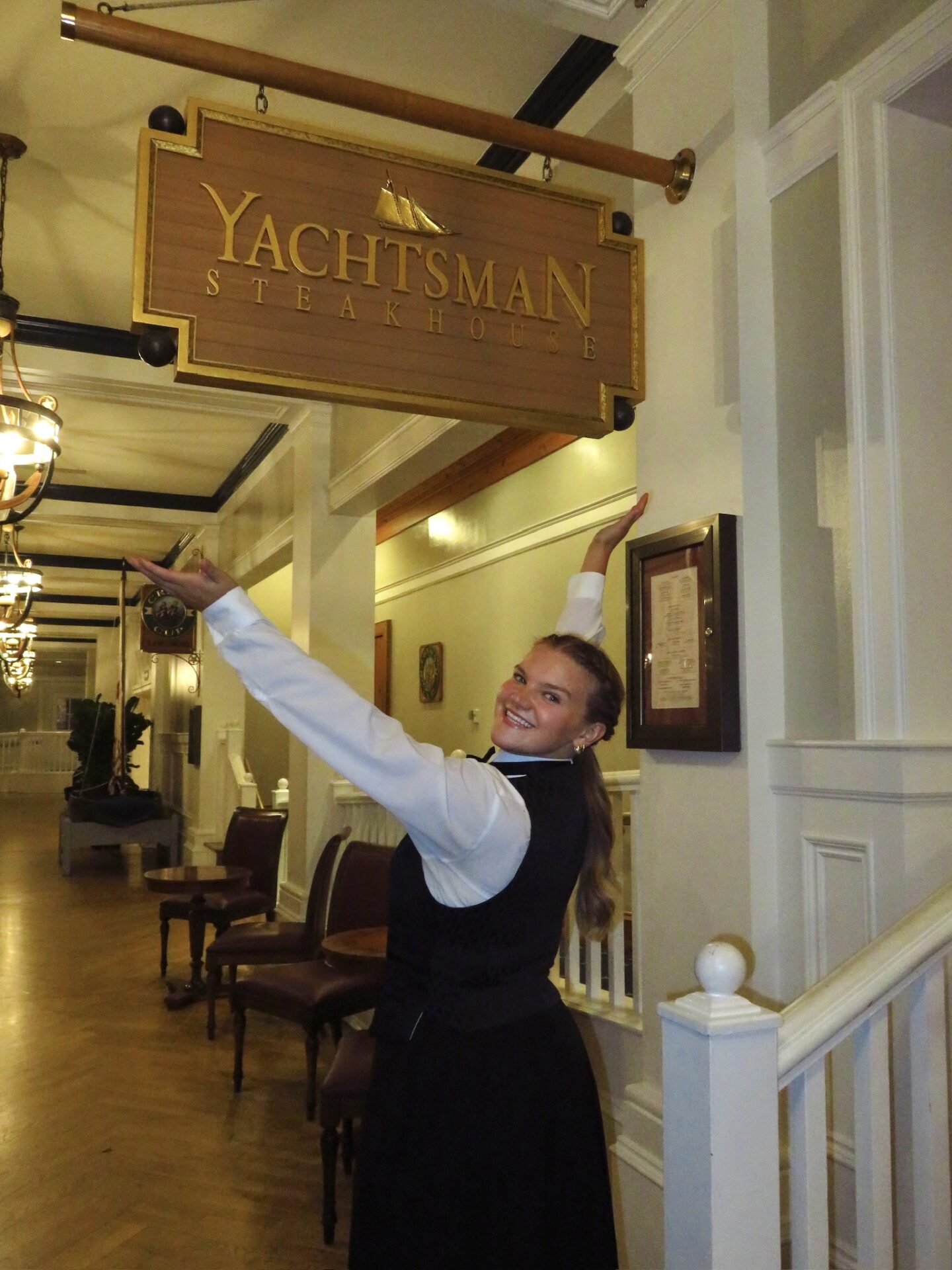
Keona Smith (HTM ’27) recently finished her semester in the Disney College Program where she spent time working at the Yachtsman Steakhouse in Disney’s Yacht Club Resort.
For all the emphasis on data and design, the heartbeat of these destinations remains unmistakably human.
Keona Smith (HTM ’27), who participated in the Disney College Program, experienced this firsthand while working in a high-volume dining environment. Each interaction, she says, had the potential to shape a guest’s memory. “Even the smallest interaction can turn an ordinary day into a lifelong memory.”
She recalls one couple who returned to the restaurant where they had their first date – only this time, it became the site of a surprise proposal. With help from staff, the moment was amplified into something unforgettable. “It easily became the best day of their lives,” Smith says.
Experiences like this reveal what no algorithm can replicate entirely: empathy, spontaneity, and emotional connection.
“Cast members are the heart of the guest experience,” Smith emphasizes.
A Mirror of American Identity
Taken together, amusement parks and entertainment destinations reflect broader cultural shifts.
Seidell sees them as a response to changing values. “There’s a greater emphasis on experiences over possessions,” he says, noting a desire for shared moments and memory-making across generations.
Rogers connects that trend to a broader societal shift; in an increasingly digital world, people are seeking physical, shared experiences again. “We really miss other people,” he says.
Smith, meanwhile, highlights how these spaces bring together diverse audiences. At Disney’s EPCOT, for example, cast members from around the globe represent their home countries, creating an environment where culture is both celebrated and shared.
These destinations, in essence, become modern gathering places, spaces where identity is expressed not through isolation, but through connection.
Educating the Next Generation of Experience Creators
As the industry evolves, so too does the need for interdisciplinary talent.
At Purdue, collaboration between the White Lodging–J.W. Marriott, Jr. School of Hospitality and Tourism Management and Purdue Polytechnic Institute reflects that shift. The themed entertainment design minor, and a proposed certificate program, bring together storytelling, engineering, and hospitality into a single framework.
This convergence mirrors the industry itself, where success depends on the ability to connect data to emotion, design to operations, and technology to human experience.
“The future leaders in this industry,” Seidell notes, “will be people who can connect data to emotion.”
Looking Ahead to 250 – and Beyond
What will the next generation of American entertainment destinations look like?
The answer, according to all three perspectives, lies in balance.
They will be more personalized, powered by data and AI. They will be more immersive, shaped by storytelling and design. And yet, at their core, they will remain deeply human, places where families reconnect, strangers share moments, and memories are made.
“They’ll be more connected and experience-driven,” Seidell says, “but the human element will matter even more.”
Smith agrees, envisioning spaces that are “technology-driven and immersive while still prioritizing human connection.”
And Rogers offers perhaps the simplest, and most enduring, insight: these experiences will continue to bring people together.
As America nears its 250th year, that may be the most defining feature of all. Not just the rides we build or the technologies we deploy, but the moments we create – standing side by side, looking up at the sky, waiting for the next spark to light the dark.