| Problem statement Solution video |
DISCUSSION THREAD

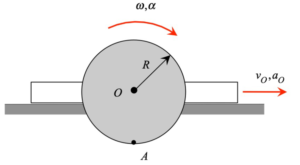
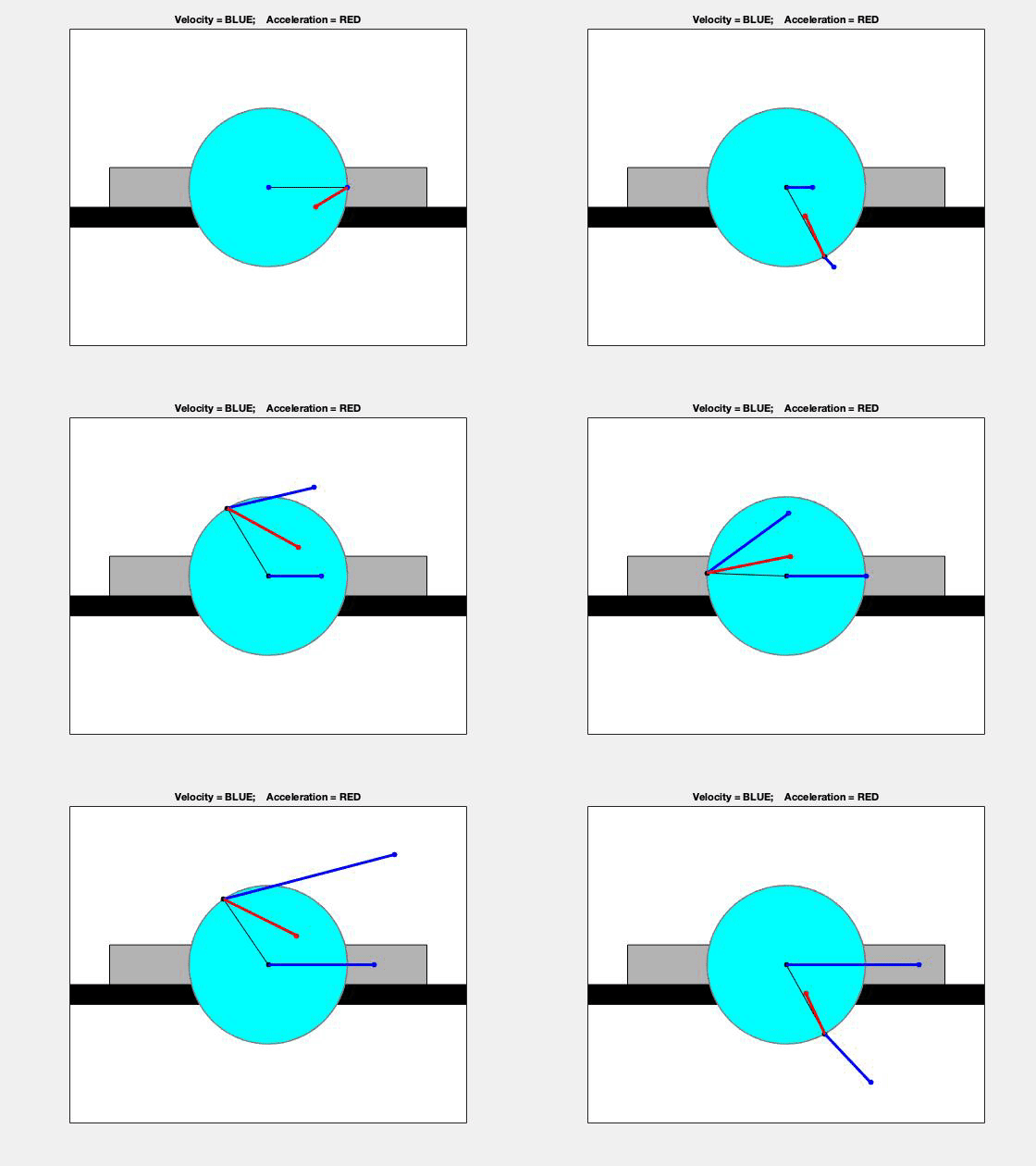
This is a fairly standard problem using the rigid body kinematics equations:
vB = vA + ω x rB/A
aB = aA + α x rB/A – ω2rB/A
| Problem statement Solution video |
DISCUSSION THREAD

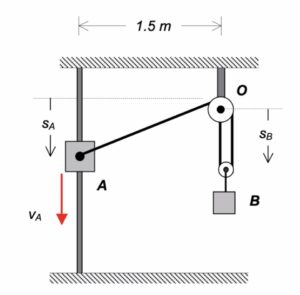
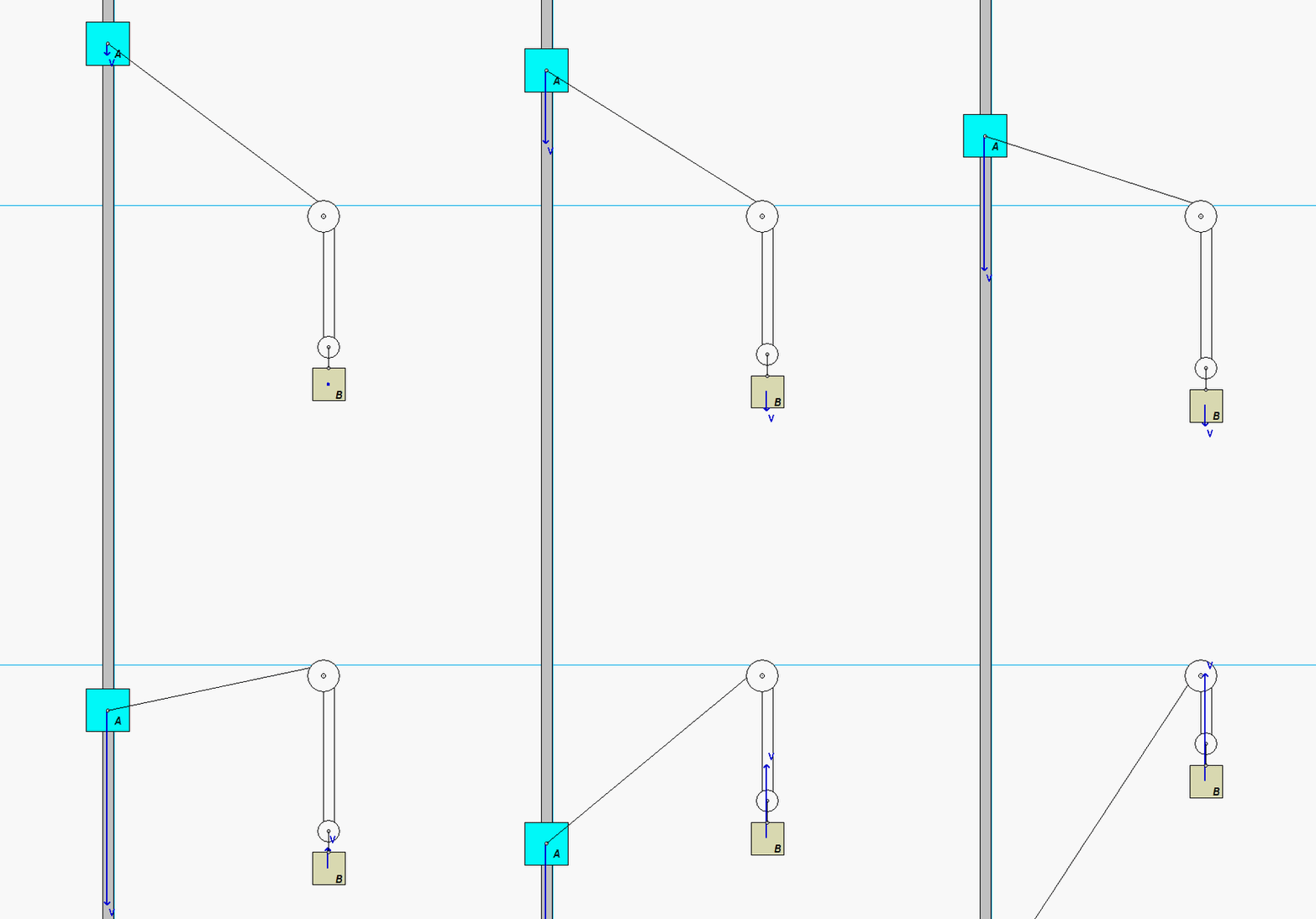
This is a fairly standard problem using the rigid body kinematics equations:
vB = vA + ω x rB/A
aB = aA + α x rB/A – ω2rB/A
| Problem statement Solution video |
DISCUSSION THREAD

DISCUSSION
Please ask and answer questions here. Either way, you learn.
| Problem statement Solution video |
DISCUSSION THREAD

NOTE: Use phi = 20 degrees.
Discussion and hints:
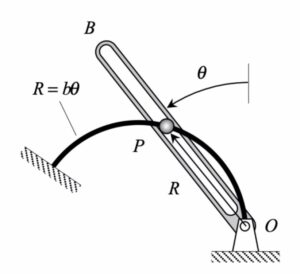
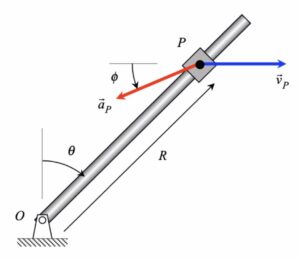
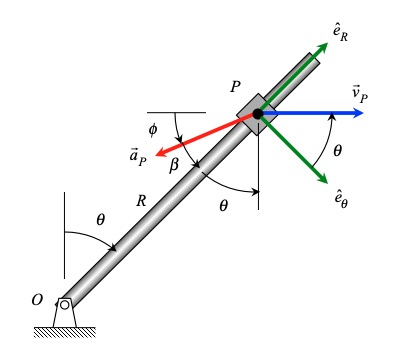
For the polar description to be used here, the radial unit vector eR points from O toward P. The transverse unit vector eθ is perpendicular to eR and points in the direction of increasing angle θ (clockwise from eR).
The solution of this problem comes down to trig – can you do the projections of vP and aP onto the polar unit vectors eR and eθ ? For example, the velocity of P can be written as vP = vP sinθ eR + vP cosθ eθ. And, the acceleration of P can be written as aP = –aP cosβ eR – aP sinβ eθ . No formulas to remember, just look at the figure and do the trig! From these results, you can identify the time derivatives of R and θ.

Any questions??
| Problem statement Solution videohttps://youtu.be/uTfjHrtO_pQ |
DISCUSSION THREAD

DISCUSSION
Please ask and answer questions here. Either way, you learn.
| Problem statement Solution video |
DISCUSSION THREAD

Discussion and hints:
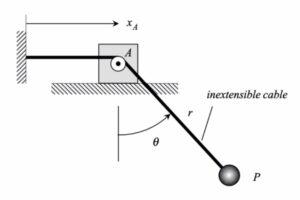
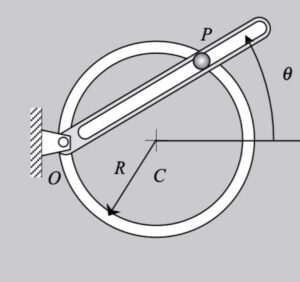
For this problem, the “Given” information is in terms of the path kinematical description. The “Find” asks for parameters that are part of the polar kinematical description.
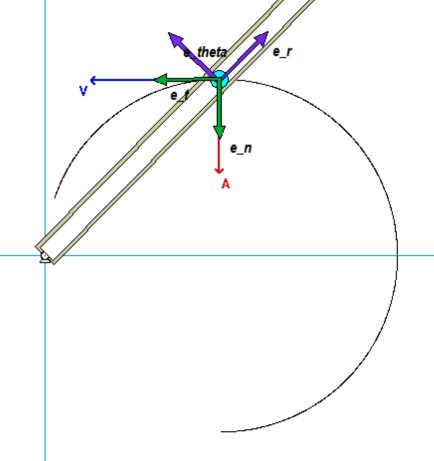
The key to the solution of this problem is being able to correctly draw the sets of path and polar unit vectors.
For the position of interest (θ = 45°), these vectors are as shown below.

It is recommended that you write the path unit vectors in terms of the polar unit vectors, balance coefficients and then solve for the unknowns.
Warning: Do not confuse the roles played by “r” and “R” in this problem.
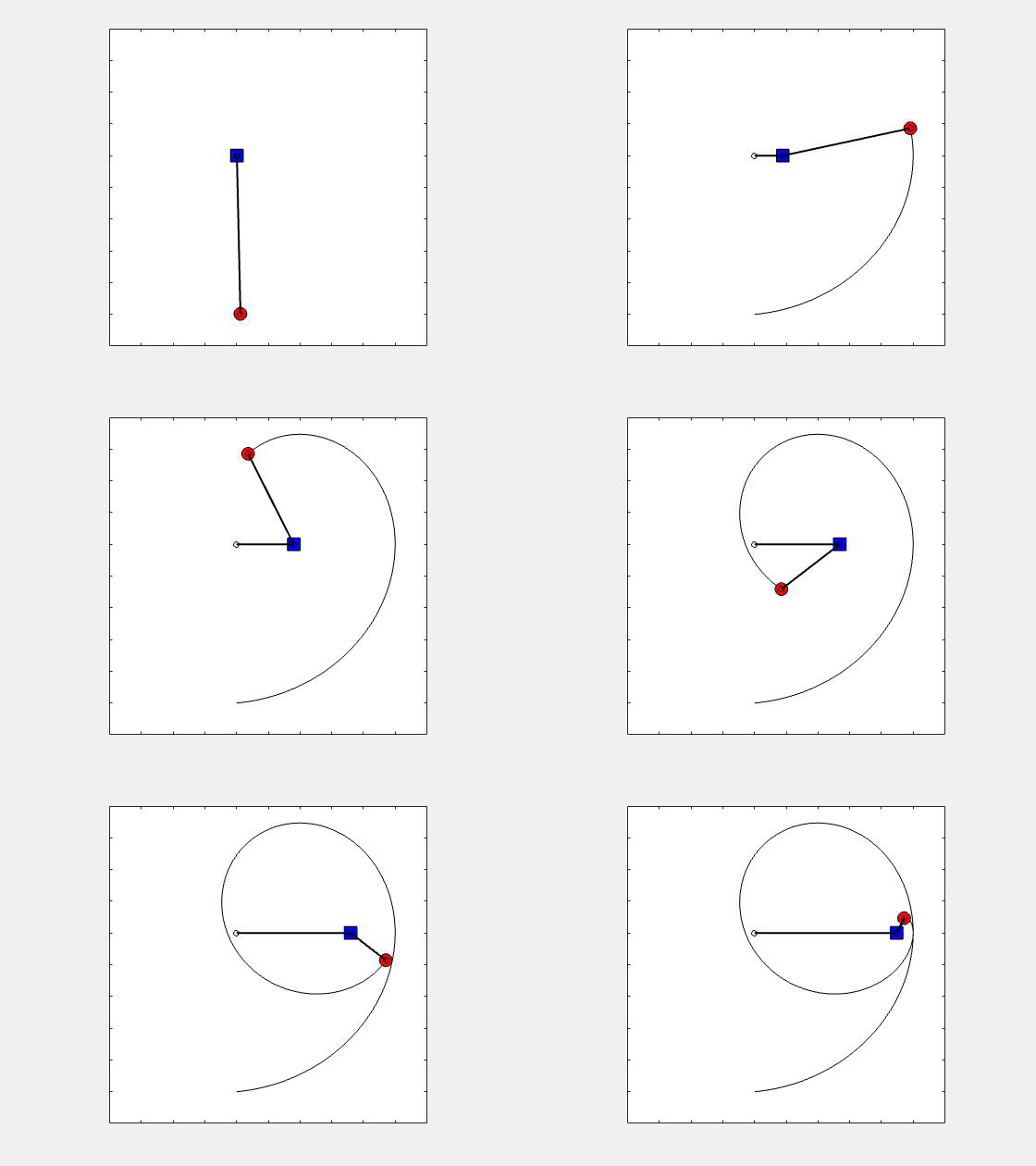
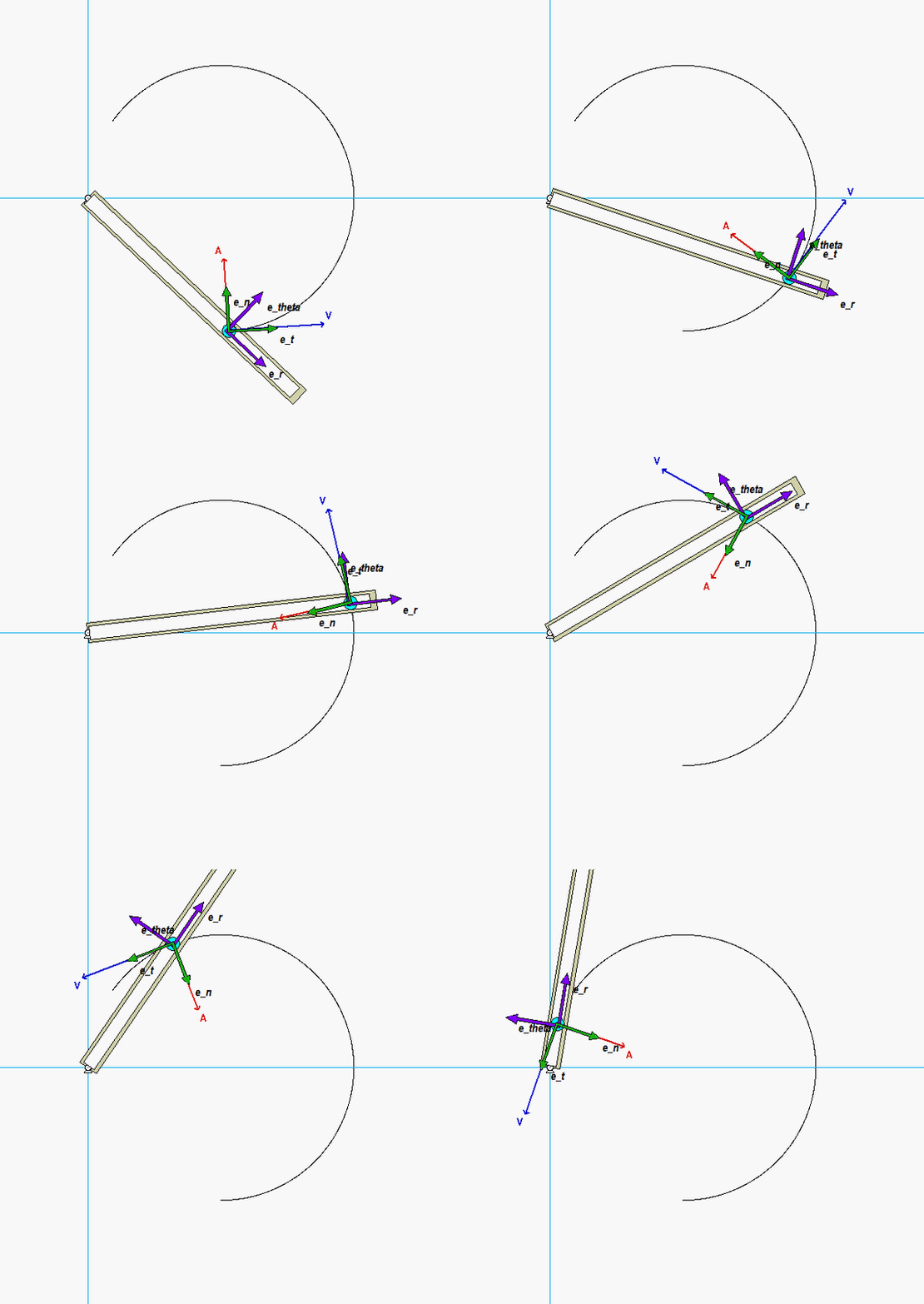
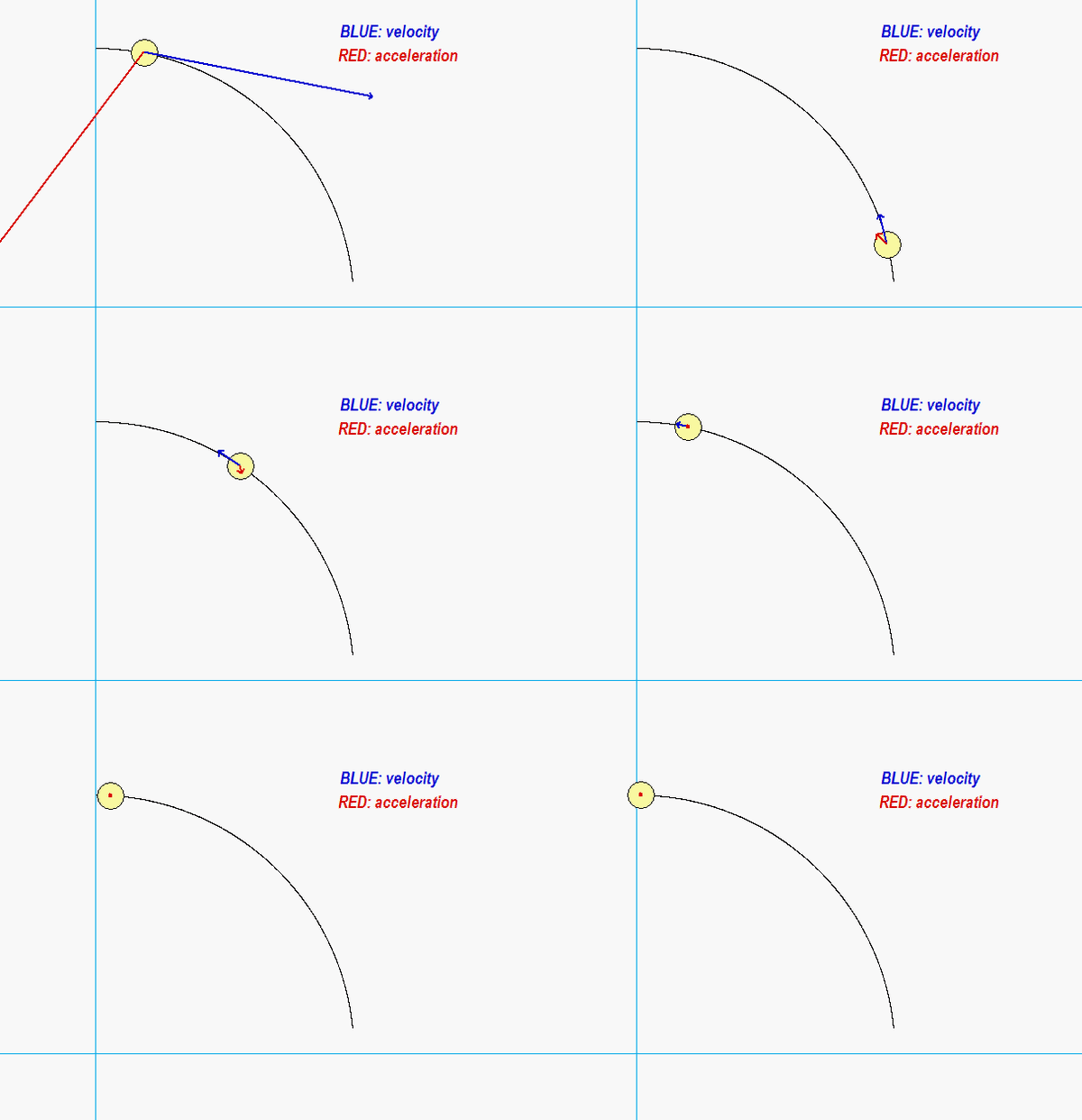
The animation below shows the results of this analysis over a range of angles θ. There is an interesting result here. These results show that the acceleration vector is always perpendicular to the path (the circular slot). This is rarely the case. What is special about this problem that makes it true here? HINT: Think about the relationship between the angle of rotation of the arm and the angular rotation of P around the circle.

Any questions??
| Problem statement Solution video |
DISCUSSION THREAD

DISCUSSION
In this problem, the x- and y-components of the position of the bottle are prescribed functions of time. The Cartesian components of velocity and acceleration for the bottle are found directly through the time derivatives of these prescribed functions of time.
Please ask and answer questions here. Either way, you learn.
| Problem statement Solution video |
DISCUSSION THREAD

Discussion and hints:
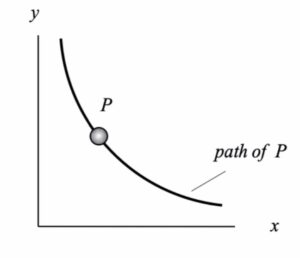
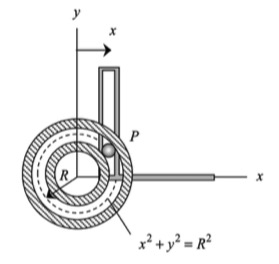
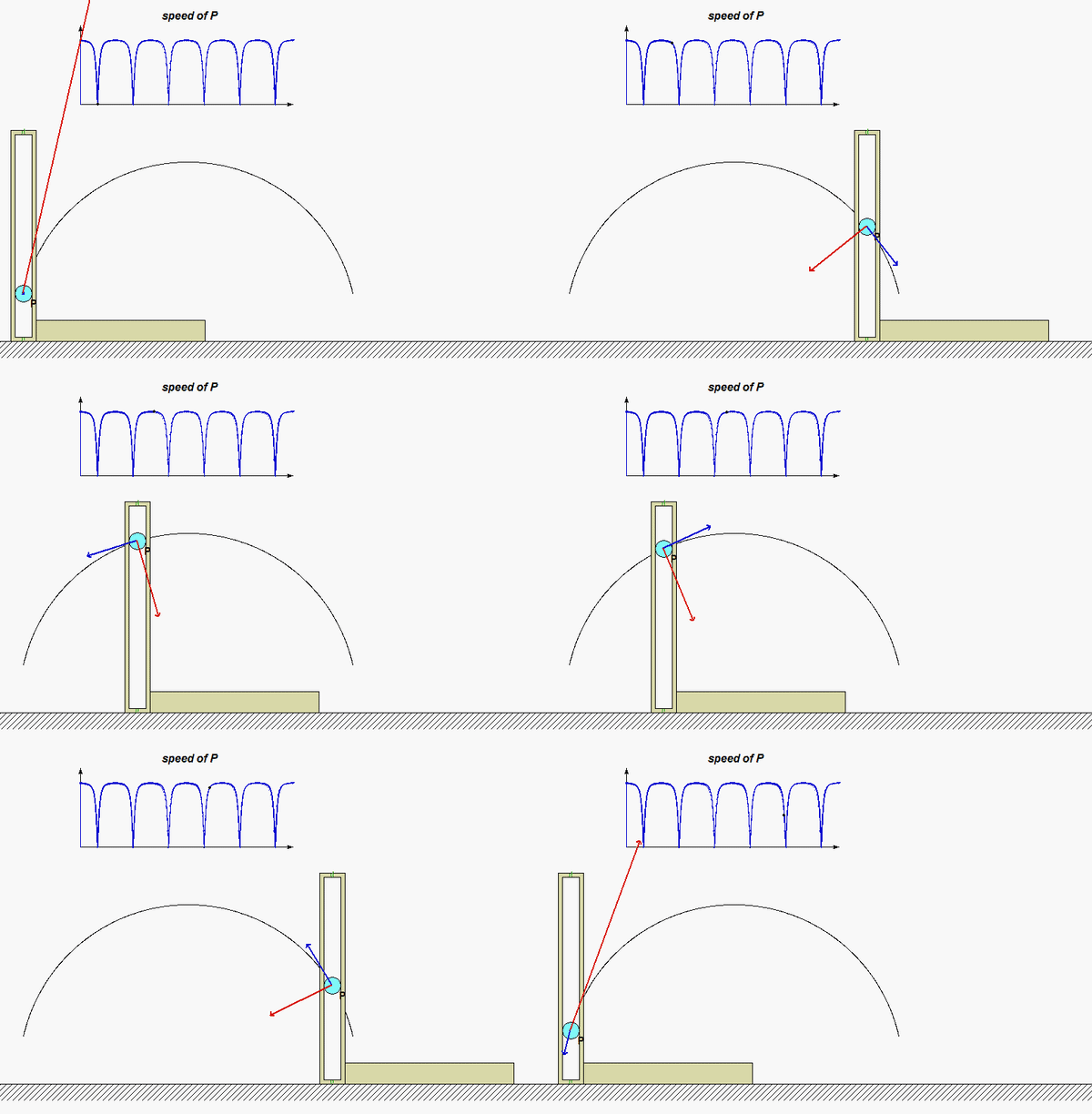
In this problem, the xy-Cartesian components are constrained through the equation of the path of P: x2 + y2 = R2. The x-component of the position is an explicit function of time. Finding the time derivatives of x is done through simple time differentiation of x = b sinωt. The derivatives of y with respect to time is found through the time differentiation of the constraint equation: x2 + y2 = R2. Please review the examples worked out in lecture to assist you in this differentiation.
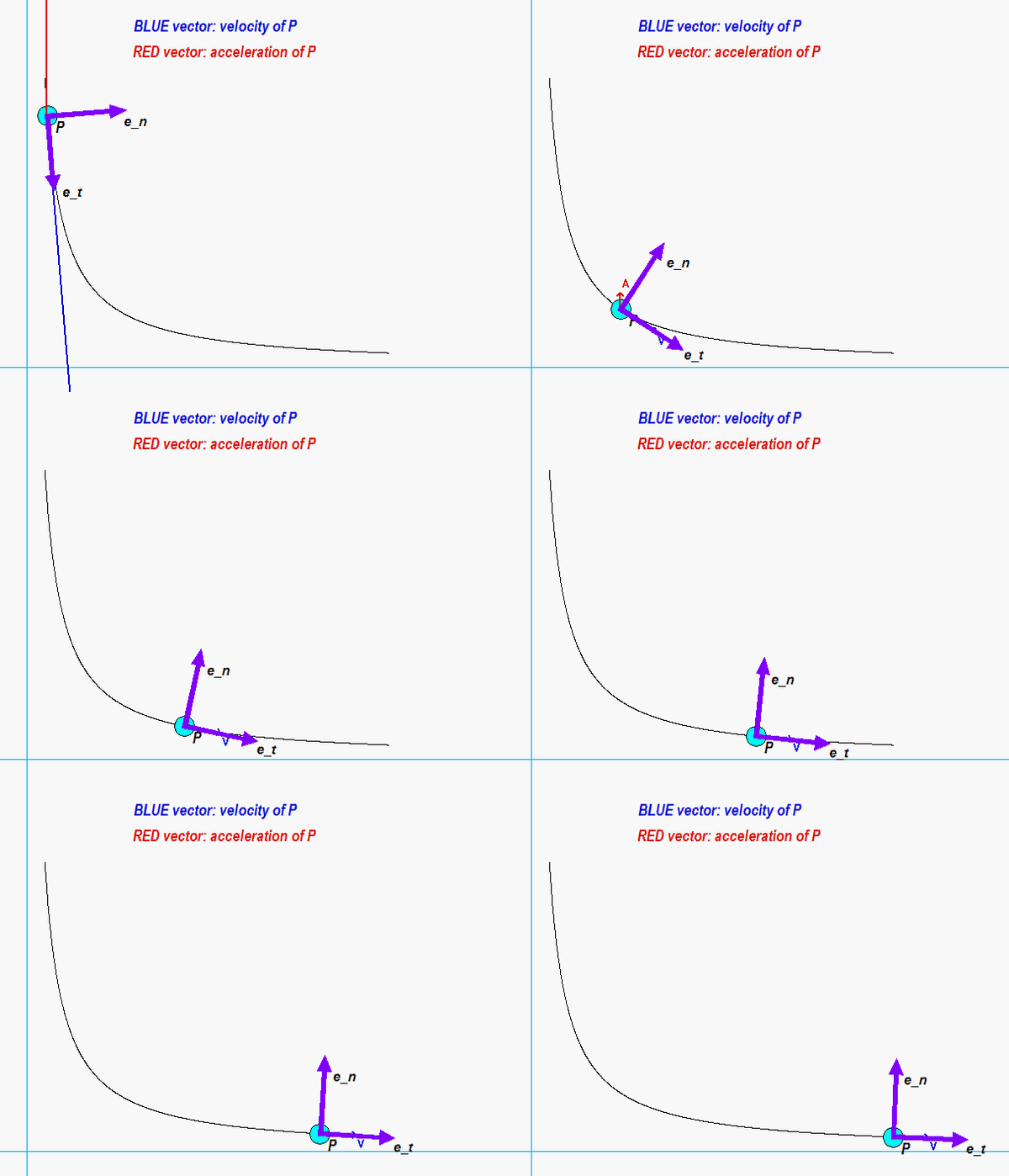
The results of this analysis are shown in the animation below. From this animation, we see that the velocity of the P (shown in BLUE) is always tangent to the path of P. The acceleration (shown in RED) is not quite so simple: it has components both tangent and perpendicular to the path; however, the component perpendicular to the path always points inward on the path. Both of these observations are consistent with what we see in the next lecture when we develop the expressions for velocity and acceleration in terms of their PATH components.

Any questions??
Ask and answer questions here. You learn both ways
| Problem statement Solution video |
DISCUSSION THREAD

DISCUSSION
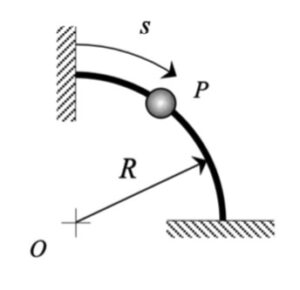
The path variables of radius of curvature ρ and speed v are provided in terms of the distance traveled variable s. Please recall that the time rate of change of speed v_dot that appears in the acceleration vector is (as the name implies) the derivative of v with respect to TIME. Since we know v as a function of position and not time, we need to use the chain rule of derivatives to find the rate of change of speed: v_dot = dv/dt = (dv/ds)*(ds/dt) = v*dv/ds.
Please ask and answer questions here. Either way, you learn.
| Problem statement Solution video |
DISCUSSION THREAD

Discussion and hints:
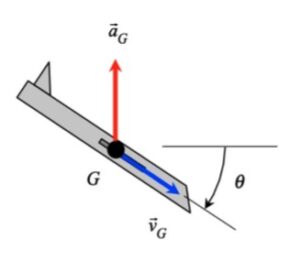
In this problem, we know both the magnitude and direction for each of the velocity and acceleration vectors for the center of mass G. We know that the unit tangent vector et is in the same direction as the velocity vector vG. The unit normal vector en is perpendicular to et, and points “up and to the right” (do you know why?). Projecting the acceleration vector aG onto the unit tangent and unit normal vectors gives us the information that we need to find the rate of change of speed and the radius of curvature of the path.
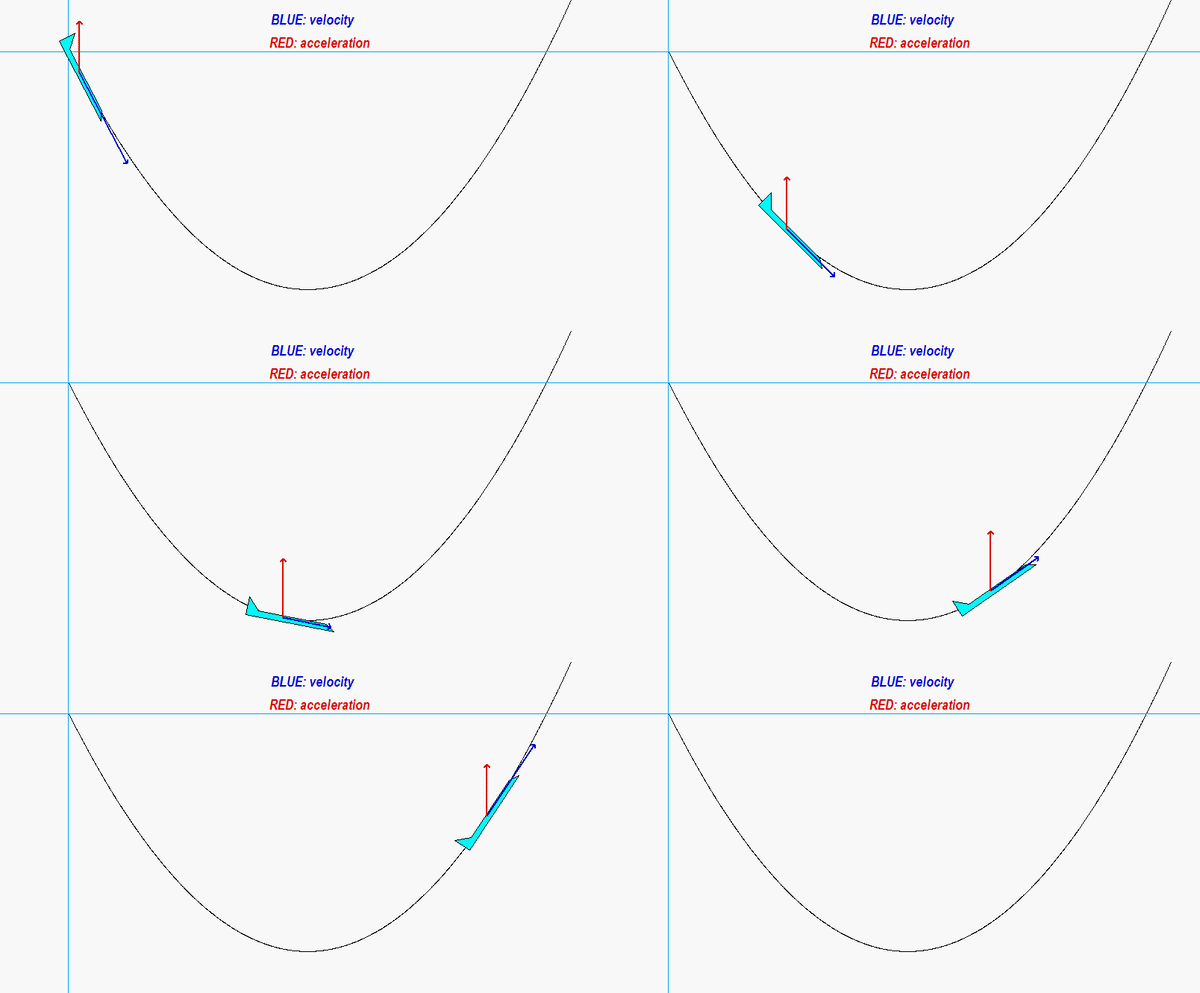
Carefully watch the animation below of the motion of the aircraft. When the acceleration vector shown in RED points “backward” from the direction of travel, the aircraft is slowing down; that is, the rate of change of speed is negative. Conversely, when the acceleration vector is “forward” of the direction of travel, the aircraft is increasing in speed with a positive rate of change of speed. If you follow this logic, you are on your way to understanding the usefulness of the results of the path description of kinematics!

Any questions??