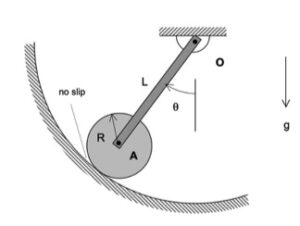
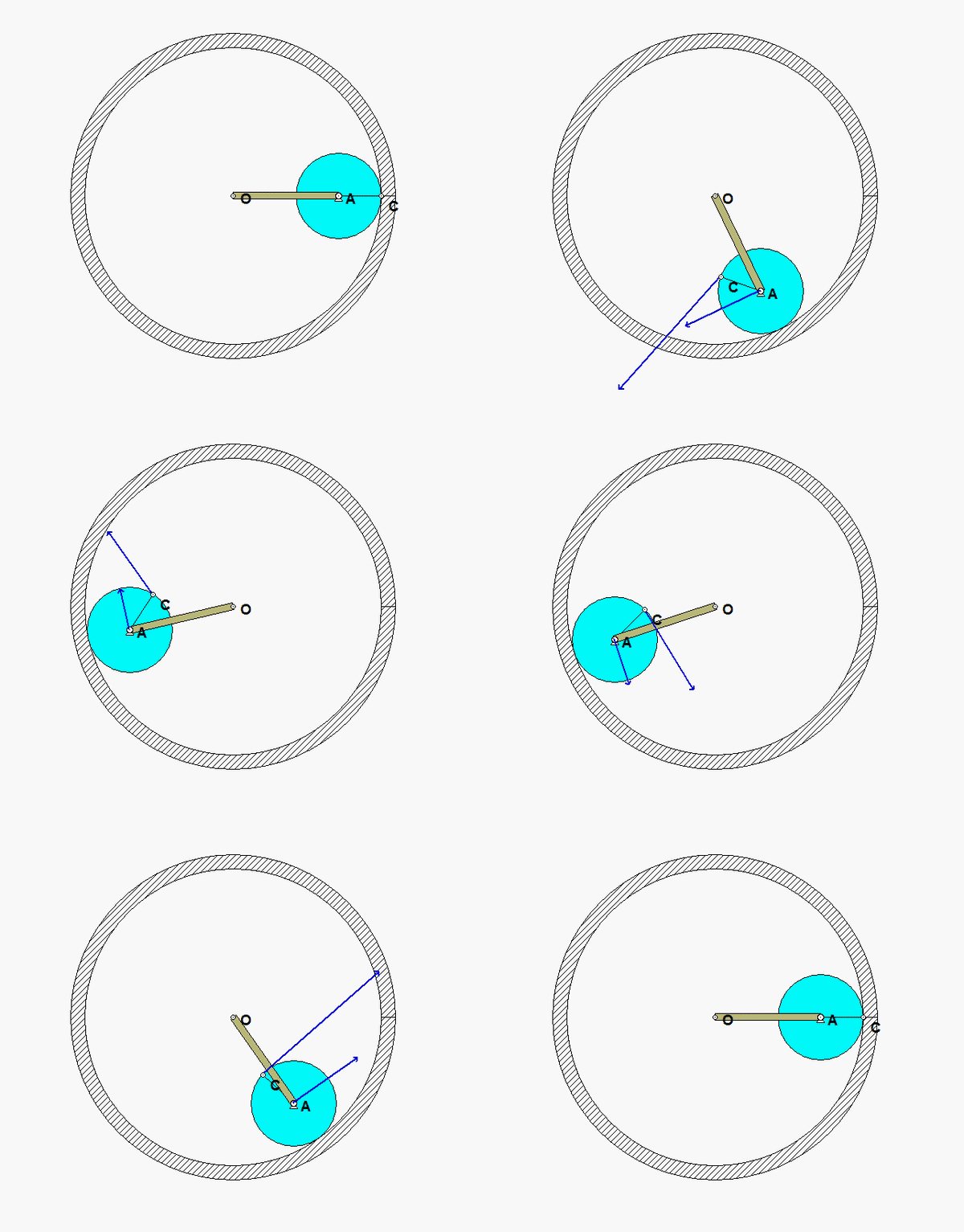
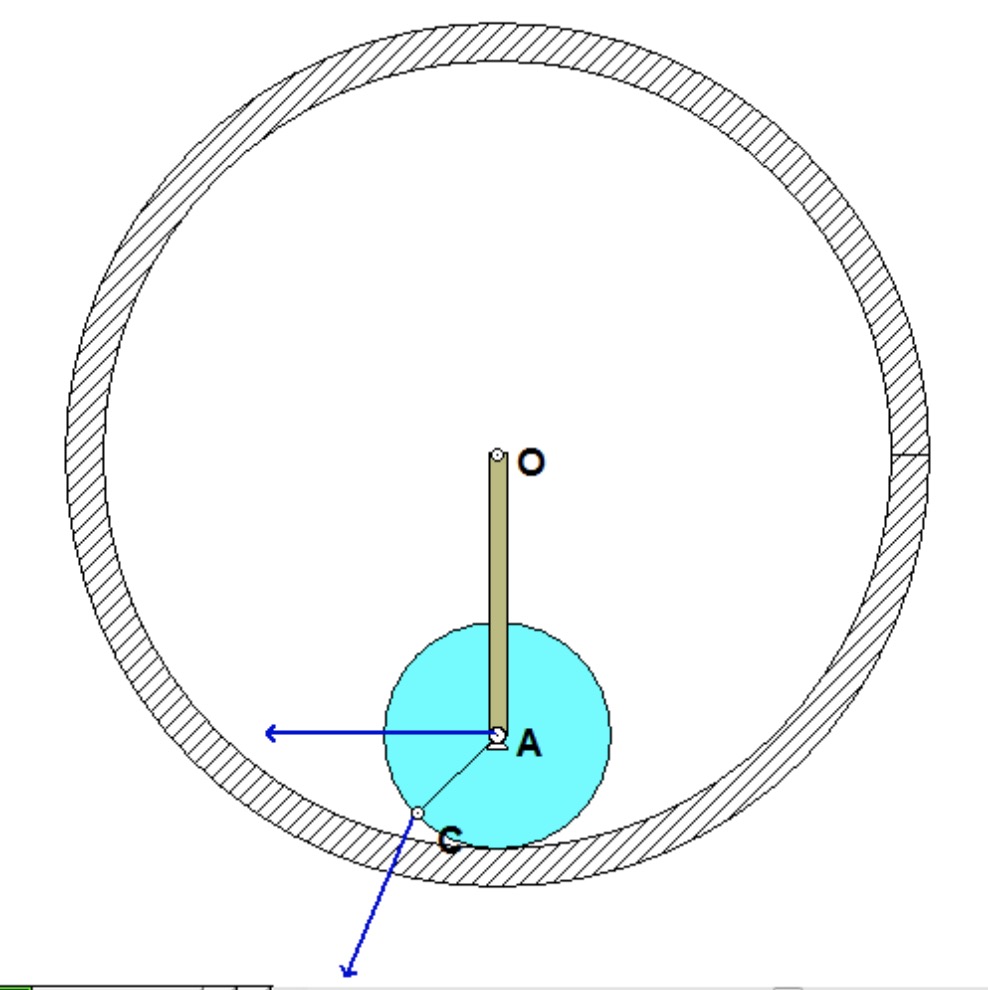
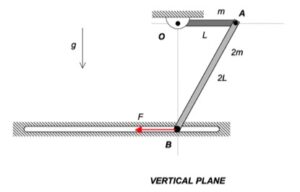
All posts by CMK

Homework H6.B – Fa 25

Problem statement
Solution video

DISCUSSION THREAD

Discussion and hints:

The derivation of the dynamical equation of motion (EOM) for a system is a straight-forward application of what we have learned from Chapter 5 in using the Newton-Euler equations. The goal in deriving the EOM is to end up with a single differential equation in terms of a single dependent variable that describes the motion of the system. Here in this problem, we want our EOM to be in terms of x(t).

Recall the following four-step plan outline in the lecture book and discussed in lecture:

Step 1: FBDs
Draw individual free body diagrams for the two disks and block A.

Step 2: Kinetics (Newton/Euler)
Write down the Newton/Euler equations for the two disks and block based on your FBDs above.

Step 3: Kinematics
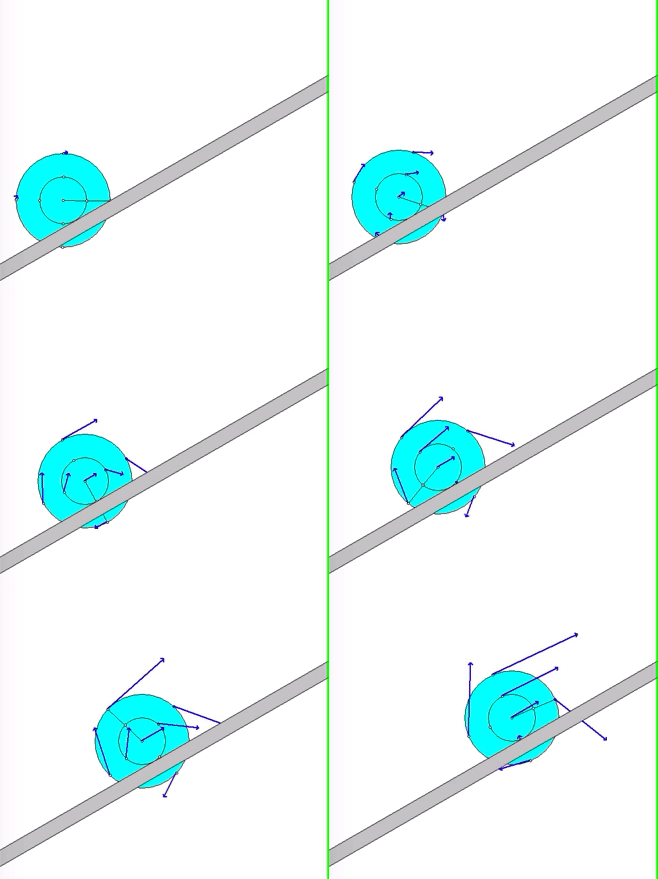
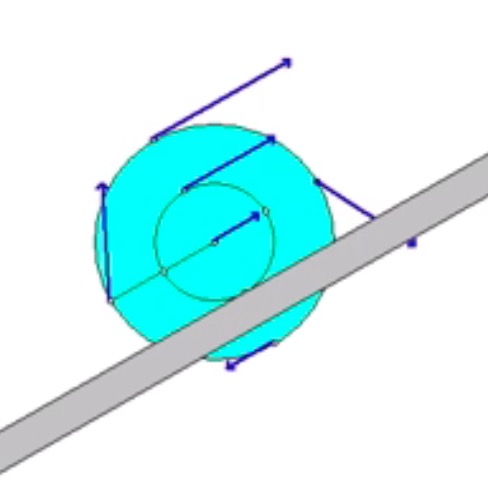
Use the no-slip condition between each disk and the block to relate the angular accelerations of the disks to the acceleration of the block. As confirmed by the animation above, the angular rotations of the disks are NOT the same, in either magnitude or direction.

Step 4: EOM
Combine your Newton/Euler equations along with your kinematics to arrive at a single differential equation in terms of the dependent variable x.


Any questions?

Homework H6.D – Fa 25

Problem statement
Solution video

DISCUSSION THREAD

Discussion and hints:

The derivation of the dynamical equation of motion (EOM) for a system is a straight-forward application of what we have learned from Chapter 5 in using the Newton-Euler equations. The goal in deriving the EOM is to end up with a single differential equation in terms of a single dependent variable that describes the motion of the system. Here in this problem, we want our EOM to be in terms of θ(t).

Recall the following four-step plan outline in the lecture book and discussed in lecture:

Step 1: FBDs
Draw a FBD of the particle. It is recommended that you define and use a set of polar coordinates for this problem.

Step 2: Kinetics (Newton)
Write down the Newton equation for the particle in the θ-direction.

Step 3: Kinematics
Do you need any additional kinematics for this problem?

Step 4: EOM
Step 2 should produce a single differential equation in terms of the dependent variable θ. Note that this EOM contains a nonlinear term of sinθ. Recall that we can represent the sine function by its power series representation: sinθ = θθ3/3! + θ5/5! – …    For small angles θ, we see that this series could be approximated by its leading term, giving: sinθ = θ. The approximation for small angles of oscillation produces a LINEAR differential equation. Use this approximation here.


Any questions?

Homework H6.F – Fa 25

Problem statement
Solution video

DISCUSSION THREAD

Ask your questions here. Or, answer questions of others here. Either way, you can learn.


DISCUSSION and HINTS

After block B strikes and sticks to block A, the two blocks move together as a single rigid body. In deriving your equation of motion here, focus on a system with a single block (of mass 3m) connected to ground with a spring and dashpot.

Recall the following four-step plan outline in the lecture book and discussed in lecture:

Step 1: FBDs
Draw a free body diagram (FBD) of A+B.

Step 2: Kinetics (Newton/Euler)
Use Newton’s 2nd law to write down the dynamical equation for the system in terms of the coordinate x.

Step 3: Kinematics
None needed here.

Step 4: EOM
Your EOM was found at Step 2.

Once you have determined the EOM for the system, identify the natural frequency, damping ratio and the damped natural frequency from the EOM. Also, from the EOM we know that the response of the system in terms of x is given by: x(t) = e-ζωnt [C*cos(ωdt)+ S*sin(ωdt)]. How do you find the response coefficients C and S? What will you use for the initial conditions of the problem? (Consider linear momentum of A+B during impact.)

Homework H6.N – Fa 25

Problem statement
Solution video

DISCUSSION THREAD

Ask your questions here. Or, answer questions of others here. Either way, you can learn.


DISCUSSION and HINTS

In this problem, the excitation does not come from a prescribed force, but, instead, it arises from a prescribed displacement on one body in the system. The support B here is given a prescribed motion of xB(t) = b cosωt, where ω is the frequency of excitation. Our goal is to solve for the particular solution of the response. Shown below are animations of this forced response corresponding to two different frequencies: the top animation has ω < ωn, and the bottom animation has ω > ωn, where ωis the natural frequency of the system. Can you see the difference between these two simulation in terms of the the phase of the response? Study both the time histories and the animation of motion.


Recall the following four-step plan outline in the lecture book and discussed in lecture:

Step 1: FBDs
Draw a free body diagram (FBD) of block A. Take care in getting the directions correct on the spring forces acting on A. Note that you do NOT need an FBD of B since you already know its motion.

Step 2: Kinetics (Newton/Euler)
Use Newton’s 2nd law to arrive at the EOM.

Step 3: Kinematics
None needed here.

Step 4: EOM
The EOM was found back in Step 2.

Once you have determined the EOM for the system, identify the natural frequency from the EOM. From the EOM we know that the particular solution of the EOM is given by: xP(t) = A*sin(ωt)+ B*sin(ωt). How do you find the forced response coefficients A and B?

Does your result here agree with the expected relationship between excitation frequency and response with regard to the “phase” of the solution, and with the animations above?

Homework H5.J – Fa 25

Problem statement
Solution video


DISCUSSION THREAD

Discussion and hints:

Recall the following four-step plan outline in the lecture book and discussed in lecture:

Step 1: FBDs
Draw a single free body diagram for the system made up of the disk, bar and block, combined.

Step 2: Kinetics (work/energy)

  • Write down the kinetic expressions for the three bodies in the system, individually, and then add those together to find the total KE for the system of your FBD.
  • Do the same for the potential energies: write down the PEs for each body individually and add together.
  • Also, based on your FBD above, which, if any force or couple, does nonconservative work on the system in your FBD? Determine work for such a force/couple.

Step 3: Kinematics
Since the bar is welded to the disk, the angular velocities of the bar and disk are the same. The no-slip condition at the point of contact of the disk and block enforces a constraint between the rotation rate of the disk and the translational speed of the block. What is that constraint?

Step 4: Solve
Solve your equations above for the angular velocity of the disk.


Any questions?

Homework H5.L – Fa 25

Problem statement
Solution video


DISCUSSION THREAD

Discussion and hints:

Note that the animation above is for a generic set of parameter values that may or may not be the ones assigned for the problem this semester.

Recall the following four-step plan outline in the lecture book and discussed in lecture:

Step 1: FBDs
Draw a single free body diagram for the system made up of bar OA and particle P, combined.

Step 2: Kinetics (impulse/momentum)

  • From you FBD above, what can you say about the moments acting about the fixed point O in your system? What consequence does this have on the angular momentum about point O for the system?
  • Use the coefficient of restitution, COR, equation relating the “n-components” of velocity for P and end A of the bar. (You may want to review Section 4.C of the lecture book in regard to impacts and the COR.)

Step 3: Kinematics
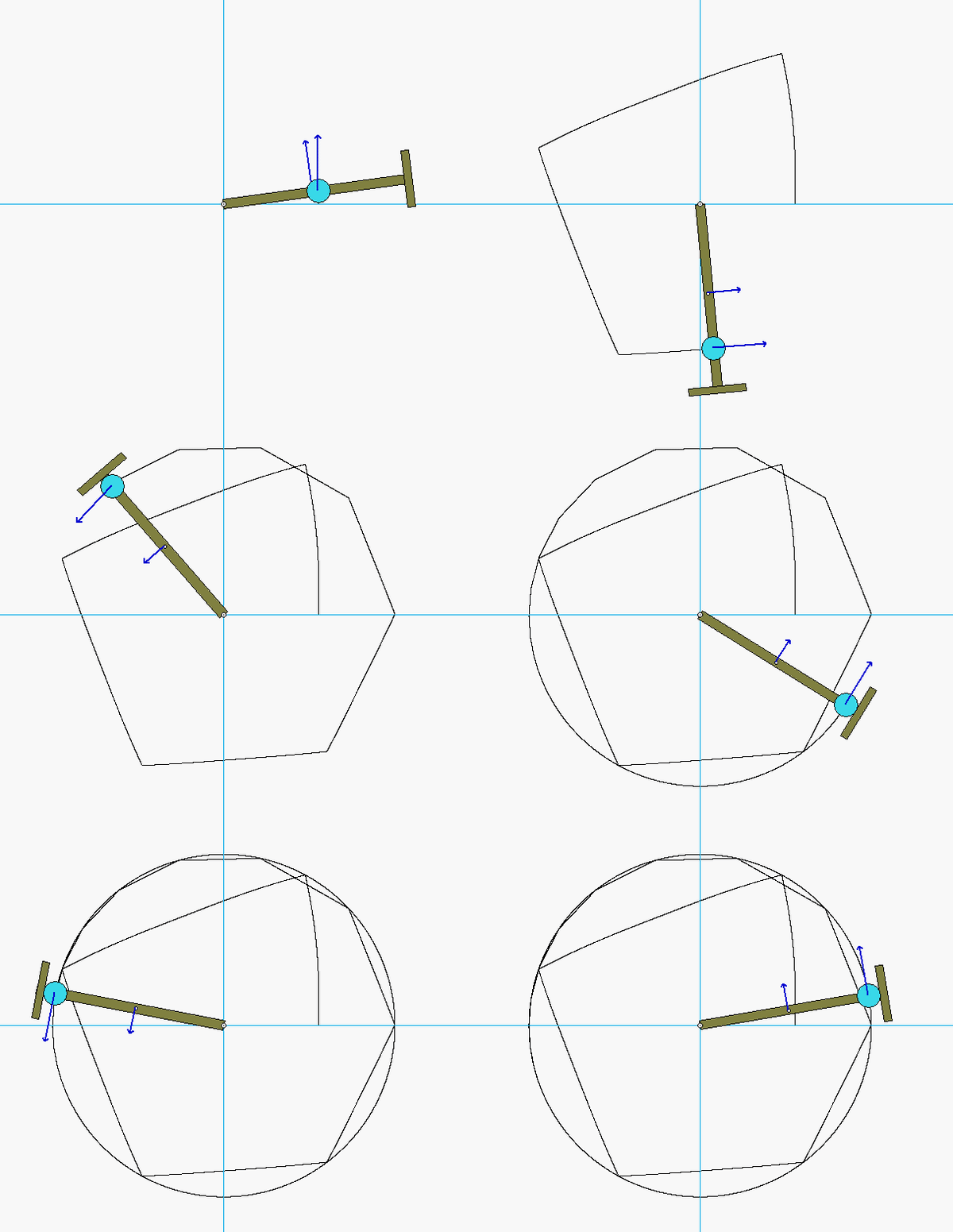
Note that bar OA rotates about point O. What does that say about the direction of the velocity of point A on the bar after impact? Study the animation above, and the freeze-frame images below of the motion. Do your kinematics agree with what you see about the direction of the velocity of A?

Step 4: Solve
Solve your equations above for the angular speed of bar OA.


Any questions?

Homework H5.M – Fa 25

Problem statement
Solution video


DISCUSSION THREAD

Ask your questions here. Or, answer questions of others here. Either way, you can learn.


DISCUSSION and HINTS

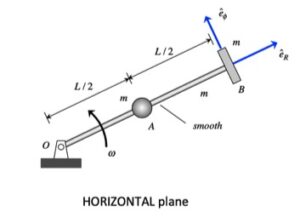
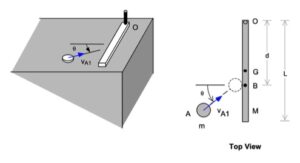
The animation below shows the impact of the particle with the rigid bar. As stated in the problem statement, the particle sticks to the bar during the short impact time.

Considering the system made up of the particle and the bar, we see that there are no fixed points that are easily recognized and determining the location of the center of the mass requires some calculation. Because of this, it is advisable to consider the particle and the bar in separate FBDs in your analysis.

Recall the following four-step plan outline in the lecture book and discussed in lecture:

Step 1: FBDs
Draw individual free body diagrams (FBDs) of the particle and bar. Be sure to draw the impact force on both FBDs.

Step 2: Kinetics (impulse/momentum)
Consider the linear impulse/momentum equation for the particle and the angular and linear impulse/momentum equations for the bar. Note that each of these equations will include the impulse of the impact force.

Eliminate the impulse of the impact force from the above three equations. This will leave you with two equations in terms of the post-impact velocity of the particle, the post-impact velocity of the bar’s center of mass, and the post-impact angular velocity of the bar.

Step 3: Kinematics
Since the particle sticks to the bar during impact, you can relate the post-impact velocities above through the rigid body kinematics equation:

vB= vG + ωbar x rB/G 

where B is the top point on the bar where the particle impacts and sticks.

Step 4: Solve
From your equations in Steps 2 and 3, solve for the velocity of G and the angular velocity of the bar immediately after impact.

Homework H5.N – Fa 25

Problem statement
Solution video


DISCUSSION THREAD

Any questions?? Please ask/answer questions regarding this homework problem through the “Leave a Comment” link above.


Discussion and hints

The four-step plan:

  1. FBD: It is recommended that you draw a free body diagram of the plate and cart combined.
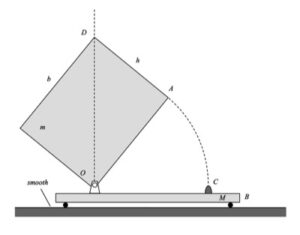
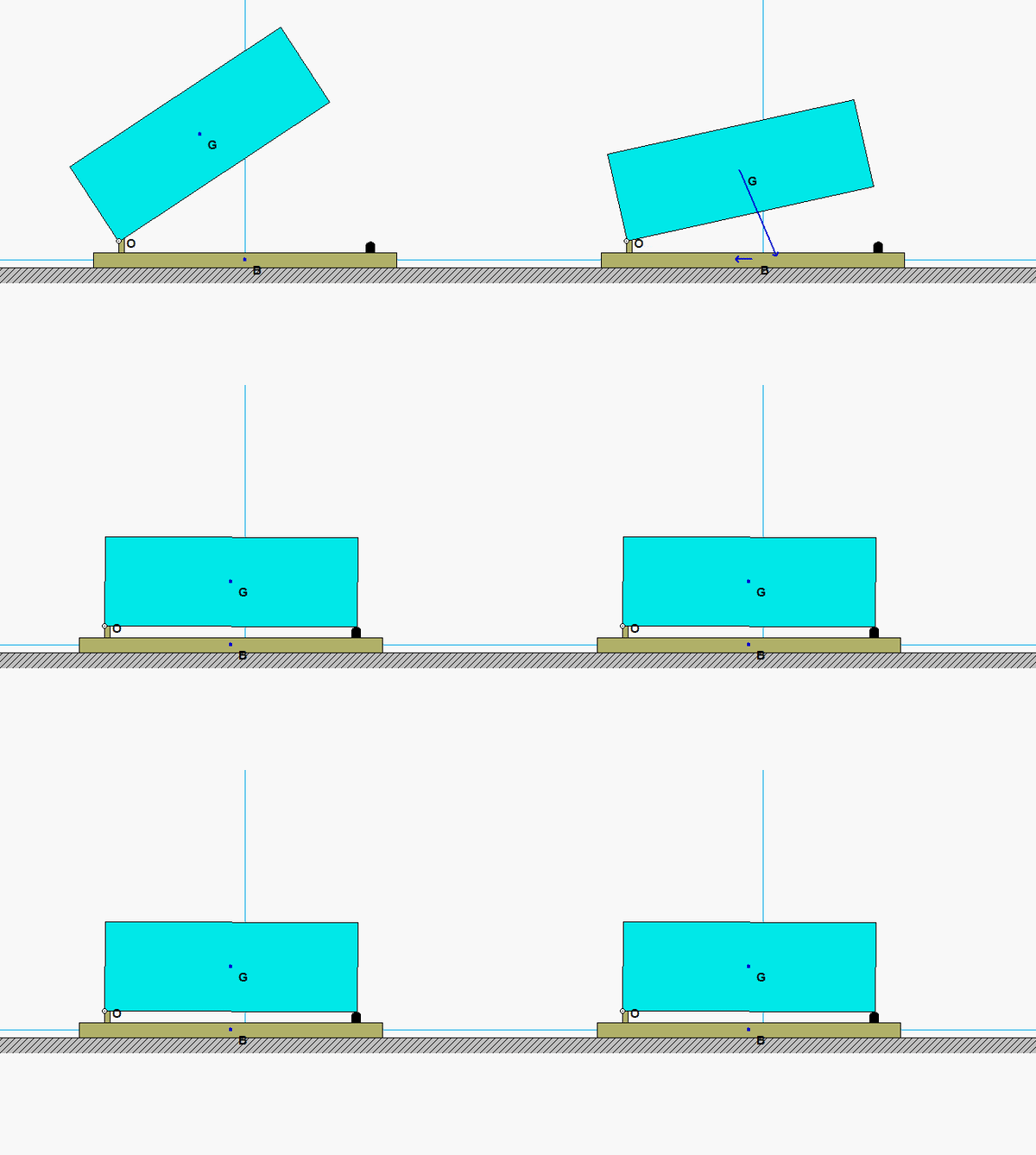
  2. Kinetics: Your FBD should show that the summation of forces in the direction of motion for the cart (call that the x-direction) is zero; therefore, linear momentum in the x-direction is conserved for ALL time. Also note that energy is conserved up to the point of impact. During impact, energy is not conserved; however, you are given the coefficient of restitution (COR) for the impact.
  3. Kinematics: Write down the rigid body velocity equation relating the motion of points O and the plate’s center of mass G. Here you will use the fact that the cart moves only in the x-direction.
  4. Solve


Homework H5.C – Fa 25

Problem statement
Solution video


https://youtu.be/4F222FOa_D8


DISCUSSION THREAD

Discussion and hints:

Recall the following four-step plan outline in the lecture book and discussed in lecture:

Step 1: FBDs
Draw a free body diagram of the bar.

Step 2: Kinetics (Newton/Euler)
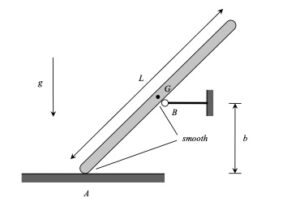
Write down the Newton/Euler equations for the bar using your FBD above. Take care in choosing the reference point for your moment equation. In order to use the “short form” of Euler’s equation, this point should be either a fixed point or the body’s center of mass. For this problem, there are no fixed points.

Step 3: Kinematics
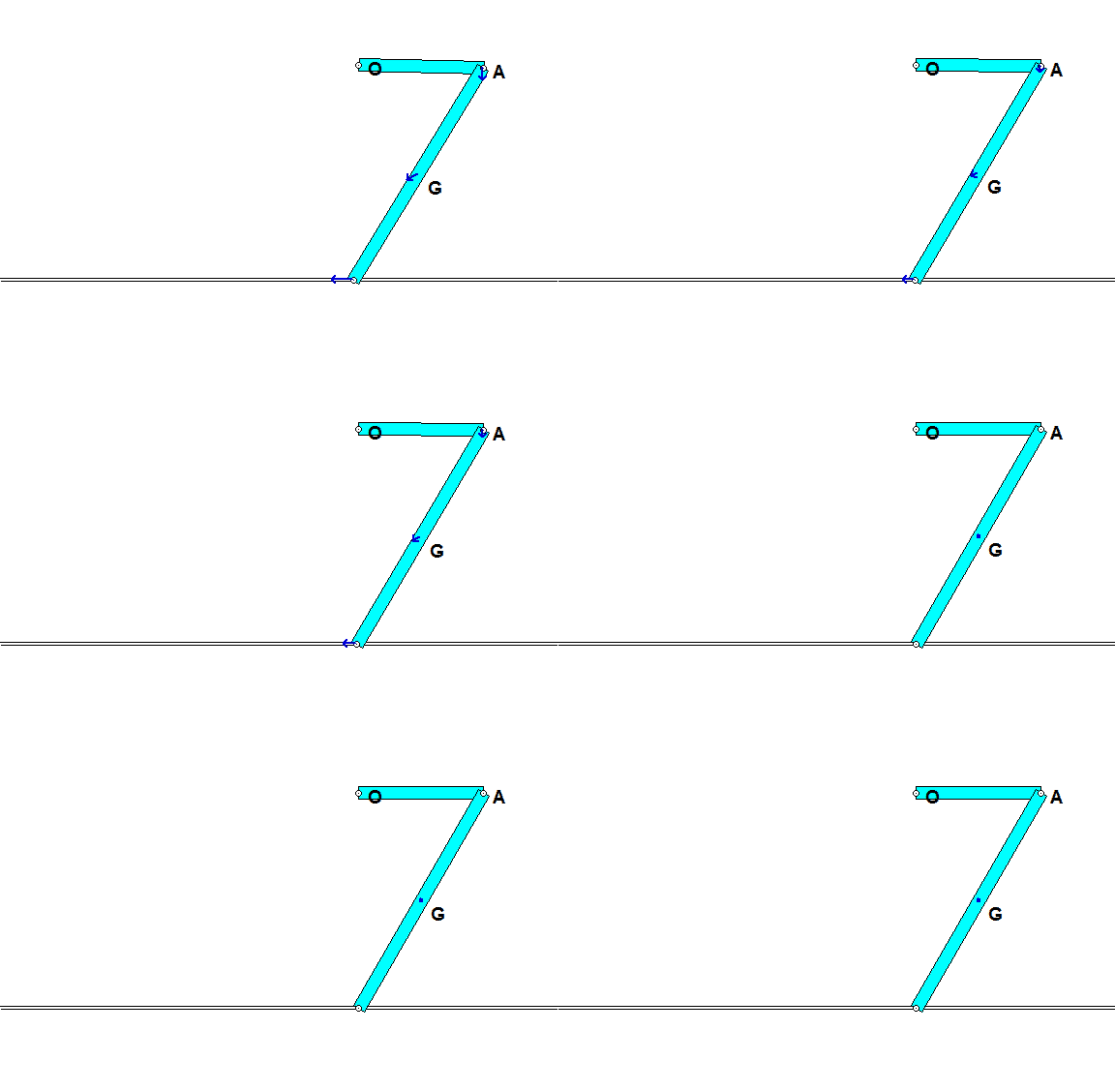
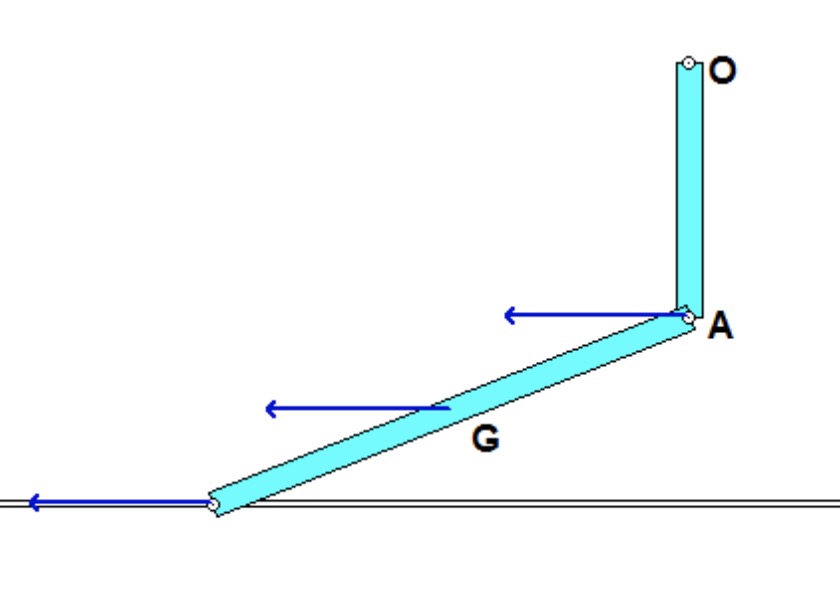
The paths of A and B are known: A travels on a straight path aligned with the inclined wall, and B travels on a circular path centered at O. Since the bar is released from rest, you know that the speeds of A and B are zero – therefore, the centripetal component of acceleration for each point is zero. This leaves the acceleration of points A and B tangent to their paths. (You can see this from the animation above for the instant when AB is horizontal.) It is recommended that you use two kinematics equations: one relating points A and B, and the other relating the center of mass G of the bar to either A or B.

Step 4: Solve
Solve your equations above for the tension in cable BO.


Any questions?

Homework H5.F – Fa 25

Problem statement
Solution video


https://youtu.be/1sYmvpvCopY


DISCUSSION THREAD

Discussion and hints:

Recall the following four-step plan outline in the lecture book and discussed in lecture:

Step 1: FBDs
Draw individual free body diagrams for bar OA and block B.

Step 2: Kinetics (Newton/Euler)
Write down the Newton/Euler equations for the block and the bar using your FBDs above. Take care in choosing the reference point for your moment equation for the bar. In order to use the “short form” of Euler’s equation, this point should be either a fixed point or the body’s center of mass. For this problem, you have a choice between using the center of mass of the bar or the pin joint O. Be reminded that if you use point O, you will need to use the parallel axis theorem when calculating the mass moment of inertia of the bar.

Step 3: Kinematics
Put some thought into the kinematics for this problem. This is the most complicated part of the solution. Importantly, the acceleration of A is NOT equal to the acceleration of B. Why? But then, how do you find the relationship between these two accelerations?

Step 4: Solve
Solve your equations above for the acceleration of block B.


Any questions?