| Problem statement Solution video |
DISCUSSION THREAD
Any questions? Ask/answer questions in the discussion thread below.
DISCUSSION
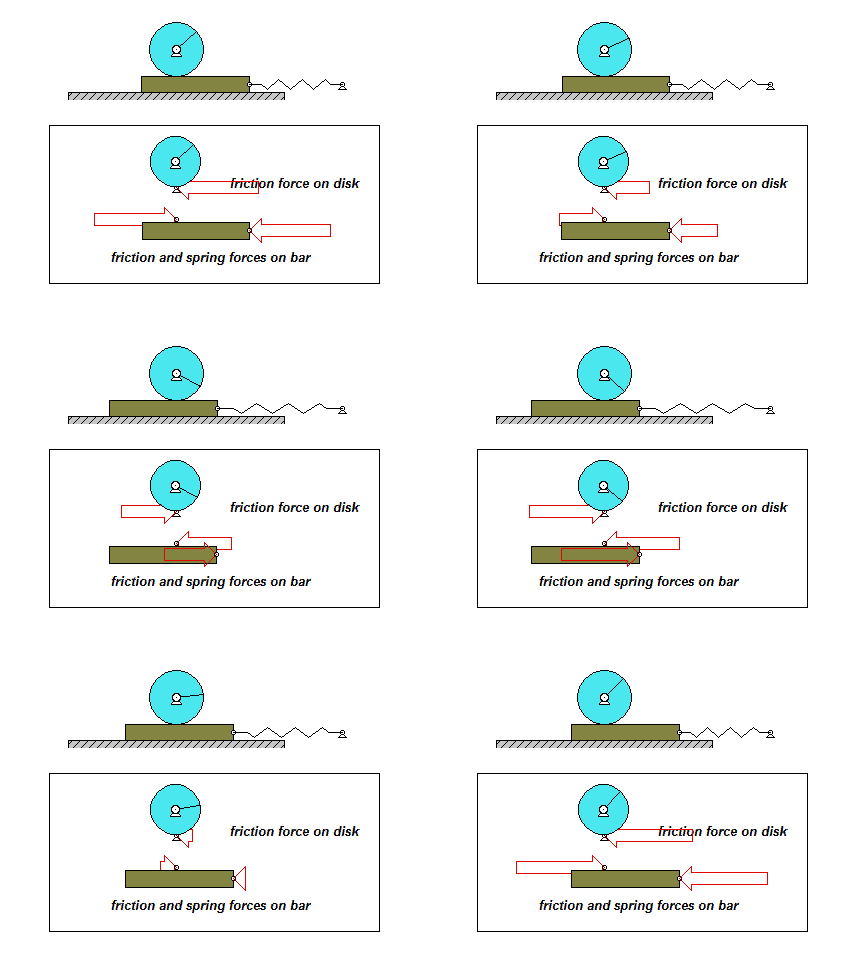
The animation below is for the case of c = 0 (undamped).
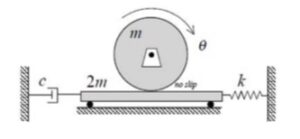
The derivation of the dynamical equation of motion (EOM) for a system is a straight-forward application of what we have learned from Chapter 5 in using the Newton-Euler equations. The goal in deriving the EOM is to end up with a single differential equation in terms of a single dependent variable that describes the motion of the system. Here in this problem, we want our EOM to be in terms of θ(t).
Recall the following four-step plan outline in the lecture book and discussed in lecture:
Step 1: FBDs
Draw individual free body diagrams for the drum and the block. Choose a translational coordinate (say x, defined as being positive to the left). Be sure the get the correct direction for the spring and dashpot forces on the block. Also, take care in drawing the friction force on the drum as being equal and opposite to the friction force on the block.
Step 2: Kinetics (Newton/Euler)
Write down the Newton/Euler equations for the drum and block based on your FBDs above. Be sure to be in consistent in your sign conventions for forces/translation and moments/rotation.
Step 3: Kinematics
The contact point of the drum on the block (call it point A) is a no-slip point; that is, the horizontal component of acceleration of A is equal to the acceleration of the block.
Step 4: EOM
Combine your Newton/Euler equations along with your kinematics to arrive at a single differential equation in terms of the dependent variable θ.
Can you clarify the correct no-slip kinematic relation between the drum rotation and the block translation, since that seems to be the key to forming the single EOM?
Im pretty sure its x=Rtheta
This equation depends on your definition of the position variable of “x”. If x is defined positive to the left, then your equation is correct. If x is defined positive to the right, then you need x = -R*theta. Getting the sign correct is important in arriving at the correct EOM in the end.
You can relate the velocity of the block to the velocity of the edge of the drum contacting the block because the block isn’t rotating at all. You can use instant centers to do this. This should give you your relationship between the block’s motion x and the drum’s rotation theta.
When drawing the FBDs, should the friction force at the drum-block contact be treated as the force that both drives the block motion and creates the torque on the drum, with equal magnitude and opposite directions on the two bodies?
I believe that is correct. That is how I approached the problem. Since the drum is pinned at its center, the friction force at the contact point is the only thing providing the torque to rotate the drum. On the block, the same force acts in the opposite direction opposing the spring and damper forces.
I think that when drawing the FBD, the drum block should be treated as a single interaction that appears on both bodies and opposite directions because I think that same tangential friction force is what accelerates the block in translation and produces torque. If that helps.
Do we consider the forces coming from the fixed point of the disk in the FBD or in the problem in general, or are we able to disregard these forces? (being Ox and Oy)
when i solved this problem, i included them in my newton eqs but didnt end up touching them at all.
Your FBD should include ALL forces acting externally on that FBD. It may occur that some forces will not appear in your dynamical equations. For example, if you take a moment about the pin at the center of the disk, the reaction forces on the disk at the pin will not appear.
Does the inclusion of the dashpot in this system change the natural frequency of oscillation, or does it only affect how quickly the vibrations decay over time?
Any damping force decreases the natural frequency of a system, and also impacts the decay of vibrations depending on whether the system is underdamped, overdamped, or critically damped. You might find this page interesting; https://www.structuralguide.com/natural-frequency-and-damping-ratio/
When setting up the free body diagram does it matter which way we assume friction acts?
it doesnt matter, as long as they are facing opposite directions in your individual FBD’s, and its accounted for in you newton.euler eqs
It depends based on which direction you assume the drum is rotating, which in turn indicates which direction the spring/dashpot forces act
I was stuck on the direction of friction, too, but I think as long as you’re consistent across the two FBDs, it works out fine. For example, if you assume the friction force f acts to the right on the drum to create a moment of M = f \cdot R, you have to make sure it’s acting to the left on the block. When you combine the Newton equation for the block and the Euler equation for the drum, that f term should just cancel out of the single EOM anyway.
If the drum is pinned at its center, does the no-slip condition still work the same way for the sliding block?
Even with the drum pinned, the no-slip condition means the block’s velocity must exactly match the tangential velocity of the drum’s surface v= r theta dot, effectively locking their motion together
In am to figure how to properly assign the signs to the various forces in these types problems, in order to keep all of the signs matching to keep the problem solvable. I keep ending up with mixed signs
If it is not given in the problem, I would suggest assuming most forces to be positive so that it is easier to interpret. If a value is positive then you know it is positive and vice versa, but if you assume a force to be negative and get a positive value, the force is actually in the negative direction, which can get confusing. I just found that to be helpful for me, hope that helps!
I would advise you to always start any FBD by first defining a positive direction of motion (if not already provided). Then you can imagine the motion actually ocurring in that direction to help you assign directions to the forces on the FBD, and then the signs. This will help reduce any potential mistakes with assigning directions to forces on the FBD. It’s fine if you think the direction of motion chosen may be opposite its true direction, as long as the FBD shows consistently how the forces would act on the body. Hope this is helpful.
When the problem says the drum is pinned to the ground, does that mean the problem is in a horizontal plane or should gravity be drawn on my FBDs?
Since the block rolls on a horizontal surface, the problem is in the vertical plane so gravitational forces should likely be included.
I think it just means no moment or reaction forces
Depending on which way is defined as positive x is important. As theta increases, the vector is actually in the -k direction, while the block moves to the left. I had right as +x and that was important because when i related theta and x at the end, my relation was inverse, with x = theta(r)
The choice of direction for positive “x” affects the steps in deriving the EOM in two different ways:
* The direction of positive x dictates the signs on forces when writing down Newton’s 2nd law; that is, if x is positive to the right, then forces pointing to the right are positive. And vice versa.
* The direction of positive x dictates the signs on the kinematic equations. If x is positive to the right, then x = -R*theta, and if x is positive to the left, then x = R*theta.
Since the drum and the moving block have no slip, it the horizontal acceleration just going to be X” = R * theta”?
yes, you would get this if u did the kinematic equation for a_c with respect to a_o
Again, the sign on this would depend on how you defined x.
How can you be sure that the friction force direction assumed in the FBD is consistent with the final direction of motion predicted by the equation?
If the direction of friction on the FBD is chosen opposite its actual direction, assuming no sign error is made, the value of friction should be negative, meaning that its true direction is opposite what was chosen. For all intents and purposes of this problem, however, the direction of friction does not affect the final EOM, given that the other FBD properly obeys Newton’s 3rd Law of motion. Friction is used in this problem to relate the drum and the block to each other. Hope this is helpful.
Keep in mind that over half of one cycle of motion the friction force will act to the right on the disk, and over the other half of the cycle friction will act to the left. The important thing for you to remember (as others have state here) is to make sure that the friction force acting on the disk is equal and OPPOSITE to the friction force on the block.
Should we consider gravity in our calculations? It’s not specified in the problem statement whether the system is in a horizontal plane or not.
The system is likely in a vertical plane. The FBDs should show the force due to gravity, but it will not be included Newton/Euler equations, at least if done via the usual approach. So the force due to gravity is not a part of the calculations. Hope this helps.
Since the drum center is fixed to the ground but the block is moving, how do I correctly relate the block’s linear displacement to the drum’s rotation??
The relation of x=Rtheta will work. Then you can take the time derivatives from there
Again, the sign on this equation will depend on what you choose for the sign convention for x.
Should there be multiple FBD’s for each position of the drum due to the changing spring force?
No need for multiple FBDs. If you consistently follow the sign conventions defined in your problem one FBD will suffice in deriving the EOM.
Making sure your friction forces are equal and opposite on the drum and block FBDs is key. If you set left as the positive direction for the block, the drum has to rotate clockwise. This makes your kinematics a simple x = R(theta), which easily plugs into the block’s horizontal force equation