| Problem statement Solution video |
DISCUSSION THREAD
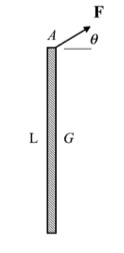
NOTE: The view of the figure provided is that of the rod as seen from above the surface on which the rod lies. Gravity is directed into the screen.
DISCUSSION
This is a straight-forward application of the Newton-Euler equations to a single rigid body moving in a plane. Consider the four-step plan:
1. FBD: Only a single force acting on the body in its plane of motion.
2. Newton/Euler: Use the two components of the Newton equations and one Euler equation for the rigid body:
∑Fx = … = m*aGx
∑Fy = … = m*aGy
∑MG = … = IG*α
3. Kinematics: None needed here.
4. Solve
Any questions?? Please ask/answer questions regarding this homework problem through the “Leave a Comment” link above.
On a frictionless surface, which components of the applied force contribute to translation vs rotation of the rod?
The component of F*cos(theta) makes contributions to both the translation and rotation of the body. The component of F*sin(theta) makes a contribution to only translation.
You will see this once you write down the three Newton/Euler equations of the body.
There will be no mg component in the Fy direction because it is viewed from the top. First, find the sum of forces, then use MG = I alpha to get the alpha value.