| Problem statement Solution video |
DISCUSSION THREAD
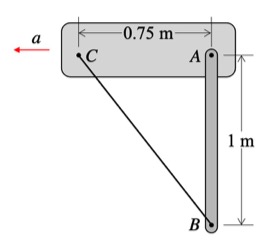
DISCUSSION
Using the four-step plan:
STEP 1: Free body diagram (FBD) – Draw an FBD of bar AB.
STEP 2: Kinetics – Write down the Newton/Euler equations for the bar based on your FBD above. For the “short form” of the Euler equation, please note that you are constrained to using a moment about the center of mass G since there are no fixed points on AB; that is, you should use ΣMG = IG α.
STEP 3: Kinematics – With the inextensible cable being taut, all points on the rigid body AB have the same acceleration, and the angular acceleration of AB is zero: α = 0.
STEP 4: Solve – Use the equations from STEPS 2 and 3 to solve for the tension in the cable and the reaction at on the bar at A.
Any questions?? Please ask/answer questions regarding this homework problem through the “Leave a Comment” link above.
When solving this, should we treat the bar as undergoing pure translation with the base, or do we need to consider rotation about point A when writing the equations of motion?
The problem statement says that the cable prevents rotation of the bar. Therefore, there is no rotation of the bar (alpha = 0).
If your question is in regard to which point that you should use for the moment (Euler) equation, then the answer is that you should NOT use point A. Point A is neither a fixed point nor the center of mass. Because of this, you cannot use the “short form” of Euler’s equation with point A. You may, however, with the center of mass of the bar.
When summing the forces for A in the j direction (if you establish j is vertical), should you account for gravity? The problem does not mention it but i take it that such an assumption is expected by this point in the course…
I assume this is the case since there is no mention of being in the horizontal plane
Either with or without weight is fine in your solution.
In the moment equation about A, why does the weight produce zero moment even though it acts downward on the bar?
There are couple ways to explain this, although they are all based on the same thing. Both are based on what you learned in ME 270.
One argument is to recall that the moment about a point A due to a force is the force times the “moment arm” of the force, where the moment arm is the perpendicular distance from the line of action of the force to point A. Since the line of action of the weight force passes through point A, the moment arm is zero, and therefore, the moment about A is zero.
Another argument is based on the definition of the moment about a point due to a force F:
M_A = r_G/A x F
For this problem, the weight force vector is parallel to the vector r_G/A. Since the cross product of two parallel vectors is zero, then the moment about A due to the weight is zero.
I have a question for you. You are asking here why the weight creates a zero moment about point A. How did you know that it created a zero moment in the first place?
Is the bar AB a two force member? If not, then how do we write the reaction forces at A for the bar? Is there one in the x and one in the y, and how do we orient the direction of those forces correctly?
In order for a body to be a two-force member, the body must either be in static equilibrium, or its mass must be negligible.
Yes, the reaction at A on the bar should be written in terms of its x- and y-components.
I believe you can write the reaction forces in x/y directions of your choosing and then the sign/orientation of these reaction forces will be solved for using second law analysis.
For the moment equation, it’s helpful to remember that because the bar is in pure translation, the sum of moments about the center of mass G must be zero
Since tension scales with the horizontal acceleration, is there a critical acceleration threshold where the vertical reaction at A becomes zero, or even reverses direction to point downwards?
” is there a critical acceleration threshold where the vertical reaction at A becomes zero?” That is the question being asked here.
“or even reverses direction to point downwards?” If the reaction force at A reverses direction (points downward on the crate), this means that the crate has tipped since there is no way for the floor to “pull down” on the crate.
Is it preferred to write forces T and Fa as vectors or as their magnitudes?
Either way is fine. Since forces are vectors, it is always better to write the force as a vector.
Should we still take moments about the center of mass even though alpha=0?
The general form of the Euler equation is:
sum M_A = I_A*alpha +m*(r_G/A x a_A)
Your question has to do with the choice of the reference point A.
If:
* A is the center of mass, or
* A is a fixed point, or
* the acceleration of A is parallel to r_G/A, then
the second term on the RHS of that equation drops out. That is typically our goal. None of these three conditions depend on the value of alpha. Therefore, make your decision on point A based on the above conditions and not based on alpha.
If alpha = 0, then the first term is also zero.
Does this help?
Hi, the link to the solution video does not work- it says the video is private. Is there another way to access the solution?
That is now fixed.