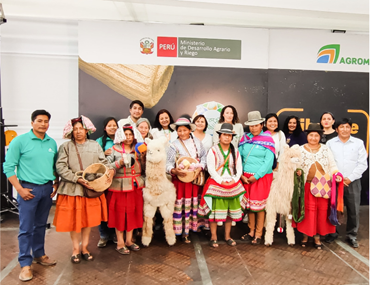
‘Camelids’ Project takes part in the Alpaca Fiber Business Roundtable
November 13, 2025
Alpaca producers in Peru face a range of challenges in raising their herds and marketing their fiber. Climate change is degrading pastures and threatening the survival of alpacas, while poverty and limited resources hinder producers’ livelihoods, herd management, and the fair compensation they received for raw fiber. To support these producers and create opportunities for direct connection with major buyers in the textile industry, Agromercado – an agency under the Ministry of Agrarian Development and Irrigation (MIDAGRI) – organized the Alpaca Fiber Business Roundtable on October 31 in Arequipa, Peru.
The event brough together 17 producer associations from six high Andean regions of Peru and four leading textile corporations – INCATOPS, Michell & Cía., CLAMASAC, and ALPROSER. A total of 3,265 quintals of alpaca fiber (approx. 150,190 kg) were offered, generating an estimated US$ 2.1 million in potential business across 68 documented meetings, 85% of which led to interest in follow-up negotiations. Producers from Puno, Cusco, Huancavelica, Pasco, Arequipa, and Apurimac successfully negotiated differentiated prices based on fiber type and quality, with certified lots –particularly RAS-certified fiber— earning premiums of up to 15% above standard market prices. These direct negotiations between producers and textile companies delivered tangible benefits for local communities: higher prices compared to intermediary sales, transparent weighing with digital scales, immediate payment upon delivery, and commitments for continued technical assistance, internships, laboratory analysis, and genetic improvement of communal herds. Additionally, the Roundtable advanced formalization and certification processes, strengthened the organizational and commercial capacities of producer associations, and integrated new zones – such as Cachipampa (Pasco)— into the formal alpaca fiber market.
The Nexus III project, ‘Integrating genomics, phenotyping, and nutrition strategies to enhance alpaca fiber quality and survival in the Peruvian highlands’ (known as Camelids), took part in the event though the participation of two co-investigators. In addition, seven students from the National University of San Agustin (UNSA) attended as observers, taking notes and supporting the program’s logistics and evaluation. For the Camelids project team, the event offered a valuable opportunity to observe the alpaca fiber value chain in action, identify barriers and leverage points for small-scale producers, and establish connections with key actors from both the public and private actors. The experience also highlighted the potential of replicating this rotating business roundtable model to strengthen fair, transparent, and competitive markets for high-Andean alpaca producers.
Contact Details
- Rosa Cossio
- rosaecossio@gmail.com
- 765-494-0721