Center on AI for Digital, Autonomous and Augmented Aviation
AIDA3 is a multidisciplinary consortium founded by Purdue University and Windracers, a leading cargo drone operator, with opportunities for additional partners dedicated to innovation. Together, we’re leveraging the research expertise of faculty and students from four colleges and a dedicated institute. Windracers, the developer and operator of the ULTRA unmanned aerial vehicle platform, provides extensive experience gained through parcel and humanitarian-aid delivery services across the United Kingdom.The AIrTonomy Vision
AIDA3 is building research infrastructure for a new field of science: Safe and trustworthy AI for aerial autonomy aka AIrTonomy. We invite scientists to join us as lead users of a new research infrastructure. Get involved now!
View AIrTonomy Report
Autonomous UAS Pylon Racing at PURT
This November and December, AIDA3 is co-hosting a challenge for collegiate teams to design, simulate, and flight-test fixed-wing UAS guidance, navigation, and control schemes for safe, fast pylon courses. The competition will be held inside PURT, the world’s largest indoor motion-capture facility.
Competition Details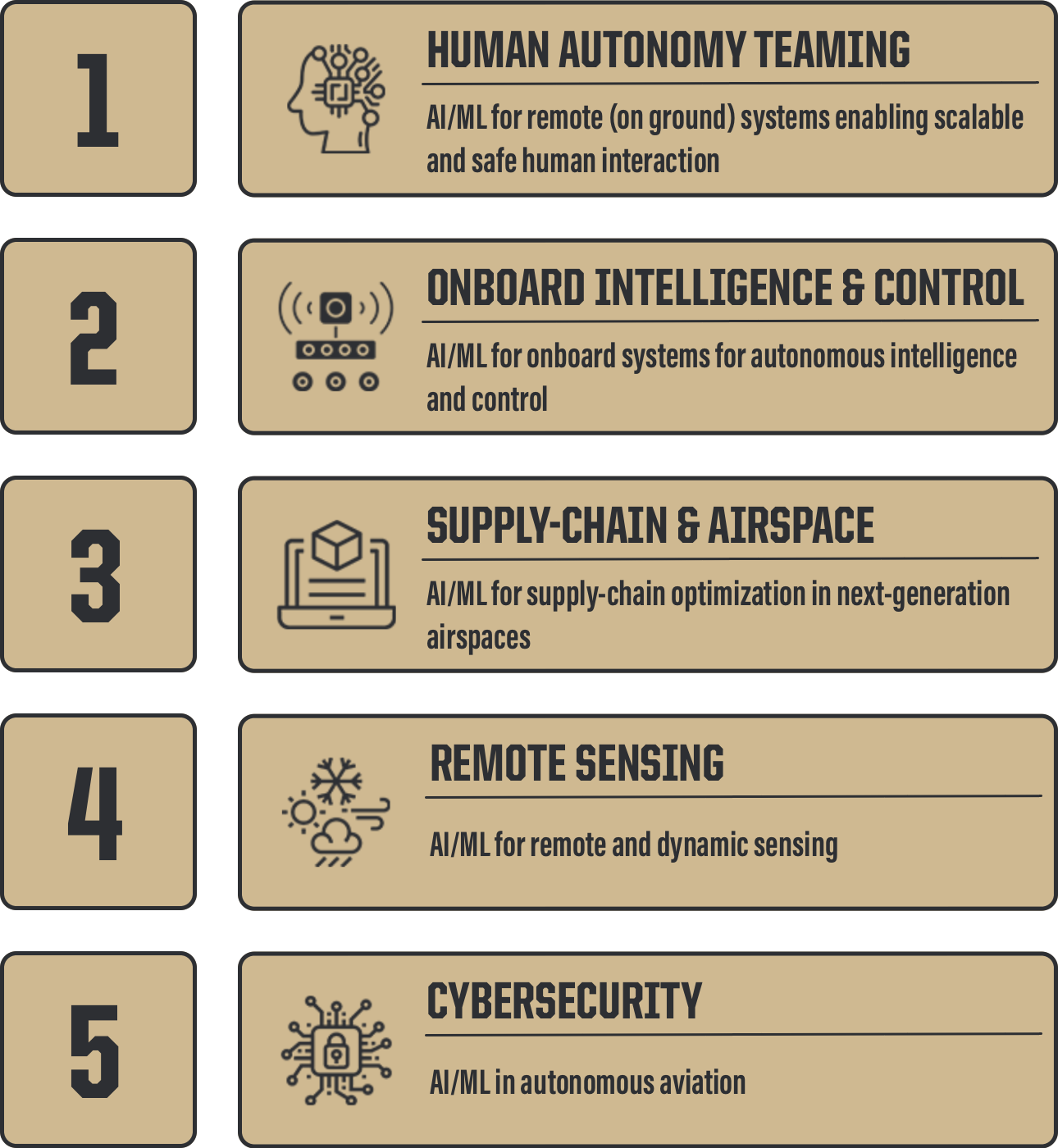
Our Research Pillars
In the pursuit of discoveries and solutions, research is organized in five pillars:
- Human Autonomy Teaming: AI/ML for remote (on ground) systems enabling scalable and safe human interaction
- Onboard Intelligence & Control: AI/ML for onboard systems for autonomous intelligence and control
- Supply-chain & Airspace Intelligence: AI/ML for supply-chain optimization in next-generation airspaces
- Remote Sensing: AI/ML for remote and dynamic sensing
- Cybersecurity: AI/ML in autonomous aviation
Testbeds and Fleet
Integrated with existing world-class facilities and envisioning new ones, the Purdue Unmanned aerial Proving Ground (PUP) has four components:
- Notably the world’s largest indoor motion-capture environment for UAS research, the Purdue UAV Research and Test Facility (PURT) enables algorithm development by capturing precise ground truth data.
- The Human Augmentation Center is being built for immersive, real-world remote operations and research. Tools like a gridded wall of screens and smart wearable devices will enhance interactions between operators and their managed AI systems.
- Envisioned as the world’s first and largest outdoor urban motion-capture space, the 12-acre Purdue Urban Canyon Lab (PUC) facility aims to enable real-time sensing with centimeter-level accuracy, which is critical for digital twin simulations.
- The Earhart Airfield, to be opened for operations in 2026, will consist of a 1,200-by-130-foot grass runway, with hangars and office onsite to operate our ULTRA vehicles for research purposes. The Earhart Airfield will be an FAA-registered UAV airport, and reported on airspace maps.
Researchers have access to AIDA3‘s fleet of two mid-scale, fixed-wing ULTRA platforms, named Earhart and Armstrong. These vehicles have a 31-foot wingspan, a 600-mile range and a 200-pound payload capacity. Researchers can equip these large drones with modular sensor stacks (e.g., GNSS, SAR, Cameras, LIDAR, Hyperspectral) to study remote sensing beyond visual line of sight.
STRATEGIC PARTNERSHIP MEMBERS
AIDA3 has a Strategic Partnership Program that encourages industry participation and feedback to our research. Through this program, the Center also stays up-to-date on current commercial technology and is able to pass this expertise on to our students. Partnership provides early access for industry partners to our research, technology, and our graduates. If you are interested in partnering with AIDA3, take a look at the online information or contact us directly.



TIER I
PARTNER
- Become a Partner!
TIER 3
PARTNER
- Become a Partner!