Employment Opportunities
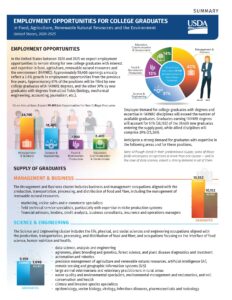
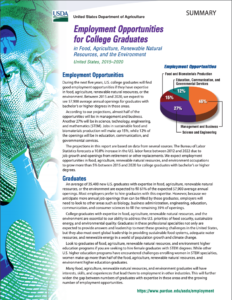
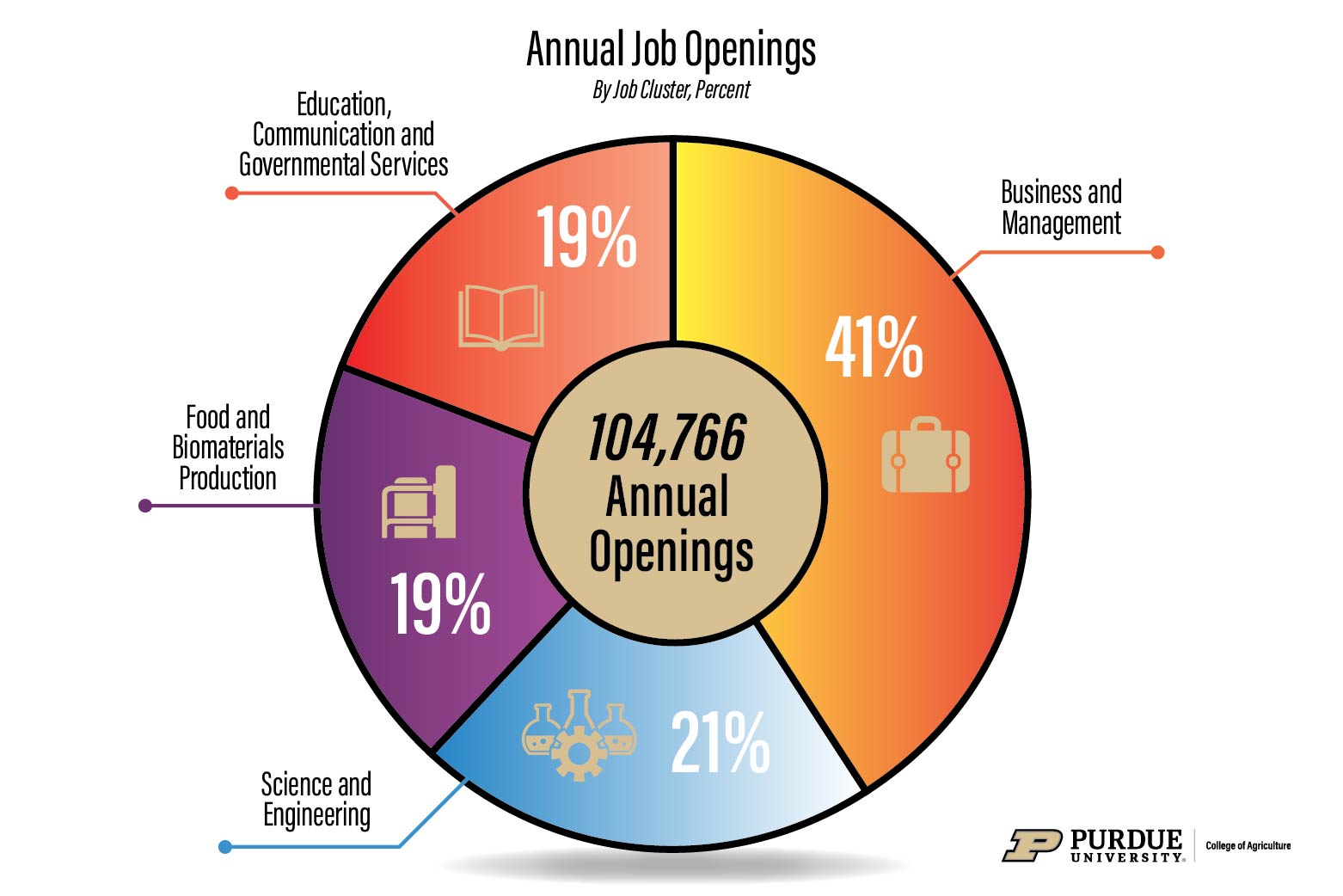
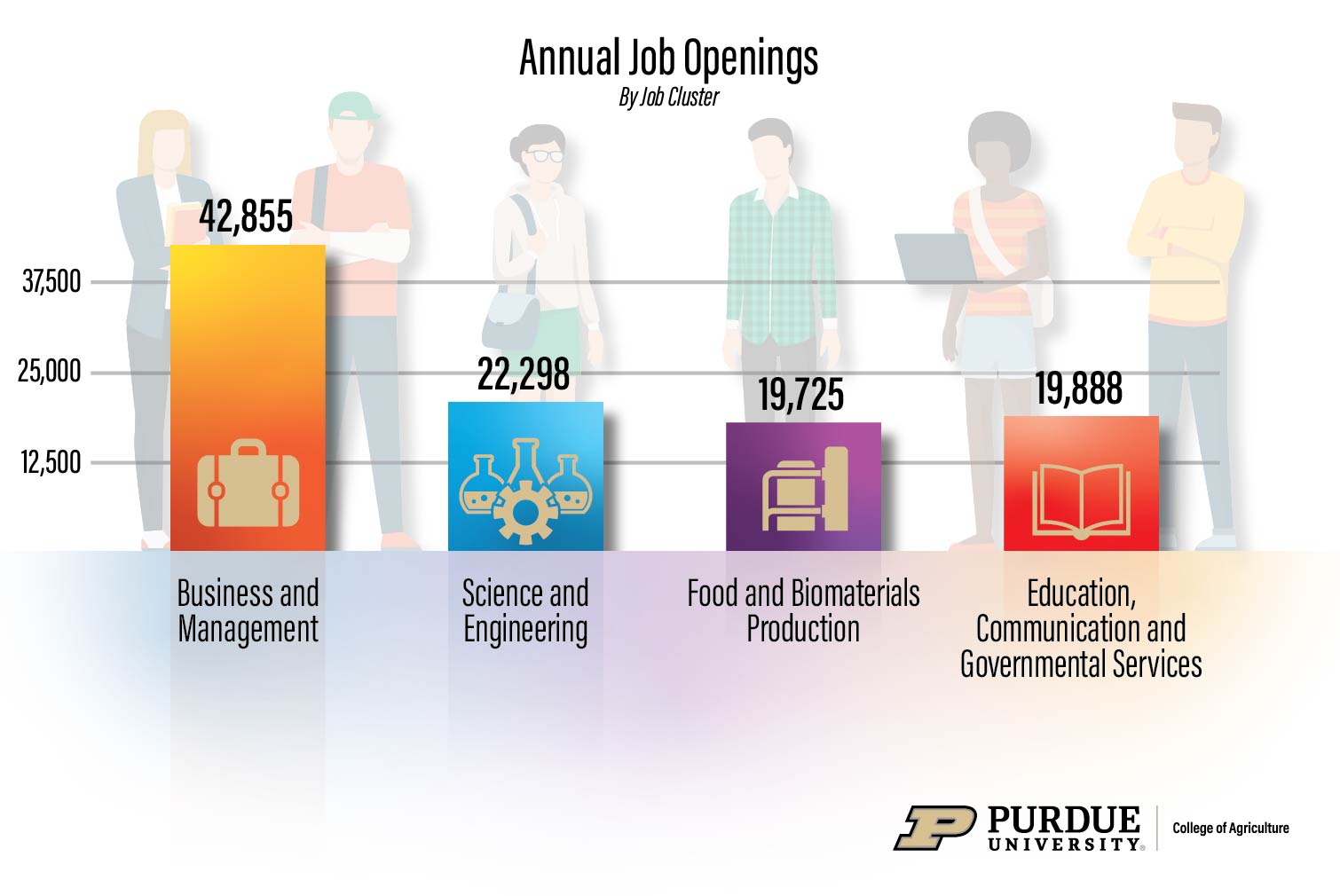
In the United States between 2025 and 2030 we expect employment opportunities to remain strong for new college graduates with interest and expertise in food, agriculture, renewable natural resources and the environment (FARNRE). Approximately 104,766 openings annually reflect an expanded and more rigorous methodology that combines Bureau of Labor Statistics (BLS) projections with large-scale job-posting data and includes associate degrees and some non-degree roles. About 90% of these openings are expected to prefer at least an associate degree.
On an Annual Basis, Expect 104,766 Job Opportunities for New College Graduates
Employer demand for graduates with FARNRE-aligned skills will exceed the number of available FARNRE majors. Of the 104,766 positions, graduates earning FARNRE degrees will account for 47.8% (50,057) of the annual supply, while allied disciplines will comprise 24.6% (25,802). To meet total demand, employers will draw on other graduates (27.6%, 28,907), including roughly 10% of total jobs filled by candidates without a degree.
Anticipate strong demand for graduates with expertise in the following areas and for these positions.
Supply of Graduates
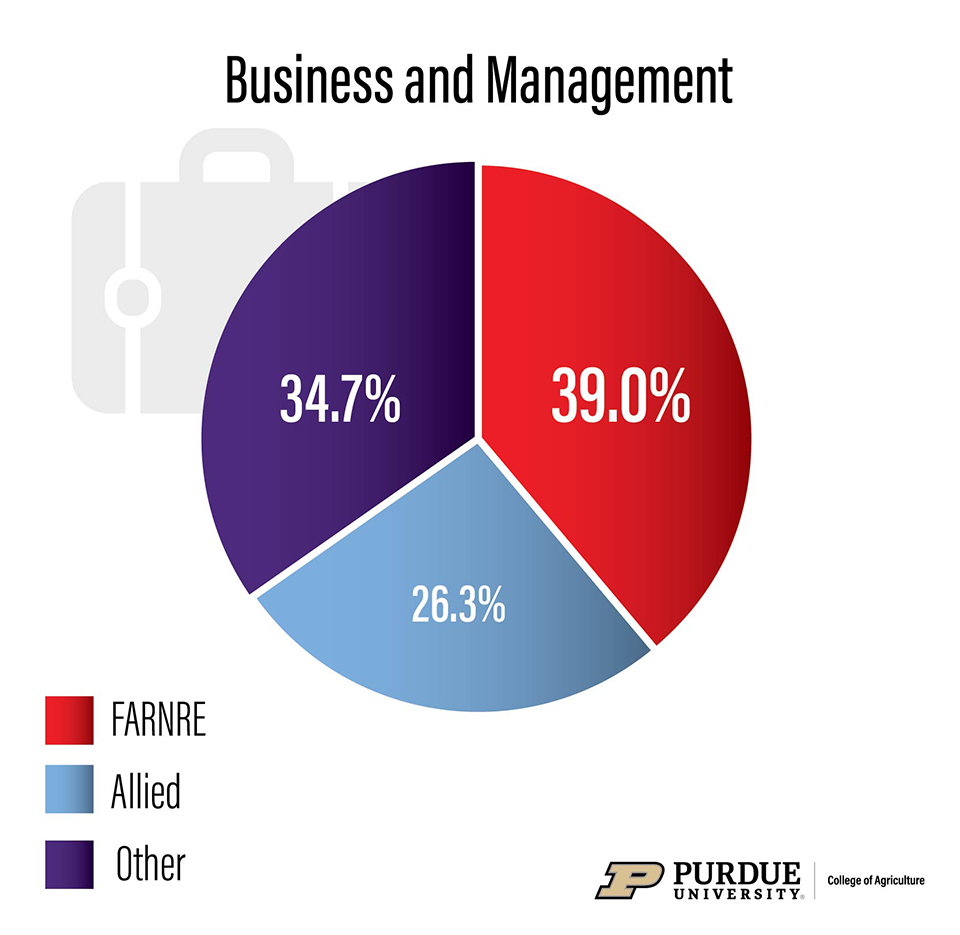
Business and Management
The Business and Management cluster includes business and management occupations throughout all stages of the food and agriculture value chain, from agricultural inputs and production to food wholesaling and distribution, including the management of renewable natural resources. It represents about 41% of openings.
- financial advisors, lenders, credit and risk analysts, insurance, and operations managers
- marketing, online sales, e-commerce, and CRM-driven performance marketing
- data and analytics skills for dashboards, KPIs, and forecasting
- technical sales and key account specialists, including integrated equipment-inputs-software solutions
- supply chain, procurement, and project or product management
- consulting and advisory services in transition planning, financial management, and strategy
Science and Engineering
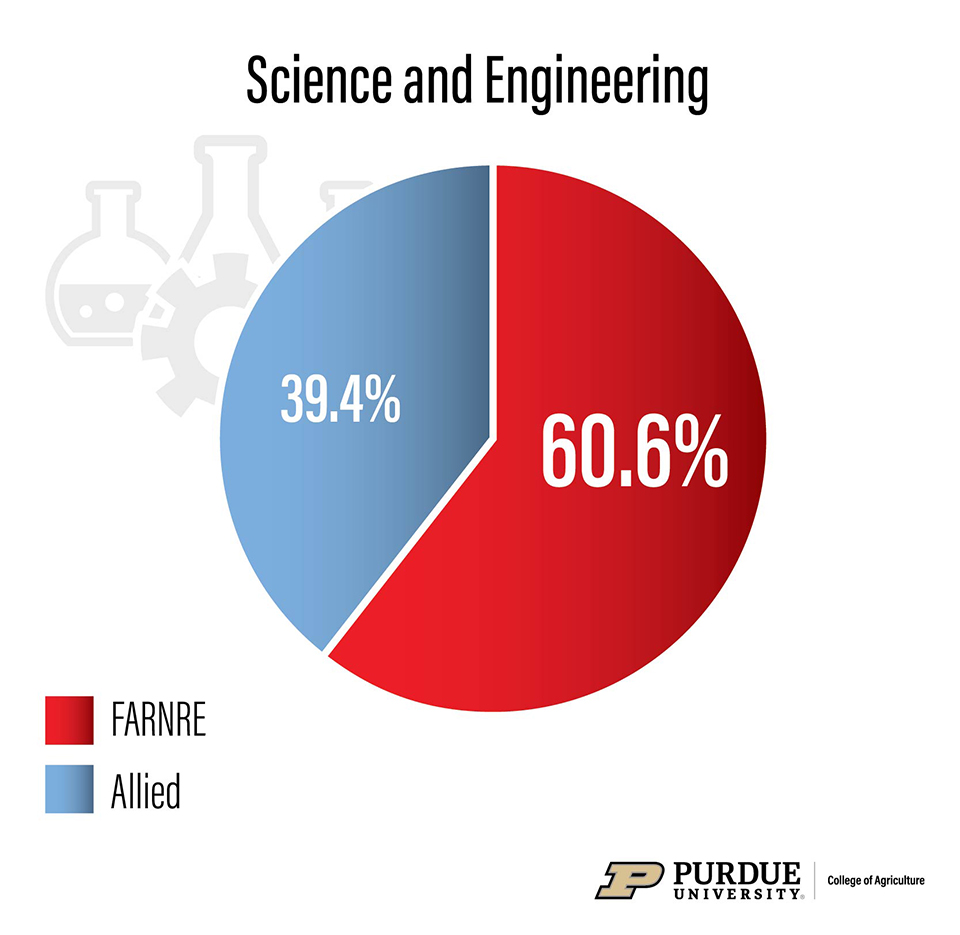
The Science and Engineering cluster includes the life, physical and social sciences and engineering occupations aligned with the production, transportation, processing and distribution of food and fiber, and roles at the interface of food science, human nutrition and health. It represents about 21% of openings.
- Agronomy, plant science, breeding/genetics and diagnostics
- Biological/agricultural/environmental engineers and computer-based systems technicians
- Food science and food process engineers
- Automation, robotics, precision management, AI and geospatial analytics
- Water and soil specialists
- Large-animal veterinarians and rural veterinary practice positions
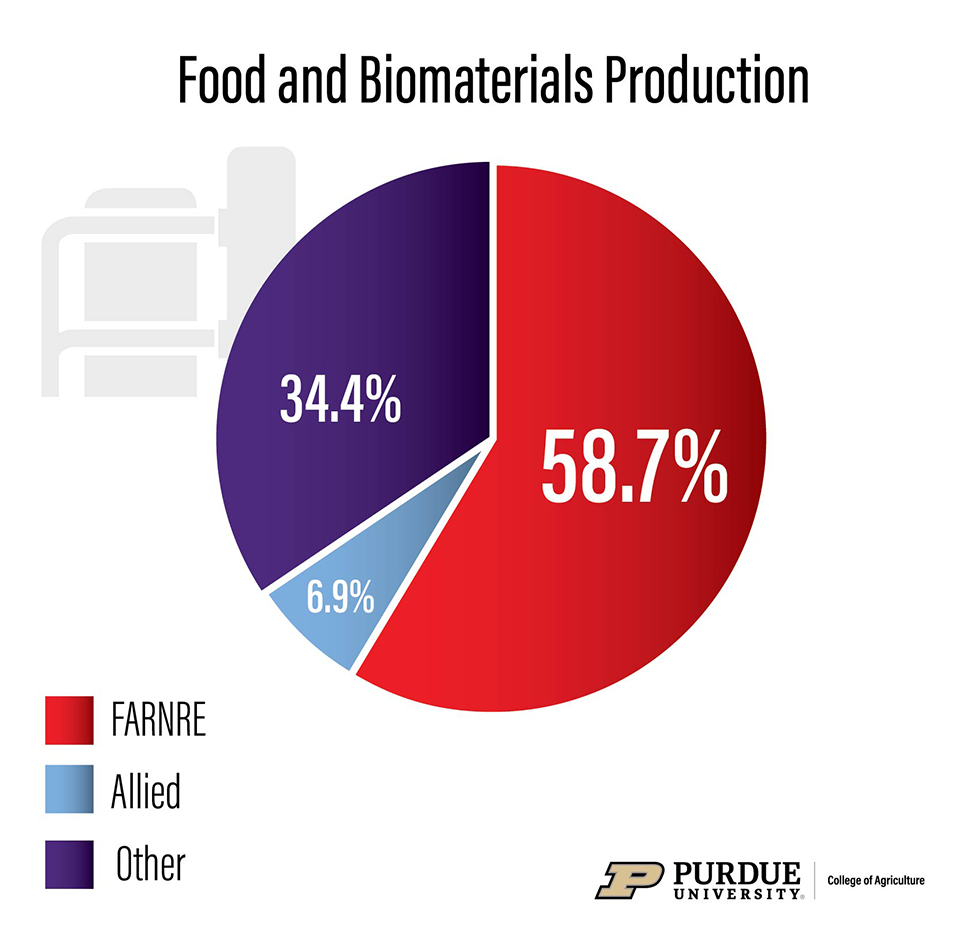
Food and Biomaterials Production
The Food and Biomaterials Production cluster includes occupations focused on production, operations, processing and logistics of commodities used as food or biomaterials, including forest production, renewable energy and environmental management. It represents about 19% of openings.
- Agronomists, horticulture specialists, crop consultants and pest management professionals
- Commercial livestock and poultry management in health, nutrition and welfare
- Biomaterials and bioenergy roles in feedstock logistics, conversion and sustainability
- Data-enabled production and on-farm analytics
Education, Communication and Governmental Services
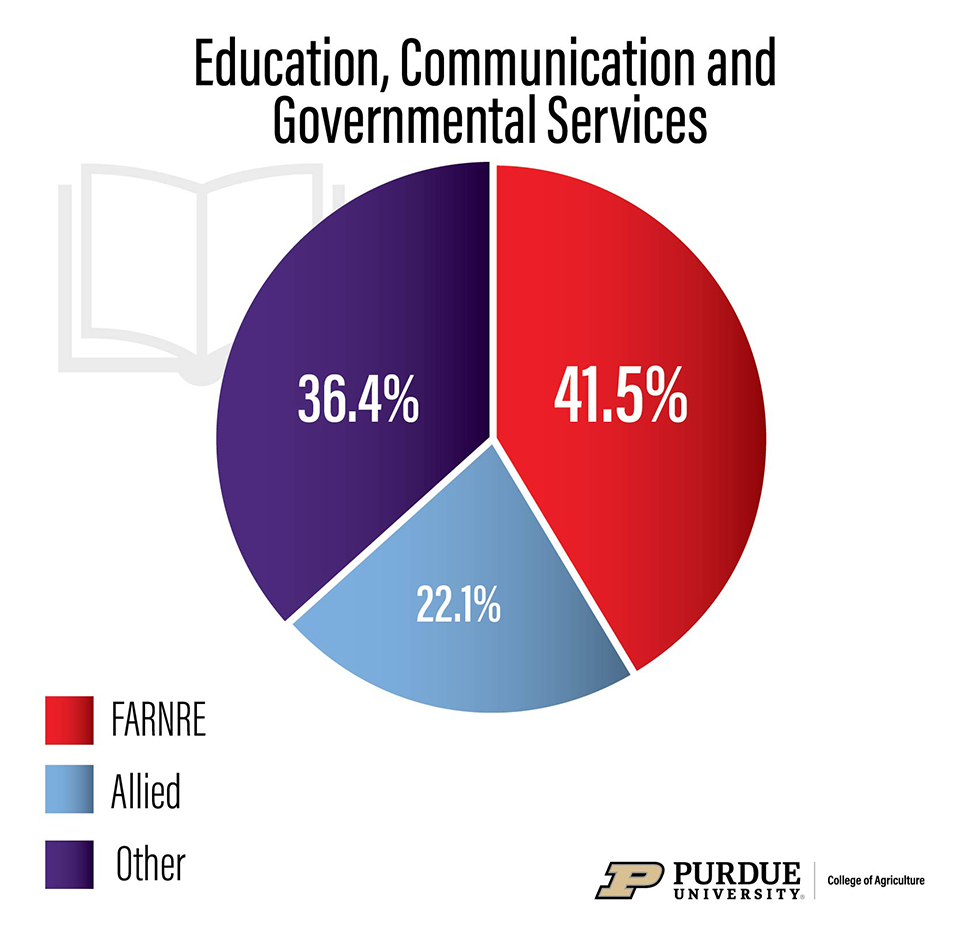
The Education, Communication and Governmental Services cluster includes educators, communicators and public relations specialists in the public and private sectors, with roles across local, state, national and international agencies. It represents about 19% of openings.
- Agriscience and natural resources teachers in high schools and middle schools
- Expect growth in specialized, fixed-term faculty with emphasis on externally funded, workforce-aligned programs
- Demand for agricultural and science communication roles remain healthy
- Data science and analytics skillsets are increasingly valued in agencies and NGOs for program evaluation
- FARNRE candidates who pair communication/policy with technical agriculture expertise/experience will be especially competitive.
Demographics
Given the complex environmental, social and economic issues directly impacting agriculture, food, renewable natural resources and the environment, the U.S. needs a cadre of FARNRE professionals from across the country, drawing on rural, urban and suburban backgrounds, who are technically sound, globally competent and prepared for the work world.
- For more than a decade across most degree levels, more females than males have graduated in FARNRE fields, with women now also the majority among recent doctoral graduates.
- Some majors tend to attract a greater proportion of female students, including animal sciences, agricultural education, agricultural communication and veterinary medicine. DVM degrees are about 82% women.
- Other majors tend to attract more male students, including agricultural engineering, forestry, agronomy and crop science, although female enrollment is growing in those programs.
- Attainment of bachelor’s, master’s, and doctoral degrees by students from racial and ethnic minorities has steadily increased. International students account for a substantial share of FARNRE doctorates, while most associate and bachelor’s degrees are awarded to U.S. citizens.
Report Series
This report is the tenth in a series of five-year projections initiated by the U.S. Department of Agriculture in 1980. The current study updates methods to better reflect today’s market by incorporating job-posting analytics and the changing role of degrees in hiring. While the approach improves accuracy and expands scope, trend comparisons to earlier reports should be made with care. The project team concludes that the need for graduates and the availability of employment opportunities in FARNRE will remain steady and strong from 2025 through 2030.
For more details, go to: purdue.edu/usda/employment/
Advisory Panel of Experts
Antoine Alston, North Carolina A&T University, Paula Beecher, Clemson University, Cynda Clary, Oklahoma State University, Ann DeLay, Cal Poly San Luis Obispo, Kathryn Doan, AgCareers.com, Penny Diebel, Oregon State University, Keith Harris, USDA – NIFA, Adrian Leighton, Salish Kootenai College, Stephanie Morriss, USDA – NIFA, Joe Sullivan, University of Maryland, Ryan Wildman, Lake Land College, Allen Wysocki, University of Florida. In addition, Tiffany Heng-Moss, University of Nebraska-Lincoln, and Wendy Fink, APLU
Authors
Christine A. Wilson, Purdue University, Jay T. Akridge, Purdue University, Brady E. Brewer, Kansas State University, Stephanie S. Martin, Purdue University, Joshua L. Strine, Purdue University