About President Mung Chiang
Mung Chiang became Purdue University’s 13th president on January 1, 2023.
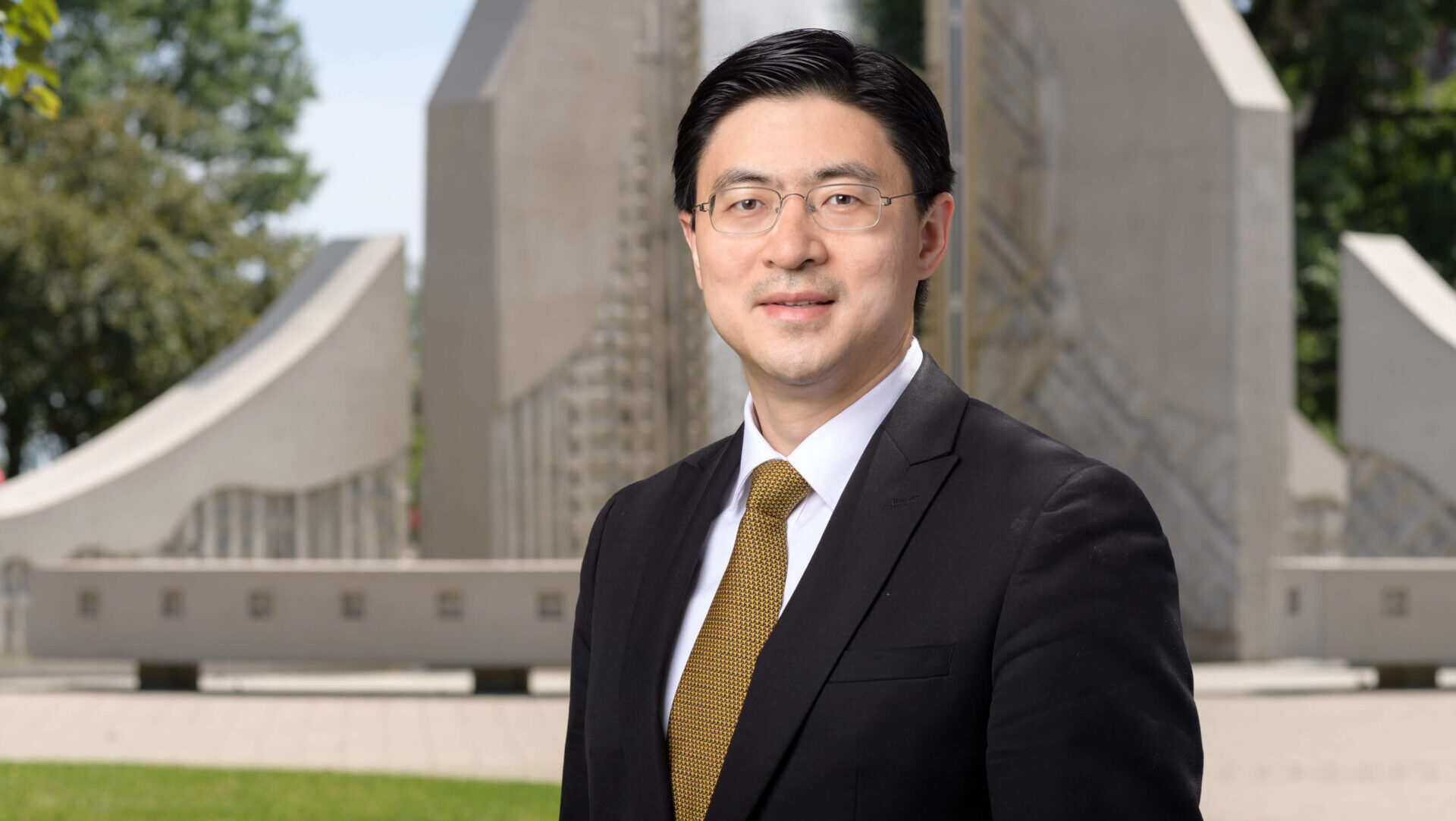
Mung Chiang served as the 13th president of Purdue University from January 2023 to June 2026 and was the Roscoe H. George Distinguished Professor of Electrical and Computer Engineering since 2017. Prior to being elected president in June 2022, he was the John A. Edwardson Dean of the College of Engineering and executive vice president for strategic initiatives at Purdue.
From 2022-26, Purdue not only remained sturdy in a turbulent period for higher education in the country, but also reached many milestones of excellence at scale, with 58,000 students on its main campus and the largest enrollment in each category: undergraduate, graduate and online. Attaining a record graduation rate and admissions selectivity, Purdue also reached $1 billion in annual research expenditures for the first time, received the largest government research grant at the university and the largest industry grant in the country, and co-launched the Crossroads Academic Medical Institute. Purdue had its best fund-raising year and the national record number of gifts in a 24-hour period, received the largest single gift to the university, and launched and exceeded the timeline of the $4 billion “Victories and Heroes” campaign. Purdue achieved its highest and top four national rankings in engineering, agriculture, online programs, patents received, media visibility, free speech and campus safety. In 2025 Purdue became the first major university implementing an AI competency graduation requirement and announced the first university operation in suborbital space. The Boilermaker men’s basketball team had its winningest four-year span in program history and competed in the 2024 national championship game. Under Chiang’s leadership, Purdue launched four strategic pillars for student and faculty excellence: its first urban campus (in Indianapolis), the Daniels School of Business, Purdue Computes and One Health. The university invested $1.5 billion in 27 construction or major renovation projects while freezing tuition and growing the endowment to new records. Purdue also contributed to attracting tens of billions of dollars in investments in AI tech stack, medicine manufacturing and modern transportation along the Hard Tech Corridor bookended by Purdue’s Indianapolis and West Lafayette locations, and to the buildout of Discovery Park District at Purdue, the Amelia Earhart commercial terminal at Purdue University Airport and three hospitals in West Lafayette.
Chiang received his bachelor’s degree (1999), master’s degree (2000) and PhD (2003) from Stanford University and an honorary doctorate in science (2024) from Dartmouth College. Before 2017, Chiang was the Arthur LeGrand Doty Professor of Electrical Engineering and an affiliated faculty member in computer science and in applied and computational mathematics at Princeton University.
He founded the Princeton EDGE Lab in 2009 and co-founded several startup companies and industry consortia since the early years of edge computing. Most of his 26 U.S. patents are licensed for network deployment. He co-authored two textbooks based on his massive open online courses: “Networked Life” (2012) and “Power of Networks” (2016). For his research in communication networks, wireless technology and network optimization, he received the National Science Foundation Alan T. Waterman Award (2013), as well as the Institute of Electrical and Electronics Engineers (IEEE) Founders Medal (2025), the IEEE INFOCOM Achievement Award (2022), the IEEE Kiyo Tomiyasu Award (2012), a Presidential Early Career Award in Science and Engineering (2008) and a Guggenheim Fellowship (2014). He was elected to the National Academy of Engineering and the American Academy of Arts and Sciences, as well as the National Academy of Inventors and the Royal Swedish Academy of Engineering Sciences.
In 2020, as the science and technology advisor to the U.S. Secretary of State, he initiated tech diplomacy programs in the U.S. government. In 2024 he was appointed by the secretary of energy to the inaugural board of the congressionally chartered U.S. Foundation for Energy Security and Innovation, which he subsequently chaired, and was elected to the board of directors of the U.S. Olympic and Paralympic Committee.
Connect With President Chiang