In Print: ‘Introduction to Density Functional Theory’
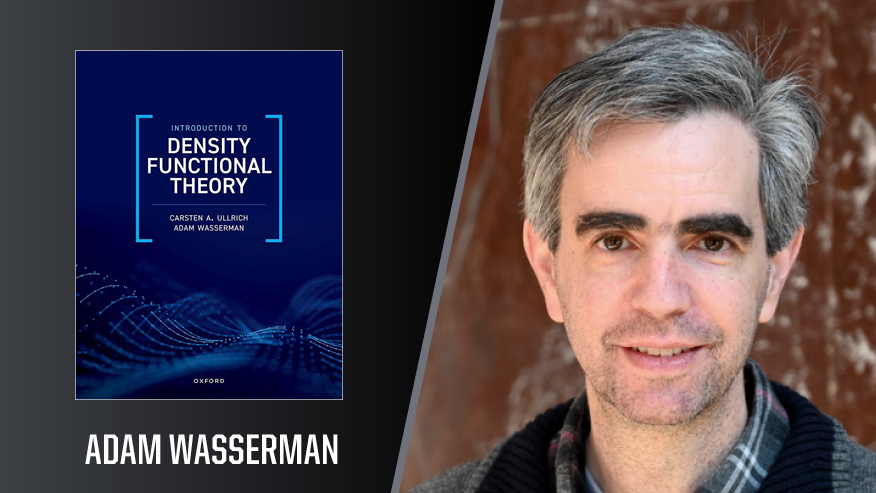
Adam Wasserman, professor of physical and theoretical chemistry, and his book “Introduction to Density Functional Theory.”
Publication title
Introduction to Density Functional Theory
Purdue author
Additional author
Carsten Ullrich
Publisher
Oxford University Press
Publication date
November 2026
About the book (from the publisher)
Density functional theory (DFT) is a quantum mechanical framework in which the ground state of interacting electronic systems is completely described in terms of the electron density. This leads to a practical approach for electronic structure calculations that is very widely used in (bio)chemistry, physics and materials science due to its reasonable computational cost and useful accuracy. This textbook presents the basic concepts and features of DFT at an introductory level, suitable for undergraduate and beginning graduate students in science and engineering.
Beginning with a brief review of elementary quantum mechanics, the book then introduces essential concepts such as many-body wave functions, orbitals, Slater determinants, functionals and the variational principle. The fundamental theorems of DFT of Hohenberg and Kohn and Kohn and Sham are formulated and explained, followed by a case study of a one-dimensional model system to illustrate the self-consistent numerical solution of the Kohn-Sham equation. To use DFT in practice, the exchange-correlation energy functional must be approximated: The most important and widely used approximations are reviewed, including the local-density approximation, generalized gradient approximations and hybrid functionals, explaining their origin and assessing their performance with many examples. Practical aspects of molecular and solid-state calculations, such as basis sets and pseudopotentials, are introduced, together with a brief review of chemical reactivity indices. The book ends with a chapter on time-dependent DFT, discussing real-time electron dynamics and excitation energies, and additional resources are provided in several appendices.
Written in an accessible and student-friendly style, the book covers the essentials of DFT and electronic structure calculations in a fully self-contained manner and without overburdening readers with formal and technical details. The book also contains many end-of-chapter exercises, including hands-on computer simulations using Python, as well as many suggestions for further reading.
About the Purdue author
Adam Wasserman is a professor of physical and theoretical chemistry in the James Tarpo Jr. and Margaret Tarpo Department of Chemistry. His research focuses on developing methods to calculate the electronic properties of molecules and understanding the role played by electron-electron interactions. Wasserman is a Purdue Faculty Scholar and also holds a courtesy appointment in the Department of Physics and Astronomy.
About the In Print series
To celebrate our faculty’s excellence in scholarship, Purdue Today’s weekly book series highlights faculty expertise across diverse subjects and disciplines. Find out more about the Purdue University Books Initiative and how to suggest a book for the In Print series on the Office of the Provost website. Purdue University’s Libraries and School of Information Studies’ authored books collection is available here.
In Print News

In Print: ‘Aquinas’s Ontology of Place: Local Motion, Space, and Spatial Location’
October 29, 2026

In Print: ‘Advanced Air Mobility: Human Factors, Ecosystem Readiness, and the Integration of eVTOLs’
October 26, 2026

In Print: ‘The Flight of the Purdue OWL: An Institutional History’
October 22, 2026

In Print: ‘A Guide to Key Theories for Strategic Management’
October 19, 2026