In Print: ‘Applying Local Climate Effects to Homicide Investigations’
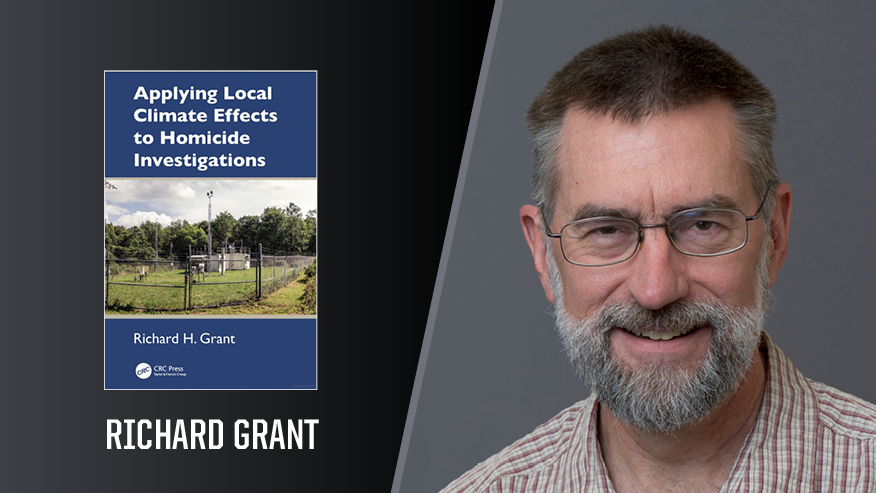
Richard Grant, professor emeritus of agronomy and agro-micrometeorology, and his published book “Applying Local Climate Effects to Homicide Investigations.”
Publication title
Applying Local Climate Effects to Homicide Investigations
Purdue author
Richard Grant
Publisher
Routledge
Publication date
February 13, 2025
About the book (from the publisher)
“Applying Local Climate Effects to Homicide Investigation” presents the concepts behind using local climate and weather records to enhance understanding of criminal cases. Sources of such local climate and weather information vary by country and region. Weather conditions are typically measured at airports or grassy areas as part of national, regional or statewide networks using many different instruments.
The information derived from such measurements is often used in conjunction with entomological or anthropological evidence to determine the time between death and discovery, called postmortem interval (PMI). However, determining the influence of small-scale climate differences in the environments where the measurements are made and where the body is found typically requires understanding factors making up the local climate. Most people recognize that cities are hotter than the surrounding countryside and that lake and coastal shorelines are cooler than fields, but there are many other local climates where bodies are found: valleys, forests, under or in buildings, near or in streams, inside vehicles, as well as many other environments. The local climate where a corpse is discovered usually differs from where temperature and humidity measurements are made. Consequently, many investigators and forensic pathologists do not realize the influence that such local temperatures and humidity can have on postmortem interval determinations.
The book focuses on local climate conditions associated with the determination of postmortem interval and gives concepts behind adjusting climate information for local climates at the corpse. In addition, the book will present guidelines for crime scene investigators and lawyers to determine whether or not expert consultation is needed and whether or not on-site measurements are needed. Most importantly, this book offers a basic working understanding of the influence of the local environment on the local climate for forensic entomologists, forensic anthropologists, crime scene investigators and lawyers. Numerous case studies are included throughout to show approaches, illustrate decision points and provide an understanding of the various impacts of regional and microclimates upon decedents and their remains.
About the Purdue author
Richard Grant is a professor emeritus of agronomy and agro-micrometeorology. Over the past 30 years, he did forensic climatology consulting in 10 homicide cases in the United States and Canada, as well as several non-homicide court cases, insurance claims and environmental compliance issues. While “Applying Local Climate Effects to Homicide Investigations” is his first book, Grant has authored over 170 articles and over 140 conference abstracts or proceedings addressing many aspects of local climates.
About the In Print series
To celebrate our faculty’s excellence in scholarship, Purdue Today’s weekly book series highlights faculty expertise across diverse subjects and disciplines. Find out more about the Purdue University Books Initiative and how to suggest a book for the In Print series on the Office of the Provost website.
In Print News

In Print: ‘The Right to Knowledge: A Learning-Systems Approach for the Sustainable Development Goals’
October 12, 2026

In Print: ‘Interiority in German Women’s Writing’
October 8, 2026

In Print: ‘Early Childhood Social Studies: Purpose, Content, and Methods From a Developmental Perspective’
October 5, 2026

In Print: ‘Case Studies in Ethics and Human Resource Development’
October 1, 2026