Purdue embraces bold experiment in rethinking STEM education
Cornerstone program is effective in holistic training for STEM, health science and business students
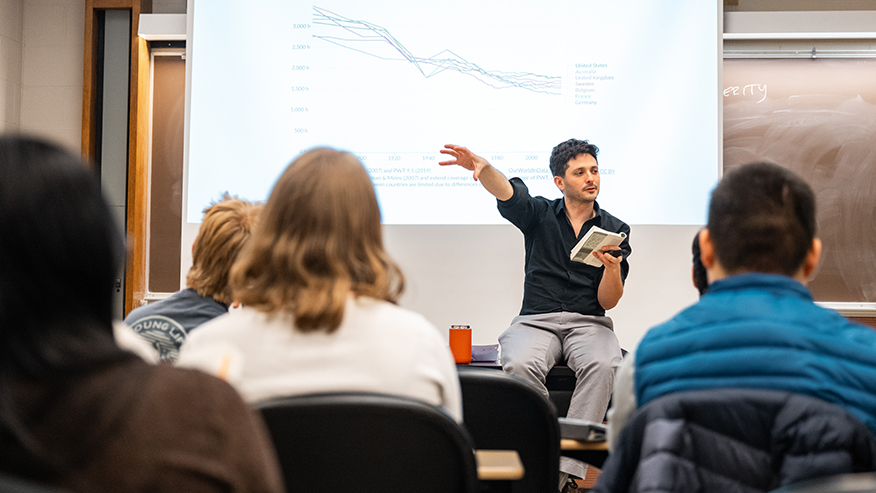
JP Messina, associate professor in Purdue University’s Department of Philosophy, guides students in a Cornerstone Integrated Liberal Arts course in a text-centered discussion on economic philosophy and morality. Purdue’s Cornerstone program is taught by full-time faculty from across the College of Liberal Arts. (Purdue University photo/Kelsey Lefever)
WEST LAFAYETTE, Ind. — Building on a decade of national recognition, Purdue University is expanding its Cornerstone Integrated Liberal Arts program in 2026 with new interdisciplinary initiatives focused on civic learning, research and engagement.
Cornerstone’s model — integrating liberal arts learning across Purdue’s STEM, health, agriculture and business fields — has already strengthened the critical and ethical capacities of thousands of career‑ready students.
“Over the past decade, the Cornerstone program has helped many Purdue graduates broaden their skill set for the workforce,” Purdue Provost Patrick Wolfe said. “The initiatives we’re launching in 2026 build on that legacy, ensuring our students enter the world not only technically prepared, but broadly equipped to shape it.”
By weaving liberal arts learning into science, technology, engineering, mathematics and business disciplines, Purdue is enhancing students’ capacity for critical analysis and ethical reasoning in ways that complement and elevate their technical expertise.
“Purdue recognizes that employers value graduates with engineering, science, health and business degrees who understand not only the ‘how’ and ‘what’ but the ‘why,’” said Christopher Yeomans, the Justin S. Morrill Dean of the College of Liberal Arts. “A strong liberal arts foundation through Cornerstone provides exactly these capabilities, transforming specialists into leaders who can think strategically and drive innovation in an increasingly interconnected world.”
Yeomans said Cornerstone has never been more critical, as industries, and society as a whole, grapple with questions about AI ethics, tech responsibility and public accountability — and their growing influence on daily life.
Cornerstone’s 15-credit certificate program focuses on providing students with the creative, critical thinking and communication skills needed to succeed as educated adults, citizens and employees.
“We know Purdue can provide its students with the knowledge to become amazing, intelligent STEM graduates,” says Melinda Zook, the Germaine Seelye Oesterle Professor of History and director of Cornerstone. “The goal with Cornerstone is to ensure we offer a well-rounded education that not only prepares students for professional success but also fosters ethical reflection and the ability to understand and engage with society.”
From idea to institution
The impetus for what would become Cornerstone emerged in 2015 from a vision for a versatile education that extended beyond the core requirements of any single major. Incoming students were encouraged to view their elective courses as opportunities to broaden their perspectives and to take at least one course in history, philosophy or literature as part of a balanced and adaptable Purdue education.
In 2020 Purdue’s Cornerstone program became the backbone for Cornerstone: Learning for Living, a grant program jointly supported by the National Endowment for the Humanities and the Teagle Foundation.
Through this grant program, Cornerstone has been replicated by more than 85 higher education institutions, ranging from community colleges to the country’s top universities, including Stanford and Vanderbilt.
Purdue enrollment has expanded from 100 students in 2017 to more than 10,000 — nearly 20% of total student enrollment at the main campus in West Lafayette and Indianapolis.
Citing Cornerstone’s commitment to excellence in undergraduate education, the Boyer 2030 Commission singled out the program in its 2030 Blueprint for Undergraduate Education at U.S. Research Universities. In 2024 the American Council of Trustees and Alumni named Cornerstone one of its Hidden Gem initiatives, an honor granted to programs for “the high caliber of their faculty, thoughtfully structured curricula, and commitment both to the challenges and rewards of liberal education.”
Last June, Purdue’s Cornerstone program, along with the Teagle Foundation, hosted a symposium on general education and the humanities at the University of Oxford. “Comparative Perspectives on Liberal Education in the U.S., U.K. and Europe in the 21st Century” sought to initiate an international discussion on the importance of integrating the values and skills of the humanities into the degree programs of all college students.
Key to Cornerstone’s design is preparing students for real-world success across majors and potential careers. After taking two core courses on transformative texts, students complete their certificate by selecting courses within one of five themes, such as science and technology or environment and sustainability. A student majoring in biomedical health sciences, for example, might complete their certificate by developing communication skills in Writing for the Health and Human Sciences or by applying their technological skills in Medical Devices and Innovation.
Boilermaker basketball star Trey Kaufman-Renn recently reflected on the impact Cornerstone courses and professors have had on his undergraduate experience as a philosophy major.
The Cornerstone for Business certificate has gained traction alongside the burgeoning Mitch Daniels School of Business, with its leadership citing Cornerstone as a factor in student success. Cornerstone offers a tailored sequence of transformative texts for all incoming Daniels School students, teaching communication skills through texts on political economy.
Cornerstone was also keenly involved in the inaugural Cornerstone for Business Conference in the spring of 2025. Building on that momentum, the Daniels School will convene the 2026 Cornerstone for Business Conference on Sept. 29-30. Timed to coincide with the 250th anniversary of our nation’s founding, this year’s program will explore the political, philosophical and historical foundations of freedom and capitalism. The annual conference brings together business leaders, policymakers, innovators, scholars and industry thinkers for two days of high‑impact learning, networking and collaboration.
Cornerstone bolsters Purdue’s other efforts, like Degree in 3, Degree Plus and 14 years of frozen tuition, to ensure today’s degrees are relevant, efficient and cost-effective.
“The value is not just an introduction to specific texts, though reading and writing is at the core of the program, but also in teaching students how to interpret and how to communicate so that they may learn from each other,” says Tulin Tosun, associate teaching professor and assistant director of Cornerstone in Indianapolis. “There are rarely right or wrong answers but instead strength in how well the students can relate their ideas to each other. And that’s a skill set valuable across all industries. Our classrooms not only foster interdisciplinary collaboration among students but also aim to cultivate social responsibility by preparing students to become active and informed citizens in an ever-evolving society.”
About Purdue University
Purdue University is a public research university leading with excellence at scale. Ranked among top 10 public universities in the United States, Purdue discovers, disseminates and deploys knowledge with a quality and at a scale second to none. More than 106,000 students study at Purdue across multiple campuses, locations and modalities, including more than 57,000 at our main campus locations in West Lafayette and Indianapolis. Committed to affordability and accessibility, Purdue’s main campus has frozen tuition 14 years in a row. See how Purdue never stops in the persistent pursuit of the next giant leap — including its integrated, comprehensive Indianapolis urban expansion; the Mitch Daniels School of Business; Purdue Computes; and the One Health initiative — at https://www.purdue.edu/president/strategic-initiatives.
Media contact: Wes Mills, wemills@purdue.edu
More Purdue News

Earhart expedition update: Weather prevents shore work for third straight day; crew to extend trip
October 16, 2026

Earhart expedition update: Weather prevents shore work Thursday; ID update expected in next 48 hours
October 15, 2026

Earhart expedition update: Underwater survey of Taraia Object begins
October 14, 2026
Earhart expedition update: Crew arrives onshore, sets up operations on Nikumaroro
October 13, 2026