Space systems degrees program meets the challenge of modern engineering
Space systems degrees program meets the challenge of modern engineering

Purdue students can keep reaching for the stars through the Comprehensive Space Engineering Degrees Program and two new additions: an online master’s degree in space systems engineering and a new space engineering undergraduate certificate. (Purdue University/Becky Robiños)
WEST LAFAYETTE, Ind. — Purdue University is standing at the forefront of expanding space exploration and a future economy with the creation of the first-ever Comprehensive Space Engineering Degrees Program in the country.
The program combines both a new online master’s degree in space systems engineering and a new space engineering undergraduate certificate to the established array of cutting-edge programs in the College of Engineering.
The Comprehensive Space Engineering Degrees Program is the latest learning opportunity at Purdue, reflecting a demand for aerospace engineers around the world. The School of Aeronautics and Astronautics continues to offer a variety of important specializations within the undergraduate and graduate degree programs.
“More than ever, Aeronautics and Astronautics is producing students with a firm grounding in how to engineer space systems,” said Bill Crossley, Purdue’s Uhrig and Vournas Head of Aeronautics and Astronautics. “This comprehensive program is tailored to the demands of engineering modern space systems, ensuring our graduates are equipped to tackle the more complex challenges of tomorrow.”
The program provides a solid a foundation for the next generation’s pioneering future in space as celebrated in this video.
Dan Dumbacher, professor of engineering practice in aeronautics and astronautics, said many of the necessary classes are already in place for the online master’s degree, with additional courses being put together to help students see how disciplines interrelate, including the human and economic aspects.
The degree offers new opportunities in engineering education that both students and industry see as important moving forward. The degree provides deeper immersion and proficiency in modern multifaceted engineering space systems, with returning graduates who are already active industry professions expected to make up many of the students.
“The space industry is in the middle of a transition with the latest advances from national security, civil space and commercial space perspectives,” Dumbacher said. “We hear people talking about making a business out of mining helium-3 on the moon and other ideas. That industry needs talented people who can understand the details and think systemically so they can build and safely operate the systems in space as we extend the human neighborhood beyond low earth orbit.”
Further bolstering Purdue’s aerospace program is a new space engineering undergraduate certificate. Steven Collicott, a professor of aeronautical and astronautical engineering, said the certificate is considered a supplemental program for undergraduates at the West Lafayette campus that demonstrates a Purdue student’s interest in space engineering while pursuing another major.
Collicott said he anticipates a large interest in the undergraduate certificate, with the interdisciplinary aspect helping answer the unrealized and ever-expanding needs of space flight beyond propulsion. Challenges continue to exist in areas ranging from biology and agronomy to biomedical engineering, psychology and more.
“The Comprehensive Space Engineering Degrees Program is unique in showing the strength of aerospace education at Purdue,” Collicott said. “The space engineering certificate and online master’s degree are integral parts of that program.”
Industry CEOs are praising Purdue’s bold initiative and expect the innovation and credentials to make real differences in rapidly building a skilled workforce for space. Here is a sampling of their comments:
- Tim Cahill, president of Lockheed Martin Missiles and Fire Control
“At Lockheed Martin, we are committed to cultivating the next generation of global aerospace and defense leaders. Purdue is taking bold steps to address the capabilities of industry and government that aligns academic innovation with real-world national security and technology challenges. As a Purdue alum, I’m proud of their work to prepare students for an increasingly complex and connected world. This program is a testament to Purdue University’s long history of comprehensive aerospace and defense education.”
- Kevin Bell, senior vice president, Engineering and Technology Group, The Aerospace Corporation
“At The Aerospace Corporation, we recognize that the future of space innovation depends on cultivating a highly skilled and cross-disciplinary workforce. Space degree programs are essential to prepare the next generation of engineers, scientists and leaders to shape the future of national security and civil space. We strongly support academic initiatives that align with the evolving needs of our industry and foster collaboration between education and the space enterprise.”
- Jeff Hanke, president of Space Systems, L3 Harris
“As the Trusted Disruptor in defense, L3Harris is committed to advancing national security through innovation. We proudly endorse Purdue University’s new Space Engineering programs, which will prepare the next generation of engineers to meet the rapidly evolving needs of the aerospace and defense industry. With our shared Indiana roots and the expansion of our Fort Wayne facility to support on-orbit technology for the Department of Defense, we are building a brighter future for both local talent and global defense capabilities.”
Purdue is the largest top five engineering college in the nation. The online master’s degree in space systems engineering and the space engineering undergraduate certificate will be accepting applications beginning in the fall semester. The certificate was approved by the Indiana Commission for Higher Education in the spring.
About Purdue University
Purdue University is a public research university leading with excellence at scale. Ranked among top 10 public universities in the United States, Purdue discovers, disseminates and deploys knowledge with a quality and at a scale second to none. More than 107,000 students study at Purdue across multiple campuses, locations and modalities, including more than 58,000 at our main campus in West Lafayette and Indianapolis. Committed to affordability and accessibility, Purdue’s main campus has frozen tuition 14 years in a row. See how Purdue never stops in the persistent pursuit of the next giant leap — including its comprehensive urban expansion, the Mitch Daniels School of Business, Purdue Computes and the One Health initiative — at https://www.purdue.edu/president/strategic-initiatives.
Media contact: Brian Huchel, bhuchel@purdue.edu
Research News
33 students capture competitive NSF research fellowships; 13 achieve honorable mentions
August 17, 2026
2 Purdue AI research projects selected among the first Genesis Mission awards
August 12, 2026
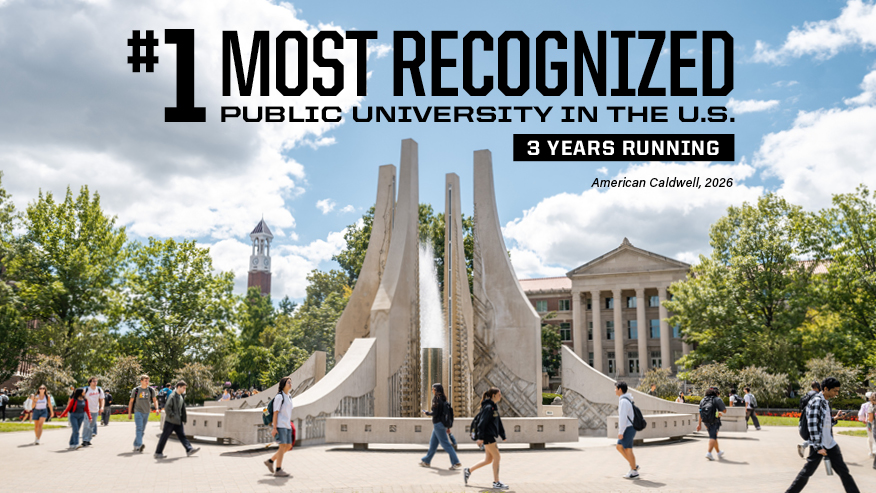
Purdue named most recognized public university in U.S., No. 4 overall in Global University Visibility rankings
August 10, 2026

Dinosaur-killing asteroid also created a dust cloud that insulated Earth, ‘charbroiling’ Cretaceous creatures
July 28, 2026