Purdue Global Law School alum’s perseverance leads to admission to Texas state bar
Nelson A. Locke earns Texas bar admission after Texas Supreme Court approval
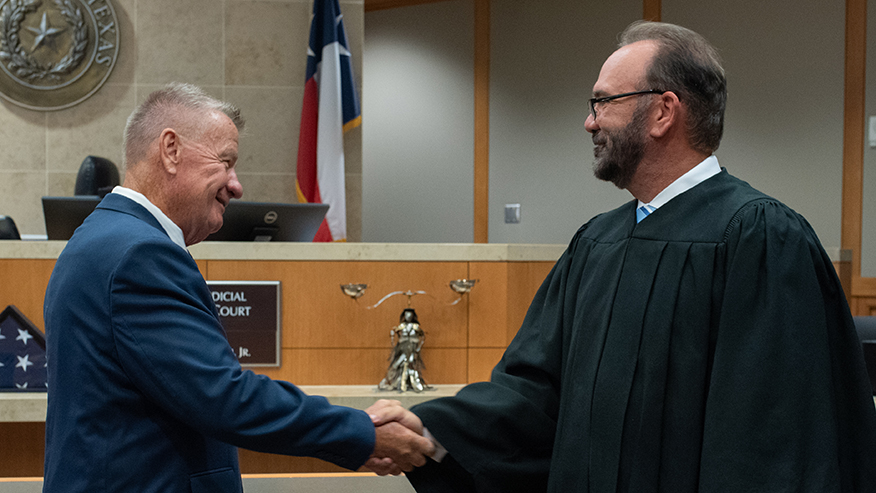
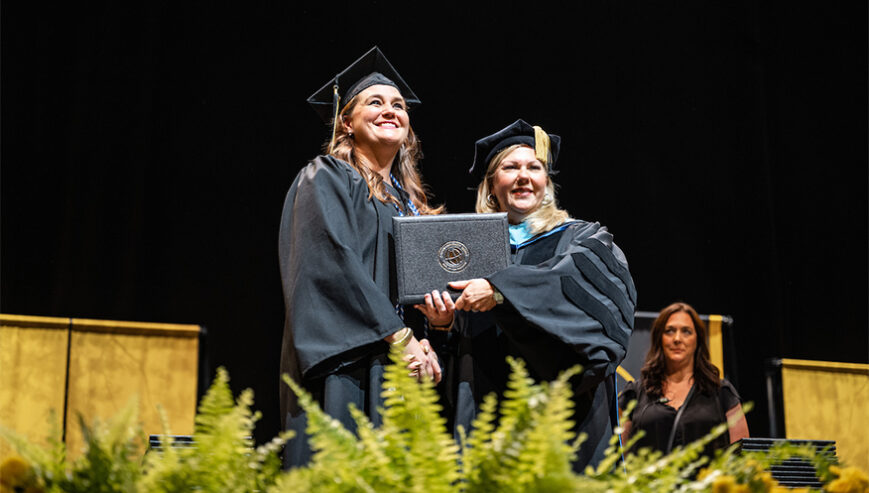
Nelson A. Locke shakes hands with Judge John Roach Jr. after being sworn in to the Texas state bar July 24 at the Collin County Courthouse. (Photo provided by Sherry Sutton)
WEST LAFAYETTE, Ind. — Nelson A. Locke’s admission to the Texas bar wasn’t just the culmination of a personal quest but a victory of persistence that could pay off for others. Locke was sworn in July 24 by Judge John Roach Jr. at the Collin County Courthouse in McKinney, Texas.
His odyssey may help pave the way for other nontraditional law school graduates to be admitted to practice in Texas.
“This ceremony marked the final step in a four-year journey to bar admission in Texas,” Locke said. “It confirmed the fact that the Texas Supreme Court found my legal training and performance acceptable. I am the result of the outstanding education I received at Purdue Global Law School. Now it’s on to the next challenge.”
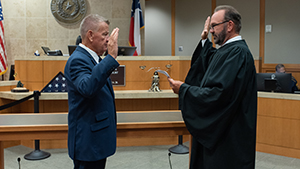
For Locke, of Plano, Texas, becoming a lawyer was not a career he anticipated pursuing for the first 50-plus years of his life. The U.S. Marine veteran and former retail executive was enjoying a successful career as a mortgage industry entrepreneur until he became frustrated by regulations he found confusing and unjustly applied, and he decided to go to law school.
The legal journey begins
In 2005, Locke enrolled part time in Purdue Global Law School (previously known as Concord Law School), the nation’s first fully online law school. Locke pursued his legal education diligently, often studying four to five hours a night while running his mortgage company full time.
He graduated in 2011 and, in 2013, passed the California bar exam and founded his law practice.

In 2014, Locke moved his family to Texas and built a thriving national law practice focused on federal mortgage compliance, with clients in 26 states. In 2021, Locke sought admission to the Texas bar by motion — a process typically available to attorneys who have practiced for at least five years in another jurisdiction.
However, the Texas Board of Law Examiners (TBLE) denied his application, citing their view that Texas’ rules prohibited admission of graduates of online law schools. The American Bar Association will allow a campus-based law school to offer an online program but will not yet allow a fully online law school to pursue ABA approval.
“The TBLE took the position that their decisions were final, that no appeals could be considered,” Locke said, describing the TBLE’s initial stance. “The TBLE believed that they operated without supervision by the Texas Supreme Court and could make decisions with no oversight.”
Undeterred, Locke embarked on a multiyear journey. In 2022 and 2023, he was again rejected by the TBLE twice — with the TBLE shifting its reasoning from an outright ban on online education to questioning whether Locke’s legal practice was exclusively federal due to his serving some California clients.
Perseverance pays off
The turning point came in early 2024 when Locke’s team petitioned the Texas Supreme Court, requesting an administrative review of the TBLE’s previous decisions and their interpretations of Texas’ bar admission rules. On May 6, 2025, the Texas Supreme Court issued an order ruling in Locke’s favor, finding that he should have been granted a waiver to be admitted notwithstanding having attended an online law school.
“This wasn’t just a win for me,” Locke said. “It’s a win for thousands of nontraditional students who chose online legal education — especially those who don’t have the time or resources to attend brick-and-mortar schools. This decision shows that merit and impact matter more than format.”
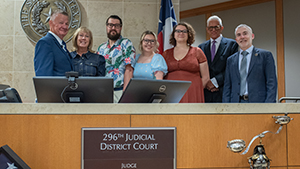
Martin Pritikin, dean and vice president of Purdue Global Law School, who was present for Locke’s swearing-in ceremony, said the significance of Locke’s victory is monumental.
“While Nelson’s admission doesn’t directly guarantee that other Purdue Global Law School alumni’s waiver requests would be granted, it is still important for several reasons,” Pritikin said. “First, it is a testament to the persistence of our graduates and what they can achieve when they don’t give up. Second, it serves as an inspiration for other alumni who are pursuing licensure opportunities in Texas and elsewhere.”
Pritikin said Locke’s advocacy and the detailed information provided about Purdue Global Law School will likely inform the Texas Supreme Court’s thinking as it considers moving away from relying exclusively on ABA approval as its criteria for eligibility for bar admission upon graduation.
Over the past two years, Indiana and Connecticut have updated their rules to allow Purdue Global Law School graduates opportunities to be eligible for the bar exam and bar admission upon graduation, Pritikin said.
Moving forward, Locke plans to continue expanding his legal practice, serving his 250-plus clients across the country. He also intends to advocate for other online law graduates facing similar hurdles in their pursuit of licensure, particularly as the Texas Supreme Court currently reviews the state’s bar admission rules.
“When I was in the Marines, they taught us to adapt, improvise and overcome, and I’ve done that in everything I’ve ever done, always fighting for the win,” Locke said.
About Purdue Global Law School
Purdue Global Law School is part of Purdue Global, the public, nonprofit, online school for working adults backed by Purdue University. Founded in 1998, Purdue Global Law School was the first to offer students a traditional law school program in an affordable, online format. For more information, please visit PurdueGlobalLawSchool.edu.
Media contact: Adam Bartels, adam.bartels@purdueglobal.edu
Note to journalists:
Video and photos of Nelson Locke’s Texas bar admission ceremony are available via Google Drive. All photos and videos courtesy of Sherry Sutton and distributed by Purdue Global.
Purdue Global News
Purdue Global Law School students shine, display legal knowledge during recent competition
January 7, 2026

Purdue Global honors faculty and staff with 2025 Distinction Awards
December 18, 2025
Gift of Knowledge benefit helps Purdue system employees take the next step in their careers
December 17, 2025

Relationships, collaborations are key drivers for Purdue Global leader’s success
November 25, 2025