Purdue Energetics Research Center aims to modernize manufacturing of energetic materials

An industrial mixer in action. Mixers are an integral component of the manufacturing process for energetic materials. (Adobe Stock image)
WEST LAFAYETTE, Ind. — The Purdue Energetics Research Center (PERC) has received approximately $7 million from the United States Department of Defense to modernize manufacturing processes for energetic materials — explosives, pyrotechnics and propellants. These new methods aim to support government and industry in scaling up production, reducing costs, and ensuring safety and quality of materials.
A team of researchers led by Stephen Beaudoin, director of PERC and professor in the Davidson School of Chemical Engineering, are partnering with Naval Surface Warfare Center Indian Head Division (NSWC IHD) on three interrelated projects involving developing processes and equipment for continuous-flow and semicontinuous manufacturing of energetic materials, meaning that production will run with no or minimal interruptions.
“Our current manufacturing landscape has evolved very little since World War II,” Beaudoin said. “Therefore, our goal is to transform the energetics manufacturing industry and develop safe, efficient processes that enable U.S. manufacturers to produce quality molecules at scale and that meet desired specifications.”
Beaudoin says energetic materials are currently manufactured using batch processing, where a specific quantity of materials is created during a single production run.
“Batch processing is often ideal for sensitive materials like energetics as they are safer to handle in smaller quantities,” Beaudoin said. “However, this type of manufacturing makes it difficult to increase production and control the quality of the materials as more manual intervention is needed throughout the entire process.”
Additionally, testing can only be performed at the end of the process, so by the time a defect is discovered, significant sensitive material gets wasted and then must be disposed of, creating environmental and safety issues.
These research efforts aim to update energetic manufacturing processes so that they are more in line with modern chemical manufacturing industries, such as pharmaceuticals. Continuous-flow and semicontinuous production methods offer significant advantages to the energetics industry. In addition to producing materials more quickly, these processes are cost-effective and incorporate real-time monitoring and control, preventing defects and ensuring consistent product quality. They also provide greater adaptability as many components can be swapped to manufacture different types of materials without extensive retooling.
The first of the three projects, funded through the Department of Defense (DOD), involves creating continuous-flow manufacturing techniques that produce energetic molecules more efficiently. The project involves reactor and reaction engineering, process control and optimization, and separation and purification. Researchers will design and build a chemical reactor to transform benign feed materials into desired energetic species. They then will develop and implement algorithms to ensure the reactor operates efficiently and maintains desired operational conditions. Finally, they will develop methods for isolating the desired energetic molecules from the reactor by-products to create a pure product. These three elements are in independent development by PERC and NSWC IHD researchers but will be integrated into a comprehensive process.
“We are excited to implement these processes in collaboration with our partners at Indian Head,” Beaudoin said. “They will scale up the optimized processes that we’ve developed, and our hope is that they will be integrated into a full-scale manufacturing effort.”
The second project focuses on improving the formulation process for energetics manufacturing by revamping how the materials are mixed. The current method involves mixing large batches of energetic powders using mechanical blades, which, according to Beaudoin, can be risky and time consuming.
“The mixers currently used for energetic materials are very similar to the kinds of mixers you might have on your kitchen counter, just much bigger,” Beaudoin said. “They often take hours to achieve the final product.”
Uneven or excessive mixing can also degrade the materials, Beaudoin said, altering their intended properties or causing them to become unstable.
Therefore, PERC researchers, through a second grant from the DOD, are exploring bladeless mixing driven by acoustics or inertial forces to execute the mixing process without any mechanical contact. They will implement this process through a train of mixers developed by Resodyn, and the complete mixing platform will be integrated with other manufacturing processes, such as the ones developed for the first project.
Finally, there are plans to develop an integrated manufacturing facility that will serve as a test bed for novel energetic material manufacturing techniques and processes. This facility will be designed with flexibility in mind by integrating various operations into a unified, adaptable process that can be reconfigured to produce different species of interest.
To achieve this flexibility, the facility will require advanced systems, including diverse mixing and separation methods, enhanced materials handling, robotics, and multiple reactor types. To optimize both individual processes and the entire system, parameters like temperature, pressure, throughput and mixing intensity will be monitored and controlled using advanced algorithms developed expressly for this system.
“This facility will be the culmination of all the work we’re doing to modernize energetics manufacturing,” Beaudoin said. “We’ll be able to test these processes and ensure they make the necessary materials safely and efficiently.”
About Purdue University
Purdue University is a public research university leading with excellence at scale. Ranked among top 10 public universities in the United States, Purdue discovers, disseminates and deploys knowledge with a quality and at a scale second to none. More than 107,000 students study at Purdue across multiple campuses, locations and modalities, including more than 58,000 at our main campus in West Lafayette and Indianapolis. Committed to affordability and accessibility, Purdue’s main campus has frozen tuition 14 years in a row. See how Purdue never stops in the persistent pursuit of the next giant leap — including its comprehensive urban expansion, the Mitch Daniels School of Business, Purdue Computes and the One Health initiative — at https://www.purdue.edu/president/strategic-initiatives.
Media contact: Brian Huchel, bhuchel@purdue.edu
National Security News
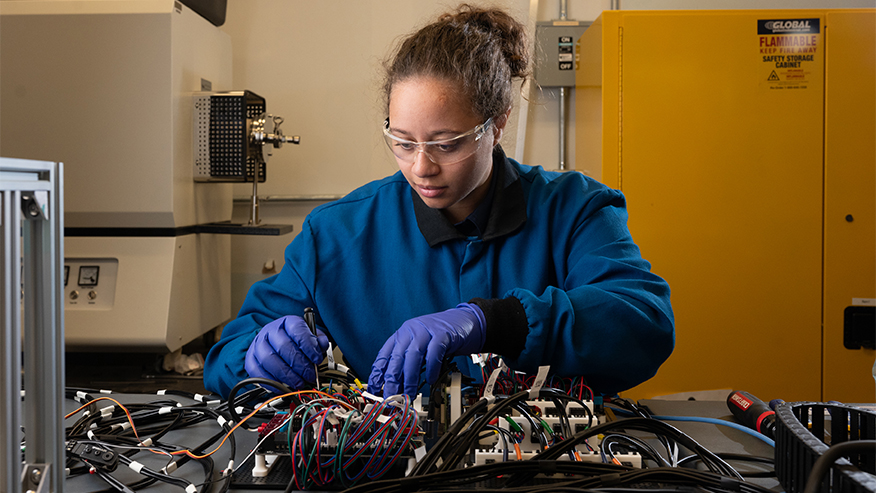
New 3D-printing and manufacturing techniques grant more control over energetic material behavior, improving safety
February 10, 2026

Purdue University launches new online Master of Science in strategy in security and defense technologies
December 16, 2025

Purdue, Oak Ridge National Laboratory sign MOU to collaborate on key national security research
December 2, 2025
Purdue’s student-led National Defense Society hosts special guests to talk national security
December 1, 2025