
Garlic drying
by Sophia Chiparus
Happy week seventeen!
I issue a warm Welcome back! to everyone, including me and many of the other interns. This week was Purdue’s fall break, so it has been a minute since I’ve set foot on the farm.
With how overwhelming the semester has been, a break was much needed. I spent some time in hilly & chilly Massachusetts, visiting one of my nearest and dearest friends. In a time of immense turmoil and important decision making (the senior year job search), it can be very grounding to spend time with someone who has known you for so long.
Because break was short and I didn’t need many clothes, I happened to have suitcase space. I stuffed several honey nut squashes into my luggage and brought them to my friend’s tiny dorm kitchen, where they were sliced and happily eaten. The Purdue student farm goes intranational!
You’ll be able to grab more of this squash for yourself tomorrow. Your bags will also contain garlic, the origins of which I expand upon in this interview with Dr. Bilenky:
Who are you and what is your relation to the student farm?
Moriah: I’m Moriah Bilenky, an assistant professor in the Horticulture and Landscape Architecture Department. I teach the small farm experience course which uses the student farm as the centerpiece, and I also conduct a bit of research out at the farm.
What kind of research are you doing, and what’s it centered on?
Moriah: At the student farm we’re primarily researching no till garlic production by examining the potential of cover crops. We’re figuring out if we can use cover crops as a weed barrier to reduce management such as hand weeding, as well as to replace mulches that are often used in garlic production.
So what does that look like?
Moriah: The specific cover crop that we’ve been investigating for a few years is sunn hemp. It is a summer cover crop, it likes the heat, but it’s also a legume, so it fixes nitrogen. There’s the potential of not needing as much fertilizer with this crop, which is one of our research questions. It can also be terminated with a roller crimper, a method that avoids herbicide use. Because of the production cycle of sun hemp, it aligns well with garlic’s growing season. This year we’re wondering if there’s a benefit to applying a tarp(stale seed bedding) right after roller crimping the sunn hemp. So, we’re looking at garlic yield, quality, and weed pressure. We also collect soil samples to see if the sunn hemp is in fact providing any release of nitrogen for the garlic.
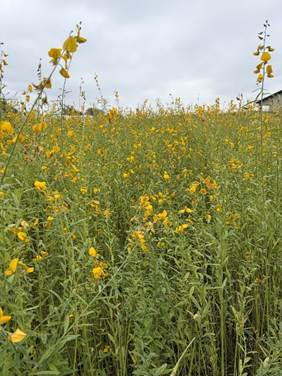
Sunn hemp
Why garlic specifically?
Moriah: One of the biggest reasons is that the student farm wanted to grow garlic for the CSA but haven’t had it in their rotation due to high seed costs. When I was looking at what research projects I could do that would also benefit the student farm, garlic stuck out.
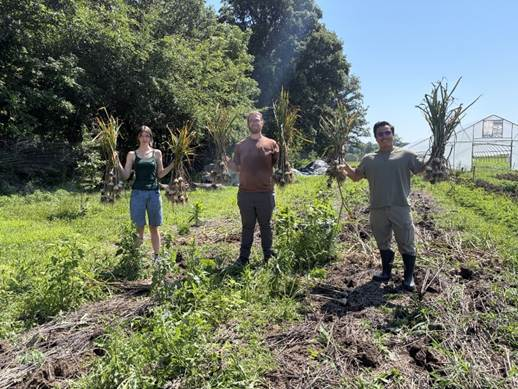
Garlic harvest!
What other research have you done?
Moriah: Our primary research interest has been in crop livestock integration, with our biggest question being: can we create more sustainable and resilient crop systems if we introduce livestock back into our systems? So that’s a question we’ve been looking into by looking at short term grazing of sheep in crop systems, as well as rotating pastured meat chickens to see if that’s something that works. A goal is to see if we can increase the amount of calories per square foot that comes off of a plot of land.

What is your favorite part of your job?
Moriah: I think its that I get to come up with ideas and think about how to solve the biggest challenges in agriculture and our food systems.
What is the toughest part of your job?
Moriah: On the flip side, it can be difficult to keep up the energy needed to continue to be creative and productive. It’s the fun part, but it’s also the challenge.
What do you like to do for fun?
Moriah: I keep a large garden at home where I like to grow lots of vegetables, hang out with my son, keep chickens, and cook.
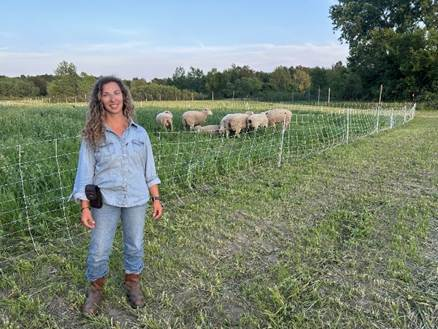
Dr. Bilenky with sheep
Any parting words, or pearls of wisdom?
Moriah: Always try to find the humor in things! And I have a joke to go with it:
What does a farmer do when her sheep are hurt?
She calls a lambulance.