New Purdue Health Sciences-created air sampler to protect human, animal and environmental health from airborne viruses, bacteria
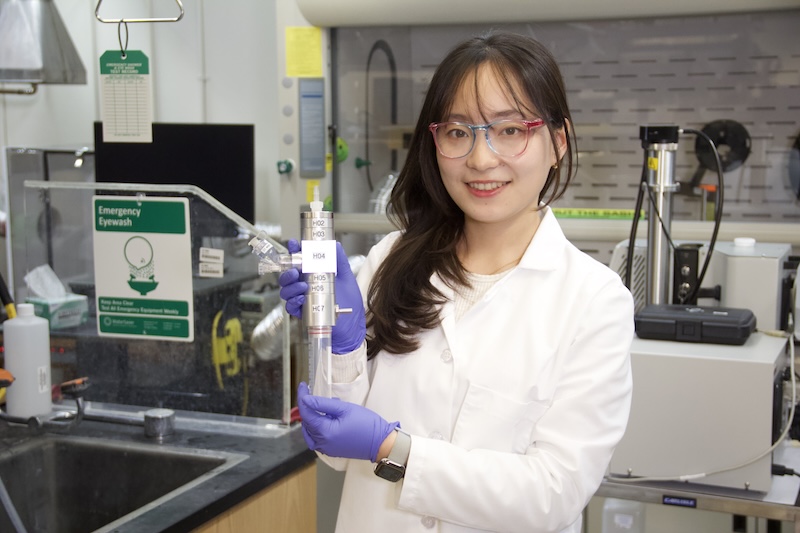
Subin Han, PhD candidate in the Purdue University School of Health Sciences, created a new air sampler design and prototype in associate professor Jae Hong Park’s Aerosol Research Lab. The new device is meant to capture airborne viruses and bacteria for later analysis.(Tim Brouk)
Written by: Tim Brouk, tbrouk@purdue.edu
Subin Han was one of the millions worldwide who contracted COVID-19. As she recovered in quarantine at her parents’ home in Seoul, South Korea, the young scholar wondered how people could better detect the threat of potentially deadly viruses. With classes moving online and daily life growing quieter, she questioned how such a virus could spread so quickly and whether its transmission might have been prevented.
These questions eventually led her to join a research lab studying disease transmission, where she was introduced to bioaerosols such as airborne bacteria and viruses that play key roles in infection spread. During her master’s program, Han continued studying airborne disease transmission through laboratory experiments, exploring how environmental particles influence microbial survival and spread. Those experiences deepened her interest in practical prevention strategies and this curiosity ultimately guided her toward the field of occupational and environmental health sciences.
Now, as a PhD candidate in the Purdue University School of Health Sciences, Han has developed a novel, patent-pending air sampler that utilizes an inertial impactor to collect harmful viruses and bacteria from the air. This device was designed and fabricated under the guidance of Health Sciences associate professor Jae Hong Park.

A closer look at the new air sampler, which has been named as a Wet Inertial Impactor.(Tim Brouk)
“My first target was COVID-19 for the proposal, but it’s mostly passed. So, my next target is influenza, avian flu or a new type of virus,” Han said. “We must prepare for the next pandemic.”
This project, a collaborative effort between Park’s lab and Lia Stanciu, professor of materials engineering at Purdue, was funded by a National Science Foundation grant of about $280,000 (Grant No. 2127756). A patent has also been filed for the device (Technology No. 2025-PARK-71048).
The innovation was disclosed to the Purdue Innovates Office of Technology Commercialization (OTC), which has applied for a patent to protect the intellectual property. Industry partners interested in developing or commercializing the innovation should contact OTC about track code 71048.
How it works
The sampler with the working name “Wet Inertial Impactor” is the latest in a line of equipment designed in Park’s Aerosol Research Lab.
Evaluation and control of airborne hazards are central to occupational and environmental health and are also vital to the One Health framework. Park’s lab has developed a range of innovative devices to advance these efforts. The lab’s work spans from improving respirators for welders to designing systems that help asthmatic horses breathe more easily, combining mechanical engineering expertise with a commitment to protecting respiratory health in humans and animals alike. While many of the lab’s inventions focus on exposure control, Han’s project emphasizes exposure assessment, representing a distinctive contribution to the lab’s research portfolio.
Han’s device is distinctive for its innovative use of water. Traditional inertial impactors required large pumps and more than 100 nozzles to maintain pressure to capture tiny particles containing viruses or bacteria. Han’s design achieves high-efficiency sampling with a simpler and smaller system. Han uses water in the device to prevent particle bounce, keeping collected particles on an impaction plate. The particles are then transported to a sampling tube, which improves sample viability for analysis.
“Tiny water droplets increase collection efficiency and improve sample viability, which makes analysis more accurate and convenient. You only need to analyze the liquid sample in the collection tube,” Han said.
During sampling, a nebulizer connected to the air sampler sprays a fine mist that transfers particles from the impaction plate into a plastic collection tube. The mist moves through several aluminum components and passes through 24 precision-drilled holes. Each hole is roughly the size of a grain of sand or the thickness of paper. The resulting liquid sample can then be analyzed using methods such as polymerase chain reaction, electrochemical sensing, or other microbiological or molecular techniques.

A look into a compartment of an air sampler as designed by Subin Han. The tiny, precise holes are required to separate viruses bacteria trapped in a water mist for eventual analysis.(Tim Brouk)
“We have to generate a high jet velocity to capture small particles, including tiny viruses and bacteria. That is why the impactor requires very small holes,” Han explained. “The holes also balance the pressure.”
Like previous devices hewn from Park’s lab, the device is portable and designed to be used anywhere indoors. Park and Han foresee it used in workplaces, health care facilities, schools — anywhere humans gather.
“This can be extended to a public health project,” Park explained. “This is for any kind of indoor-built environment.”
One Health possibilities
As Han sunsets the air sampler work, she and Park will soon be using their air sampling and bioaerosol expertise on a Purdue College of Agriculture project — “Characterization of Particulate Matter Including Bioaerosols in a Swine Farrowing Room.” Bioaerosols are Park’s specialty, as he has been studying the various particles we breathe in for years. He expanded his reach to animals, namely farm and ranch animals like pigs and horses. Ji-Qin Ni, professor of agriculture and biological engineering, and Brian Richert, associate professor of animal sciences, are leading this work. But Park and Han’s research will be key in helping Indiana swine maintain their health during the birthing process. This research is a part of Purdue’s presidential One Health initiative that involves research at the intersection of human, animal and plant health and well-being.
“We are focusing on the monitoring of and characterizing the particulate matter (PM), including bioaerosols and the general dust in the swine barn, to help develop the PM monitoring station,” Park revealed.
In this project, Han plans to use her Wet Inertial Impactor to collect any airborne viruses and bacteria.
“This is very important. Airborne viruses and bacteria can threaten not only humans but also plants, animals and ultimately the environment. My work in sampling these airborne pathogens not only helps protect human health but also safeguards agricultural products, including pigs, chickens and turkeys raised by swine and poultry farmers,” she explained.
Discover more from News | College of Health and Human Sciences
Subscribe to get the latest posts sent to your email.