Category Archives: Chapter 1 Homework

Homework H3.A – Fa 25

Problem statement
Solution video


DISCUSSION THREAD

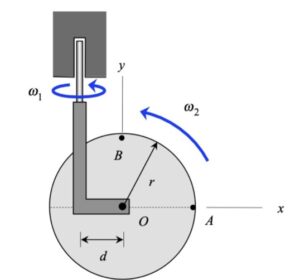
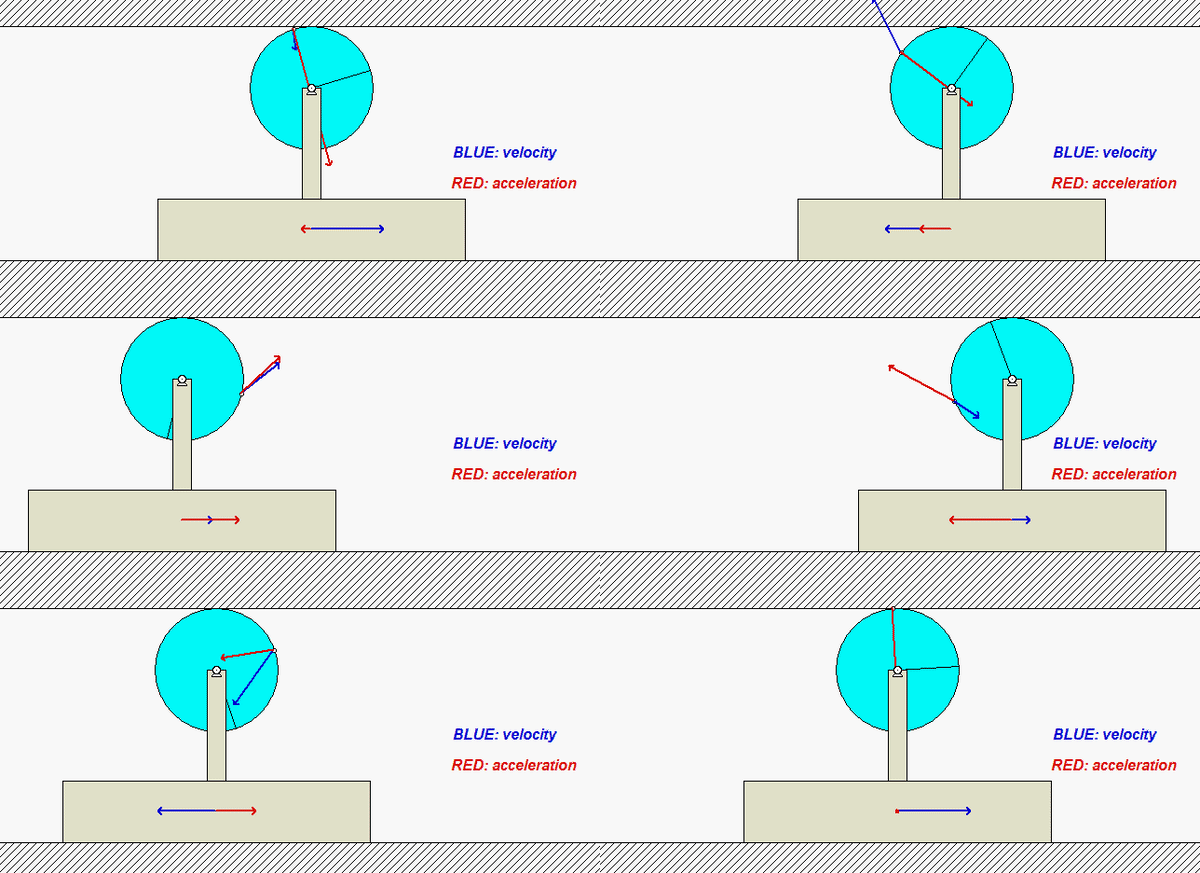
Here you will use the moving reference frame kinematics equations:
          vP = vO + (vP/O)rel + ω x rP/O
          aP = aO + (aP/O)rel + α x rP/O + 2ω x (vP/O)rel + ω x (ω x rP/O)

With the observer attached to the disk:

  • The angular velocity of the observer is angular velocity of the arm:
              ω = ωdisk k
  • The angular acceleration is the time derivative of the angular velocity vector: α = dω /dt.
  • For the (vp/O)rel and (aP/O)rel  terms, you need to ask the question: What is the velocity and the acceleration of point P as seen by the observer?
  • Note also that you have at your disposal the rigid body kinematics equations for the disk relating the motion of O to the IC of the disk at C.

Homework H3.D – Fa 25

Problem statement
Solution video


DISCUSSION THREAD

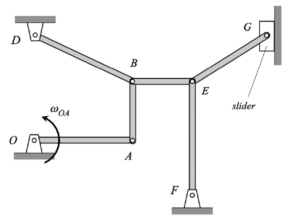
Here you will use the moving reference frame kinematics equations:
          vP = vO + (vP/O)rel + ω x rP/O
          aP = aO + (aP/O)rel + α x rP/O + 2ω x (vP/O)rel + ω x (ω x rP/O)

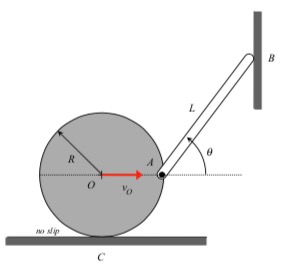
With the observer attached to arm OAB:

  • The angular velocity of the observer is angular velocity of the arm:
              ω = ωOA k
  • The angular acceleration is the time derivative of the angular velocity vector: α = dω /dt.
  • For the (vP/O)rel and (aP/O)rel  terms, you need to ask the question: What is the velocity and the acceleration of point P as seen by the observer?
  • Note also that you have at your disposal the velocity and acceleration of P through the rigid body kinematics equations of arm PC.

Homework H3.I – Fa 25

Problem statement
Solution video


DISCUSSION THREAD

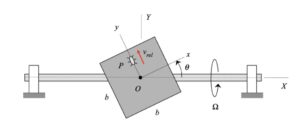
Here you will use the moving reference frame kinematics equations:
          vP = vA + (vP/A)rel + ω x rP/A
          aP = aA + (aP/A)rel + α x rP/A + 2ω x (vP/A)rel + ω x (ω x rP/A)

With the observer attached to the tube AB:

  • The angular velocity of the observer is the vector sum of the angular velocity of arm OA and the angular velocity of the tube AB relative to the arm:
              ω = Ω I + θ_dot  k
    where I is a fixed axis and k is a moving axis.
  • The angular acceleration is the time derivative of the angular velocity vector: α = dω /dt.
  • For the (vP/A)rel and (aP/A)rel  terms, you need to ask the question: What is the velocity and the acceleration of particle P as seen by the observer?

Homework H1.I – Fa 25

Problem statement
Solution vide

DISCUSSION THREAD

Part a)
Here it is recommended that you use the relative velocity equation of:
          vP = vB + vP/B
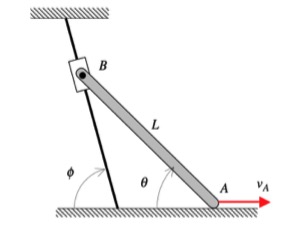
For this equation, you know the magnitude and direction of vB (vB = vB i where vB is known) and you know the direction of vP (vP = vPcosθ i – vPsinθ j where the scalar vP is unknown). For the term of vP/B you need to ask the question: What is the direction of the velocity of P as seen by an observer riding along on B? The answer to this is P appears to be moving only along the vertical slot; that is, vP/B = vrel j, where vrel is the (unknown) speed of P as seen by an observer on B. Substitute these three terms into the relative velocity equation and balance out the coefficients of the unit vectors. This will give you two scalar equations for two unknowns.

Part b)
Same hints as for Part a) except substitute in acceleration for velocity.

Homework H1.J – Fa 25

Problem statement
Solution video

DISCUSSION THREAD

For this problem, add up the lengths of the different sections of the cable in terms of the motion variables sA and sto produce the total length of the cable L. Since L is assumed to be constant (cable does not stretch, break or go slack), set dL/dt = 0. From the result, determine the speed of B. Take care in the differentiation as one of the terms in the expression for L will involve a square root.

Homework H2.A – Fa 25

Problem statement
Solution video

DISCUSSION THREAD

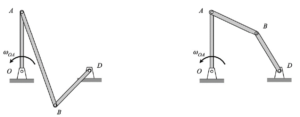
Here you are to use the rigid body aceleration equations for bar OA:
          aA =aO + α x rA/O – ω2rA/O
For this equation you know that aO = 0 and you know completely the vector expression for the acceleration of A. From this vector equation, you can write down two scalar equations from balancing the coefficients in front of the unit vectors. Solve these two equations for α and ω.