| Problem statement Solution video |
DISCUSSION THREAD
Any questions?? Please ask/answer questions regarding this homework problem through the “Leave a Comment” link above.
Discussion
.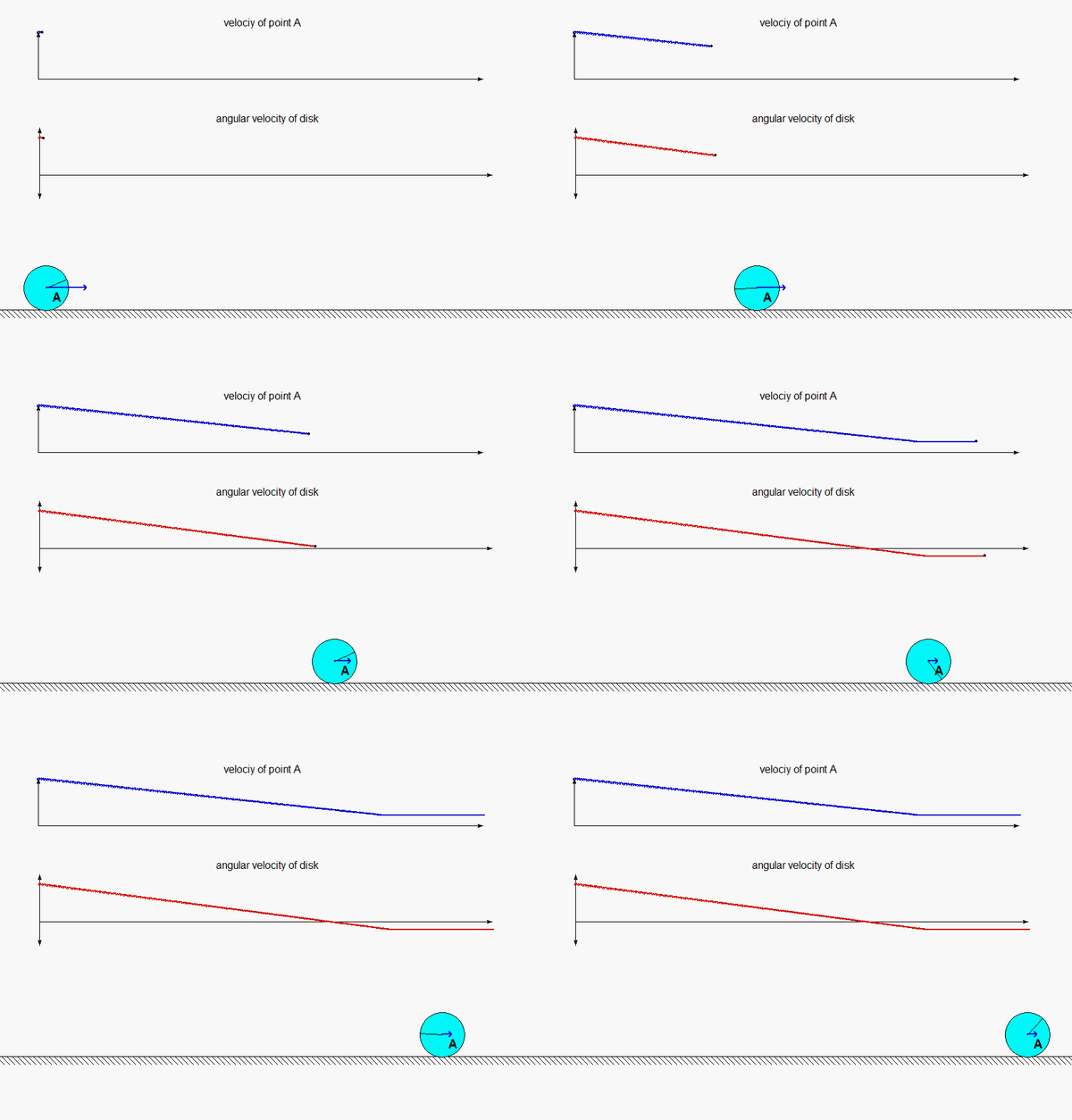
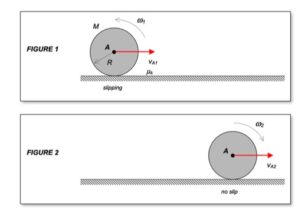
The animation shown above demonstrates the relationship between the translation velocity of the disk’s center A and the angular velocity of the disk. Recall that the disk is initially projected to the right with an initial velocity of A and a counterclockwise rotation rate; that is, the disk is given a “backspin” on release.
As the disk slides, the friction with the floor does two things: it slows down the translational motion of the disk, and exerts a clockwise moment on the disk reducing the rotational rate of the disk. At some point the rotation rate changes from counterclockwise (positive) to clockwise (negative). And shortly after that, slipping ceases to exist between the disk and the floor. Rolling without slipping starts at the point where the plots of velocity of A and angular velocity of the disk go “flat”.
HINT: As always, we should follow the four-step plan for solving this problem.
STEP 1: FBD. Here, draw a free body diagram of the disk.
STEP 2: Kinetics (here, linear and angular impulse momentum equations).
STEP 3: Kinematics. Slipping ceases when the velocity of the contact point on the disk with the ground goes to zero. At that point: vA = ω x rA/C, where C is the point on the disk in contact with the ground.
STEP 4: Solve
Should we include two separate FBD’s for the two states of rotation?
I suppose that you could; however, they would be the same FBD.
I am confused why the FBD would remain the same between the states. Does the frictional force acting at the point of contact with the ground simply always act in the opposite direction of movement of the center of mass of the disk?
While I think frictional force does in fact change directions, I don’t think it matters. This is because we are looking at the velocity at the point where friction flips, and the time it takes until the friction flips. Thus, we only need the frictional force when the disk is spinning counterclockwise.
I believe friction is always pointing left as it is opposing motion at the point of contact with the ground.
I see now, thank you.
In this problem I found it easiest to set up equations for angular and linear momentums, then solve for time first. To do this I solved for w2 in terms of time from angular momentum and similarly put v2 in terms of time by relating that and angular velocity w2. To finish the problem I solved for time in the linear momentum equation then plugged it back in to get v2.
If you take the moment about A, do friction and the normal force have to be taken accounted for? Should I take the moment about C, the point of contact?
I am pretty sure friction would need to be accounted for but normal force goes through point A so should not be in the moment equation. Also, since point C is slipping, it is neither fixed nor the center of mass of the disk and cannot be used
For a moment around A, the friction force does create a moment the force is acting perpendicular to the radius vector. But the normal force does not, since the force is directed through point A. Knowing this, I found it much easier to take it about A when solving.
It is recommended that you choose point A for your moment. The contact point is slipping; therefore, its acceleration does NOT point toward A, and you cannot use the simplified version of the AIM equation.
Could someone reexplain the parallel axis theorem we have to use for this case with the bar. I think I might have messed up my equation and forgot how to apply it here.
I did not use the parallel axis theorem for this problem, but in general this is how it works: You start at the center of gravity, and find the polar moment of inertia at the center of gravity. Then you take the point you want the moment to be about, and add the mass (distance between the points)^2 to the original moment. So the general formula for the polar moment about any point A would be (I_G) + (mass * (distance_AG)^2)
Should we assume that omega2 is ccw can we use cw, will my choice change the answer in any way?
You should be able to use either as long as you keep it consistent and account for the changed sign convention in your final answer
Can we always assume friction opposes rotation, or can its direction depend on the translation velocity?
I believe friction opposes the intended motion. I like to ignore rotation when I think about it and imagine a case where there’s no friction. In that scenario the disk would want to slide to the right (no rotation because there is no friction), so friction is acting to the left
After solving for V2 using both the angular momentum and linear momentum equations, I got a value for V2 which is larger than V1. However, the given graph seems to show that this isn’t the case. What could have caused this issue?
Did you take omega2 to be positive? I found that changed my answer
Meaning I changed my omega2 to be negative and vA2 decreased
What helped me for this problem was realizing that the friction affects both the translation of the center and the rotation of the disk at the same time. After writing the expressions for the linear speed and angular speed, the rolling condition right when slipping stops can be applied.
Is friction constant during this process?
I believe that we treat friction as a constant force throughout this process. I think that once the disk stops slipping (the instant shown in Figure 2), the friction force is no longer calculated using the coefficient of kinetic friction, and instead you would have to use the coefficient of static friction when analyzing the disk after the point in time shown in Figure 2.
When using LIM we should sum in the x direction. This should allow us to quantify the work that friction does from 1 to 2
Do we assume that in the start the motion of the disk is going to the right? Therefore the friction is in the negative x-direction?
Yes, the problem statement tells you that the center of the disk is moving to the right. Additionally, the angular velocity in Figure 1 is counterclockwise, meaning that the bottom of the disk is also getting pushed to the right. This means that the friction force must act to the left to oppose this motion.
The rotational momentum equation can be written and there is rounded impulse there and then there is another equation for momentum just the right, both are affected by friction, so we can set them equal to the friction force and solve through.
Is there any specific thing we should keep in mind when assuming the direction for angular velocity?