| Problem statement Solution video |
DISCUSSION THREAD
We encourage you to interact with your colleagues here in conversations about this homework problem.
| Problem statement Solution video |
DISCUSSION THREAD
We encourage you to interact with your colleagues here in conversations about this homework problem.
Comments are closed.
It says there are 3 parts but there are only 2 parts posted. Is this a mistake or do we just do only Part A and Part B?
Part A has two mechanisms, so that counts as two parts, and Part B is the third part.
There are only two parts: A and B.
Do we have to do a drawing?
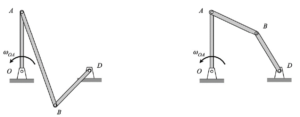
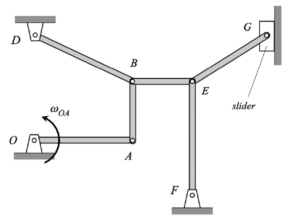
You need not redraw the figures of the mechanisms. Feel free to add the instant center construction line directly to the figures that are provided in the problem statements.
What’s the most reliable way to determine the direction of point B?
In each of these three IC problems, point B is on link BD, with link BD being pinned to ground. Because of this, point B has a circular path center of point D. The direction of the velocity for B is tangent to this circular path, and therefore is perpendicular to link BD. In each case, the IC for link AB is at the intersection of the perpendiculars to the velocities of points A and B.
Does this help?
I understand how to find the general way the velocity of a point is going but I don’t know how to tell which direction the velocity is pointing (positive/negative). Like point B on the first figure is the velocity pointing left and up or down and right?
Using the IC approach, you need only know the direction of motion. You do not need to know the “sense” of the motion. You determine the sense from using IC’s.