| Problem statement Solution video |
DISCUSSION THREAD

Ask your questions here. Or, answer questions of others here. Either way, you can learn.
DISCUSSION and HINTS
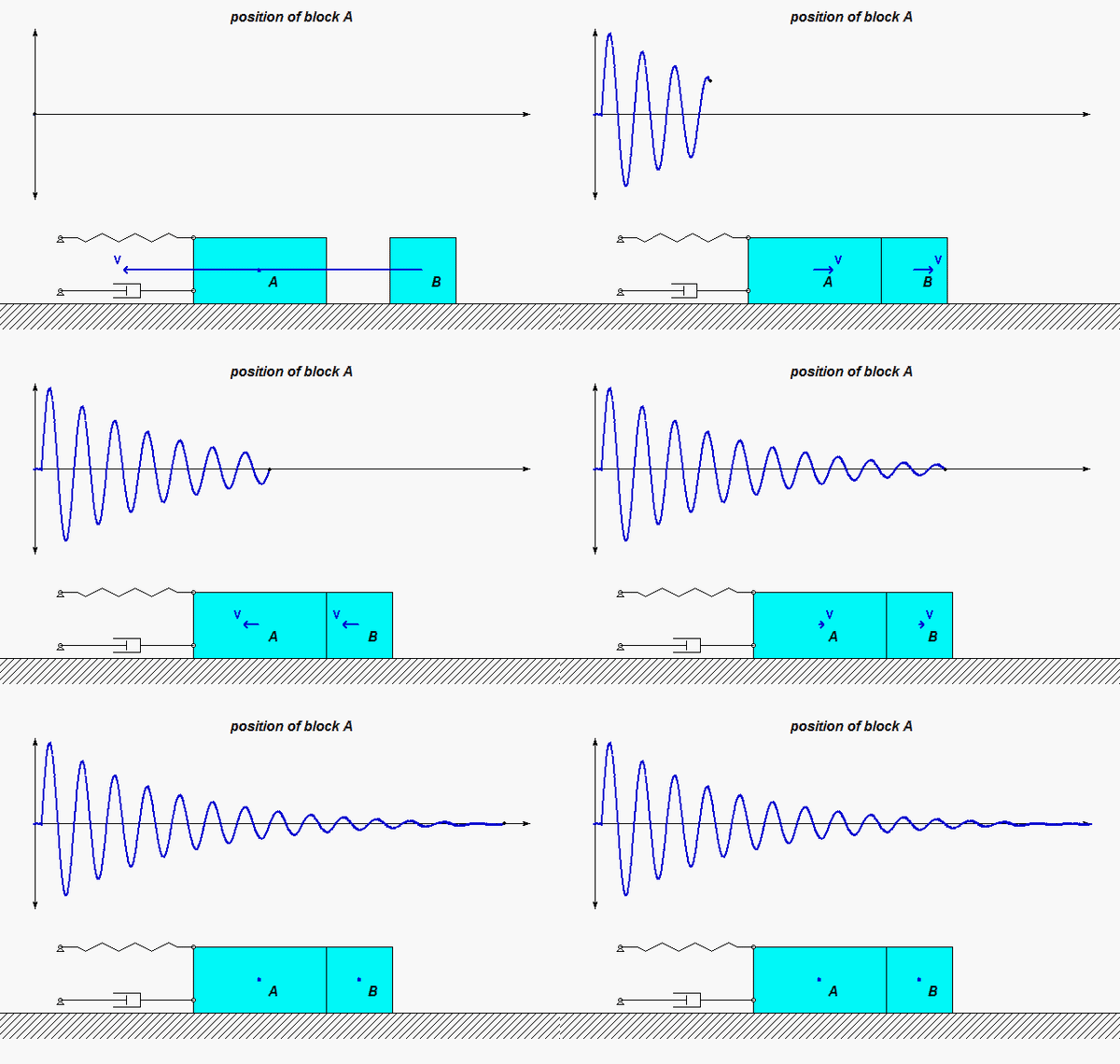
After block B strikes and sticks to block A, the two blocks move together as a single rigid body. In deriving your equation of motion here, focus on a system with a single block (of mass 3m) connected to ground with a spring and dashpot.
Recall the following four-step plan outline in the lecture book and discussed in lecture:
Step 1: FBDs
Draw a free body diagram (FBD) of A+B.
Step 2: Kinetics (Newton/Euler)
Use Newton’s 2nd law to write down the dynamical equation for the system in terms of the coordinate x.
Step 3: Kinematics
None needed here.
Step 4: EOM
Your EOM was found at Step 2.
Once you have determined the EOM for the system, identify the natural frequency, damping ratio and the damped natural frequency from the EOM. Also, from the EOM we know that the response of the system in terms of x is given by: x(t) = e-ζωnt [C*cos(ωdt)+ S*sin(ωdt)]. How do you find the response coefficients C and S? What will you use for the initial conditions of the problem? (Consider linear momentum of A+B during impact.)
do we leave our final answer in terms of v0, because this is needed to find constant S
I am also having this issue I think they forgot to add vo into the problem statement
Leave the answer in terms of v0.
Yeah I think leaving it in terms of v0 is intentional. Since they never give a numerical value, it lets you see how the initial velocity affects the entire response of the system. It also carries through into the constant S when you solve for x(t), so everything stays consistent instead of plugging in a number that was never provided.
That’s true. This is similar to the set up of a conceptual problem, where it could be asked how the initial velocity would effect the rest of the system if it was changed (halved, doubled, quartered, etc)
Also how much will we be given on the equation sheet relating to free vibrations will we be given standard solutions to the EOM in terms of variables and wn and wd or expected to memorize them?
the equation sheet from spring 2021 has wn, wd, zeta, the differential form, and the solved differential equation in terms of x(t)
I believe they will provide vibration formulas on the formula sheet
My professor mentioned that the equation sheet will be shared sometime next week.
Because we calculated the speed immediately after the collision, can we say that LIM is conserved and that the position is still x = 0 (the unstretched length of the spring)?
I think so, because the impact is instantaneous, we would assume linear momentum is conserved while the spring and damper forces are considered negligible during the collision; also since no time has passed for movement to occur, the initial position would remain as x(0) = 0.
To find the speed immediately after the collision, you will use the conservation of linear momentum. Since we are looking at only the instant after the collision, the spring won’t have compressed at all yet to provide an impulse (and since the time interval is so small, since we are looking at the instant after the collision, the force times time would cancel out anyway). Additionally, there is no friction, so linear momentum is conserved.
yes, LIM is conserved in collision portion of this problem.
Yes, we can assume that LIM is conserved in the x direction for the system because we can consider the system as a whole and understand that there are no external forces until right after the collision.
Yeah that is how I interpreted it too. During the collision, linear momentum is conserved because the time is so small that the spring and damper do not really affect it. Also since the collision is happening at the instant when the spring is unstretched, the position does not have time to change, so x at time zero stays zero for the combined system.
Yes, you would think about the moment after the collision being infinitely close to 0, so the position would have the displacement = 0
If we have the initial condition that x(0)= 0 or are told the spring/damper is initially unstretched, will the motion given by x(t) always exclude the cos(wd*t) term?
I believe so. Whenever the the standard underdamped solution is written at t=0 and initially unstretched the exponential term will always go to 1, and the sin term will always go to 0, resulting in the constant of cosine always equaling 0. However, if the solution equation was written in a different form such as phase shift, I do not think this would be the case.
I think for this problem yes, since x(0) = 0. If you plug in t = 0 in the standard underdamped form, the cosine term is the only one left, so its coefficient has to be 0. So for that form the cos term should drop out
For this one yes but not always in every form of the solution. In the standard underdampened form, x(0) determines that cosine coefficient since the sine term is 0. So since x(0) = 0, the coefficient becomes zero and the cosine term goes away. However, if the response was written using a form with one amplitude term and a phase shift, the cosine wouldn’t literally disappear. the zero initial displacement would be built into the amplitude and phase angle.
Yeah I was confused about this at first too. When you plug in the initial condition x of 0 at time zero into the standard solution, the sine term becomes zero and the exponential becomes one, so the whole expression reduces to just C. Since the displacement is zero at that instant, C has to be zero, which is why the cosine term drops out for this problem.
Because B sticks after colliding with A, can we assume that the velocity of B will not be used in calculations. Are the only velocity values v_A and v_0?
Not sure of what you are asking. Once the two bodies impact, they move with the same motion. That is, you still include both in your EOM.
vb post-collision is equal to va post-collision so they can be represented in the same term
the (velocity of a initial * mass a) plus the (velocity of b initial * mass b) will equal (mass total * vf)
For part (a), is linear momentum the correct method to use during the impact between A and B, with the spring and damper forces neglected over the very short collision time?
Yeah that’s correct. The momentum is conserved across the really short impact time (damper and spring impulses can be ignored) allowing you to use linear momentum method.
Yes, linear momentum is the correct method because the impact occurs over an infinitely small time interval. Additionally during impact, the spring force is equal to zero while the damping force is negligible due to the large instantaneous force of the impact.
Yes, linear momentum would be conserved as no external forces would affect the system, since the spring and damper force would be negligible.
I think yes, linear momentum is the right approach for part (a) since the collision happens so fast that the spring and damper can be neglected during impact.
Since block B sticks to block A after impact, should we treat them as one combined mass immediately when writing the EOM?
Yes, for all motion occurring after the impact, you must treat them as a single rigid body with a combined mass of 3m. Since they stick together, they share the same displacement, velocity, and acceleration, meaning the inertia term in your equation of motion must account for the total mass of both blocks. This combined mass is what the spring and damper will be acting upon as the system oscillates.
Will there be problems on the exam where a coefficient of restitution is given that governs that relationship, or is that not typical for spring mass problems?
Yes after the collision you should treat them as one combined mass. Since they stick together, they have the same displacement, velocity, and acceleration, so it becomes a single degree of freedom system. That is why the mass in the EOM becomes 3m and both the spring and damper act on that combined block.
when solving part c, do we use a mass of 2m + m for the variable M?
Yes, once they’ve stuck together a mass of 3m should be used
On the exam, will spring mass problems involve the other kinetics that we discussed before, like angular momentum conservation?
What is the reason they wanted us to leave it in terms of V_0 but not in terms of the other variables?
I think it is in terms of V_0 so we can see the relationship between the initial speed and the EOM as well as the response of the system.
For the initial conditions in part (d), remember that the momentum before impact (m * v0) must equal the momentum after (3m * v_final). This v_final becomes your initial velocity x_dot(0). Also, once you plug in the given values for m, k, and c, you’ll see the system is underdamped, so make sure your response equation matches the oscillatory form.
Would x˙(0) need to carry a negative sign depending on the chosen positive x direction, since the post impact velocity comes from the collision direction and not just its magnitude?
Yes, depending on your chosen positive x direction, the initial velocity could be negative. In part A of this problem, I found it helpful to define the unit vector “i” as being positive to the left. This is consistent with the direction of x which is defined as being positive to the left. This should simplify the problem in later steps but if you define it differently, that is also okay but you will have to keep the negative sign.
Yeah, it’s all about staying consistent with the positive direction chosen. The x˙(0) sign only reflects direction in your coordinate system, while the magnitude still comes from the momentum calculation after impact.
Well regardless of the sign, when you do the linear impulse equation, we can equate that the velocity of v of (A + B) at the second state (when they hit each other) is equal to one-third of v initial of block B. the Linear impulse equation is a vector quantity so this tells us that the instant that B and A stick to each other, they are still traveling to the ‘left’.
Yeah this actually depends on how you define your coordinate direction. In this problem x is positive to the left, and block B is moving left, so the initial velocity comes out positive.
If you defined positive to the right instead, then your initial velocity would be negative, but the physics would stay the same. It would just carry through into your constants and the final expression.
Since the problem specifies that A is at rest and the spring is unstretched at the moment of impact, does the static equilibrium position of the combined A+B system shift after the collision? If so, should x(t) be written relative to the new equilibrium, and how would that affect the initial conditions?
Motion for this problem is constrained to be in a horizontal plane. There are no forces acting on the system in the horizontal direction to create a static displacement. Therefore, x_st = 0.
Why can the spring and damper forces be ignored during the instant of impact, but not afterward when writing the EOM?
EOM defines motion over an interval rather than a instance of time.
it is because up until the instant after the collision the springs aren’t impacting the system. At the moment of the collision the displacement of block A is still 0 so the springs are not affecting the system. Once the blocks collide (by which point you’ve already used your LIM assumption) the springs started to affect the system which is when your springs play into your EOM.
I agree. I also think that since the collision happens of a really short time interval, the contact impulse is much larger than that of the spring or damper during the moment, hence why it’s neglected. After impact and the blocks start moving, the spring and damper forces become the main terms in the EOM
Should I keep the x=0 for the spring after the collision since its immediately after so the distance doesn’t change?
yes, you should
Thank you for your concise and informative comment. This will help me solve the problem
Just a little bit of a notation question. For the EOM, do we write it in terms of c,m,k, or using the parameters given below? In other homeworks, it explicitly states to write it in terms, but here it doesn’t mention any. On exams, will writing the equation in c,m,k, etc be okay?
You can leave it in terms of the terms or their full values. On Homework 35 (A, B), I wrote in terms of the parameters given to us and they gave me full points. In the answer sheet, they explicitly show in terms of the terms instead. I think they’ll give you the benefit of the doubt. I recommend writing the terms, then inputting the parameters in a line below so at least they know where you get the final answer from.
For part d of this problem, I am confused about the initial condition for the x coordinate of the system. I know that block A starts at x = 0 but does this initial condition apply to the whole system or is there some way we have to solve for the initial position of the system?
I believe you can assume that the initial condition applies to the whole system. You can assume at the instant of impact that x(0) = 0 and use that to solve for C in the response of the system equation x(t). You would just have to use the linear impulse momentum equation to solve for the initial condition of x_dot(0) and what that velocity is equal to (but this is done in part a of the problem). Finding this can help you solve for S in the x(t) equation.
What would the major changes of this problem be if the blocks did not stick? Besides only accounting for A in the oscillations would B add anything?
If the blocks didn’t stick, you would first not treat them as one mass and would have to find the post-collision velocities using the momentum equations, as well as using the coefficient of restitution of the collision. Additionally, as you said, the oscillations would use only A, so 2MX” instead of 3MX”.
To add to that, B would only affect A during the initial velocity, but not after impact.
That’s a good question. I think the mass in the EOM would be different. I also wonder if the final speed of A would be different if B collided elastically.
The final speed of A would be different in an elastic collision–the coefficient of restitution would be 1 in that case instead of 0, which means the final velocity of B would be opposite in direction which impacts the equation of motion assuming conservation of linear momentum
Yes, the final speed of A would be different if B collided elastically or had a different coefficient of restitution, because then we would need to use the coefficient of restitution formula to determine the speed of both objects after the collision.
When solving for the response x(t) of the system in part d, I got c=0 so the cosine term disappears. Why does this happen?
Because the solution equation of the EOM is x(t) = e^-(w_n)(Z)t (C cos(w_d t) + S sin(w_d t) ), where C and S are response coefficients! Since C is directly multiplying the cos term, it cancels out.
Pretty sure it comes from that initial condition x(0) = 0. If t=0 is plugged into the undamped solution, the exponential term becomes 1 and the sine term 0 and only cosine coefficient remains. So x(0) = -C (for the standard underdamped) and since the system starts at 0 displacement, C=0, which removes that cosine.
I believe a key takeaway from this problem is that the response coefficients are determined by the hand off from the momentum phase to the vibration phase. Since x(0) = 0 the C drops out leaving a pure sine response.
When forming the equation of motion after impact, is it valid to interpret the collision as setting an initial kinetic energy for the system, or is it important to strictly carry forward only the initial velocity from momentum conservation?
As we don’t know the coefficient of restitution, I believe it’s just better to conserve momentum and then use that to contextualise your KE.
I thought it was easier to conserve momentum than set an initial kinetic energy because I assumed it was an inelastic collision afterwards because they stuck together
what helped was treating the problem in two stages, first the sticking impact using momentum and then the spring damper motion using the combined mass together.
Using LIM, you can solve for Vo, as there are no forces at the moment of contact. If the blocks would not stick together, would you be able to break the system into timesteps where they are in contact vs not in contact to solve it that way?
I think you would have to find it just before collision and just after the collision in order to break it down and solve. However, I think you would still need to be given another value in order to solve, otherwise I think there are too many variables.
I think what helped me was breaking the problem into two parts, the instant of impact and the motion after. During impact I used conservation of linear momentum since the time interval is so small that the spring and damper do not really contribute any impulse. That gave me the initial velocity for the combined system. Then I treated A and B as one mass equal to 3m when writing the EOM and solving for the response. One thing I am still wondering about is if we chose the positive x direction the opposite way, would that just change the sign of the initial velocity and the S constant, or would it affect anything else in the final answer?
When solving for the damping ratio, it was interesting to see how the extra mass from block B changes the behavior. Since the damping ratio is inversely proportional to the square root of the total mass, increasing mass in the system lowers the damping ratio.
For part (a), when block B sticks to A, should we treat this as a perfectly inelastic collision and use conservation of momentum only, even though a spring and damper are attached to A?
I treated it as an inelastic collision and used conservation of momentum because I don’t think the spring and damper have a velocity to base the momentum off of
The way that the blocks collide and stick make it an inelastic collision, as collision type is determined by the interactions of the colliding bodies with one another, without taking into account the way that they interact with their environment. As long as A and B stick together, the collision is inelastic.
The spring/damper forces are considered to be instantaneously negligible after the collision, such as in Example 6.B.13
When solving for the response coefficients C and S, does x(0)=0 always eliminate the cosine term, or are there cases in this problem where it would still remain depending on how we define the solution?
No not always, the cosine term represents initial displacement, so if it was initially moving it would not be 0.
Is it ever valid to use energy instead of momentum for part a, or does the inelastic nature of the collision completely rule that out?
No, because the collision is inelastic you will have energy dissipation in the form of heat, sound, and other factors that you aren’t able to take into account with the given setup of this problem.
We’re unable to use energy for part a due to the inelasticity of the collision which causes energy to be dissapitated through the collision through things like heat and deformation, so there’s no conservation of energy
Do we have to treat this as a two-step problem due to the change in mass after the collision?
yes, you need to break it into a conservation of linear momentum problem to get the initial velocity of the spring system, and then you can use that as your x_dot (0) term for the EOM portion of the question.
Yep! After determining the initial velocity of the carts after sticking, the rest of the process is the same as the other vibrations problems in similar homework problems.
What would vo be? Do we just leave our answer in terms of vo?
I believe that we can use Linear Impulse to find v_o since all of the forces are in the x direction.
Ok after actually looking through, no, I do not believe we solve for v_o and our answer should b left in terms of v_o.
initial velocity of B. you don’t get a numerical value, so answers should be in terms of Vo.
If friction were to be included in this problem, would the period of x(t) be affected? As in, would the time it takes for the blocks to stop oscillating be reduced?
the friction would reduce the time it takes to decay to 0, however, it wouldn’t actually affect the oscillation period. Oscillation period would stay the same based on the dashpot.
I’m confused about how to handle the instant right after the collision, how do I correctly find the velocity of the combined mass and then use it as the initial condition for solving the system’s response x(t)?
I used linear momentum to solve for va2. your xdot(0) condition is the answer to part a.
Do we keep our answer in terms of v0?
This problem visits linear-impulse momentum again, which is conserved in the x-direction because there is no external forces acting in that direction. Additionally, conservation of momentum is NOT equal to conservation of energy, since the two particles stick. This means that the kinetic energy is lost and therefore, the collision is inelastic. The vibration part of this question is pretty familiar to what we have been doing so far.