| Problem statement Solution video |
DISCUSSION THREAD
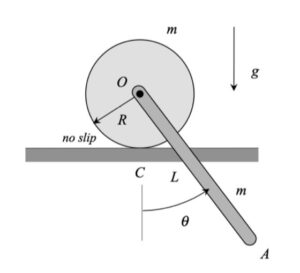
Discussion and hints:
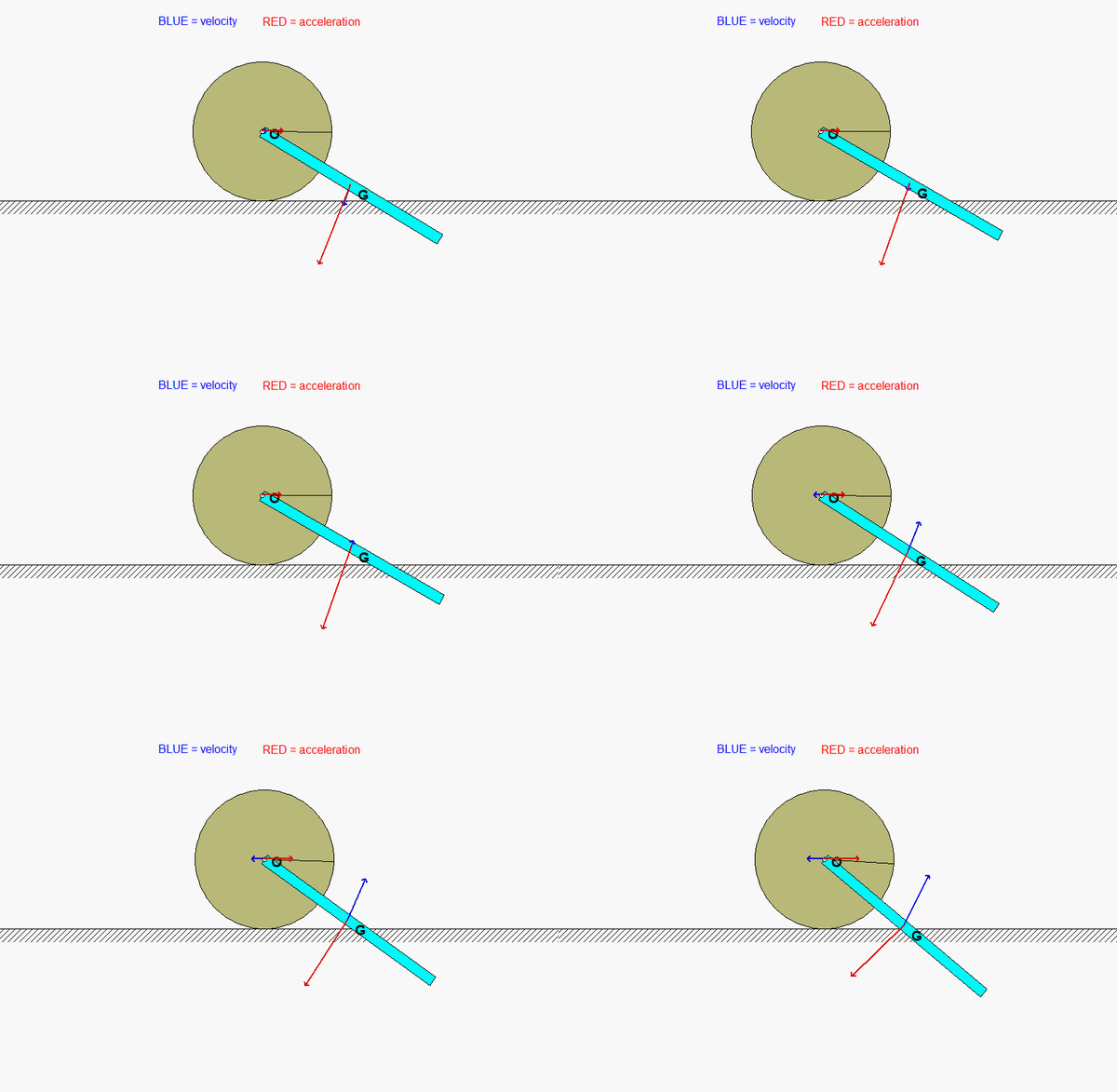
Recall the following four-step plan outline in the lecture book and discussed in lecture:
Step 1: FBDs
Draw individual free body diagrams for the bar and the disk.
Step 2: Kinetics (Newton/Euler)
Write down the Newton/Euler equations for the disk and for the bar based on your FBDs above.
Step 3: Kinematics
You need to use the rigid body acceleration equations to relate the accelerations of O and the center of mass of the bar, G, through the angular acceleration of the bar. Also, you need to relate the acceleration of O to the angular acceleration of the disk.
Step 4: Solve
Solve your equations for the angular accelerations of the bar and the disk.
Any questions?
Would it be best to take the moment about C for the disk?
How much more complicated does the problem become if the rod was attatched to the outer edge/circumference of the disk? Or like an arbitrary point away from O but still on the disk?
Do we assume that the reaction force at O is parallel to the bar? If so, the Euler equation about G results in a moment of 0. Is there something I am missing? Are we supposed to do the Euler equation about 0 for the bar and include the acceleration cross product?
Since the bar is not weightless, it cannot be a two-force member so the force will not be parallel to the bar. Instead, take the reaction at O in x and y components. This way, each component is different and produces its own moment.
I am not sure if this fully right, but I was able to solve it when I did a moment equation about O for the disk and about C. I don’t know if we were supposed to use two moment equations for the same body but that was what worked for me.
does a moment about C for the disk require parallel axis thm?
On exams and homework, are we able to directly use a_O = -Rα or are we supposed to write a_C = a_O + α × r_C/O etc.