| Problem statement Solution video |
DISCUSSION THREAD
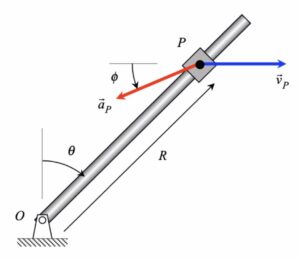
NOTE: Use phi = 20 degrees.
Discussion and hints:
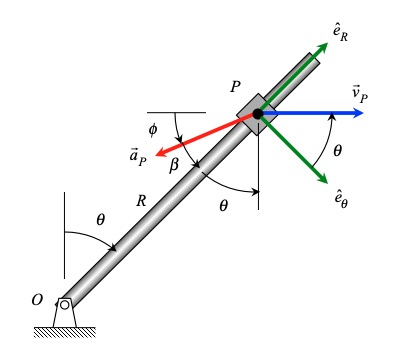
For the polar description to be used here, the radial unit vector eR points from O toward P. The transverse unit vector eθ is perpendicular to eR and points in the direction of increasing angle θ (clockwise from eR).
The solution of this problem comes down to trig – can you do the projections of vP and aP onto the polar unit vectors eR and eθ ? For example, the velocity of P can be written as vP = vP sinθ eR + vP cosθ eθ. And, the acceleration of P can be written as aP = –aP cosβ eR – aP sinβ eθ . No formulas to remember, just look at the figure and do the trig! From these results, you can identify the time derivatives of R and θ.
Any questions??