Spring 2026 Commencement Remarks
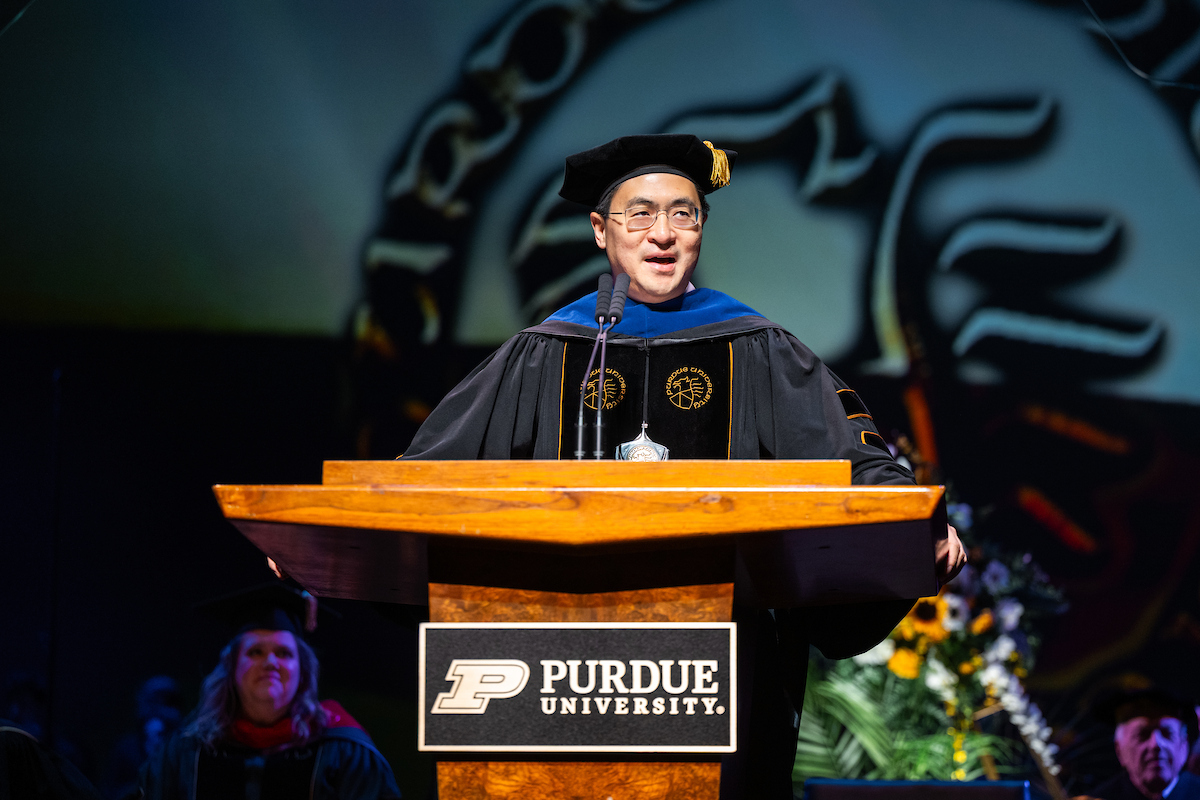
Purdue President Mung Chiang made these remarks during the university’s Spring 2026 Commencement ceremonies May 14-16.
Today marks a special occasion for all of you: no more tuition bills, and no more final exams! Unless you want to pursue another degree from Purdue. But let’s worry about that later. Today we celebrate all the hard work you have put into your study at Purdue, from early morning lectures to late-night labs, from stressful internship interviews to fun and frustrating team projects. Today you will say goodbye to what has become part of the memory as you await the calling of your name on this stage. And I shall attempt at delivering the shortest commencement remarks in Purdue history.
This graduating class has a special meaning for me as well: Most of you started at Purdue at the same time as I was preparing to start my new role to serve our university. You and I, we have together witnessed the continued growth in excellence, scale and impact of our university. And, yes, also the winningest four years in Boiler men’s basketball history.
This year also draws a special landmark for America as we celebrate its 250th birthday. Throughout the past 157 years, Purdue University has contributed in many unique ways to the United States.
- As a land-grant institution, we maximize student access and success for upward economic mobility.
- As a home of higher learning, we create talents, jobs and innovation through the discovery, dissemination and deployment of knowledge.
- As an American public university, we present that first vista of intellectual competitions and preserve a long-lasting bastion of individual freedoms.
Throughout all those generations, numerous Boilermakers have made their contributions to our country. Not just Neil Armstrong and Amelia Earhart, but also Purdue students and staff like the following three that you may not have heard of before:
- Ray Ewry was born here in Lafayette, received his BS and MS degrees from Purdue, and was the winningest Olympic gold medalist for 100 years, with eight golds in Standing Jumps for Team USA from 1900 to 1908. Ray was orphaned at a young age, and then diagnosed with polio. Wheelchair-bound, he simply wanted to stand up and walk again. In training his muscle and his mind to do so, he took the smallest steps, literally, to the giantest leaps in history.
- Captain Dorothy Stratton became Purdue’s first full time Dean of Women Students in 1933, and she created new curricula and built residence halls that helped nearly triple the number of women students at Purdue. In 1942, she was commissioned to create SPARS: the first women reserve in the U.S. Coast Guard. After World War II, she served as the executive director of Girls Scouts of the USA. Born at the end of the 19th century, she passed away at the age of 107 in this century.
- Dr. John Atalla, an Egyptian American immigrant, received his PhD from Purdue in 1949. Ten years later, while working at Bell Labs, he co-invented the first commercially viable semiconductor transistor. Powering the computer, Internet and now AI revolutions, his invention has since become the most manufactured technology artifact in American history: 10 to the power of 22 of those transistors made already and many billions more each minute.
Now, it is your turn in the rest of this century: with your own individual contributions to the most consequential, ongoing experiment in human civilization. Not just with what you have learned here, but also how to learn, and how to think critically, as a lifelong student and as a citizen. Not just with what you have covered in classes, but what we uncover together about ourselves and the world around us. Not just with the many capabilities you have acquired while at Purdue, but also the spirit of curiosity and resilience that has grown even stronger as you graduate.
Your future is America’s future. And I know that your alma mater will be as proud of you as you are of her. Congratulations, and Boiler Up!
Mung Chiang
President, Purdue University