Purdue University’s West Lafayette location has a combined heat and power (CHP) system that utilizes steam not only to provide heat to facilities but also to generate electricity and chilled water that is used to cool facilities. The combined heat and power system generates energy more efficiently and results in fewer emissions since heat that would normally be lost in the traditional power generation process is recovered and utilized. More information on CHP systems is available on the U.S. Department of Energy website.
The university’s greenhouse gas emission data since fiscal year 2011 is shown in an online interactive chart and in the image below, broken down by direct and indirect emissions. As is evident in the chart, FY25 is estimated to have the lowest number of emissions since FY11 when the university started measuring. It will be a total decrease of 39% since FY11 and 14% below the previous minimum (pre-pandemic FY19).
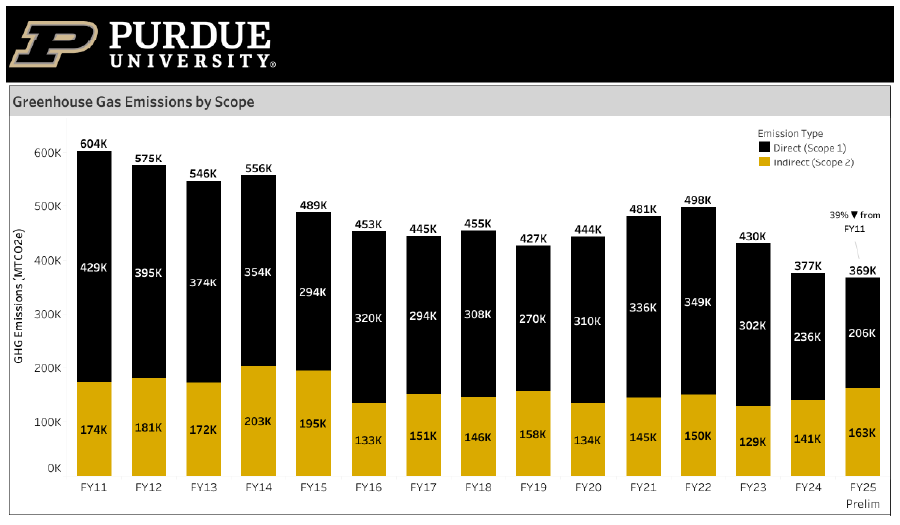
Direct (Scope 1) emissions: Direct emissions or emissions that result from campus sources owned or controlled by the university, such as the Wade Utility Plant.
- Direct emissions include all emissions from university boilers, some emissions from the Duke Energy combined heat and power plant and numerous smaller users of natural gas, propane and diesel fuel. The boilers at Wade Utility Plant have continuous emissions monitoring systems that measure the vast majority of the university’s Scope 1 emissions. The remaining Scope 1 emissions are calculated in-house using published fuel emission factors found on the EPA’s GHG Emissions Factor Hub.
- The university is required to submit greenhouse gas emissions reports to the EPA as a compliance activity under the Clean Air Act.
Indirect (Scope 2) emissions: Indirect emissions or emissions associated with purchased utilities or from sources owned or controlled by another entity.
- Purdue uses an emission factor calculation to determine the associated emissions for purchased electricity. Emission factors are calculated using State of Indiana electricity generation and emissions data from the U.S. Energy Information Administration.
Please note the EPA does not release updated emissions factors until November of the following year. The numbers shown for FY24 are preliminary until the EPA releases the 2024 emissions factors and the university finalizes data.
At the West Lafayette location, the Wade Utility Plant produces approximately half of the university’s electricity needs, and the other half is supplied from grid-purchased electricity as required by campus demand. Purdue produces all of the chilled water needed to cool campus buildings in addition to approximately 60% of the steam demand utilized for heating buildings, hot water, and other campus needs. The remaining 40% of steam demand is produced at Duke Energy’s onsite combined heat and power plant.