
Materials and Waste
Learn about a number of sustainable waste management practices that are in use across campus at the links provided below.
Recycling and Landfill

University Waste Resources
The Environmental Health and Safety (EHS) department offers pick up, transport, processing and disposal services for chemicals, storage containers and other hazardous materials. Further information and request forms can be found on the EHS website.
The Environmental Health and Safety (EHS) department provides a disposal service for rechargeable, lithium ion and other types of batteries. More information and forms can be found on the EHS website.
The University Surplus Store diverts university assets, including electronics, from the landfill through reuse, refurbishment, resale and recycling. Shop the surplus store from noon-4 p.m. Monday through Friday.
Departments interested in listing excess assets should contact 765-496-2222 or visit the Property Accounting Page for more information.
All collected paper and cardboard are sent to a paper manufacturer and recycler supporting a circular economy. More information on how to request recycling containers, trash containers or confidential carts for campus buildings is available on the Grounds website.
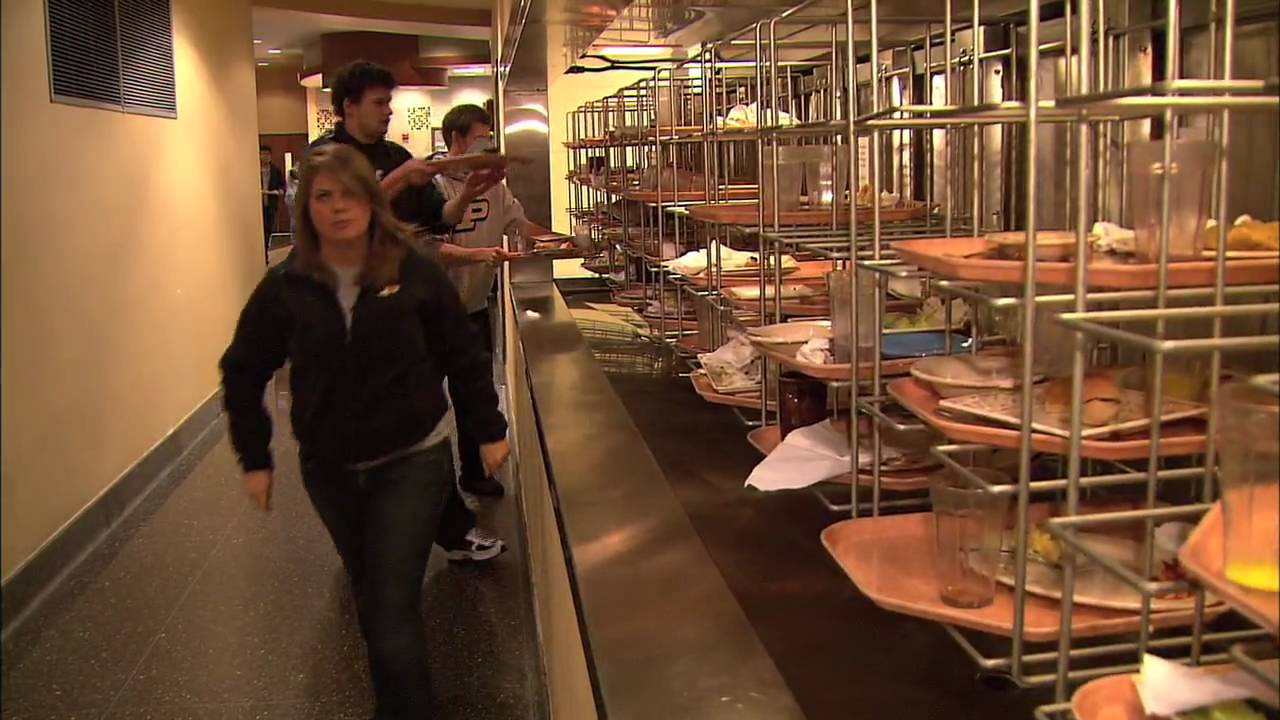
Since 2009, Purdue University has partnered with the City of West Lafayette to transform campus food waste into renewable energy. The program primarily collects food scraps from food generating locations on campus, including the Purdue Dining & Culinary’s residential dining locations.
Collected food waste is hauled internally by Purdue Grounds Refuse & Recycling to the West Lafayette Water Resource Recovery Facility (WRRF), where it is processed through anaerobic digestion. This is a natural, oxygen-free process in which microorganisms break down organic matter. As the material decomposes, it releases biogas, a renewable mixture primarily composed of methane (CH₄) and carbon dioxide (CO₂).
The WRRF captures this biogas and uses it to generate electricity and heat that power the facility’s operations, creating a closed-loop system that reduces landfill disposal, lowers greenhouse-gas emissions and supports local renewable-energy production. The remaining digested material, or biosolids, are further treated for beneficial reuse in agricultural or soil-improvement applications.
This collaboration demonstrates how Purdue and the City of West Lafayette are working together to advance circular waste management and community energy resilience.
See how the process works

Purdue University’s Yard Waste Compost Program diverts thousands of pounds of organic material from landfill disposal each year by turning landscape waste into a valuable soil amendment. Managed through the Grounds department within Administrative Operations, the program supports a closed-loop approach to landscape management across campus.
Each season, Purdue’s grounds crews collect leaves, grass clippings, brush and other vegetative debris from routine maintenance activities and storm cleanup. This material is transported to the university’s compost site, where it undergoes a controlled aerobic decomposition process. Through the action of naturally occurring microorganisms, the yard waste breaks down over several months into nutrient-rich compost.
Temperature, moisture and oxygen levels are carefully monitored to ensure effective decomposition and to minimize odor or greenhouse gas release. Once cured, the finished compost is screened and reused across campus landscapes — improving soil structure, water retention, and plant health, while reducing the need for synthetic fertilizers and topsoil imports.
By reusing these organic resources on campus, Purdue reduces hauling and landfill costs, cuts carbon emissions and demonstrates a model for sustainable land management within higher education
Personal and Household Waste Resources
Recycling and waste collection rules are specific to where you live. Information for the Greater Lafayette area can be found below.
The Purdue Grounds department offers mixed recycling drop-off locations for all students, staff, and faculty who do not currently have a home recycling service. The dumpsters marked with a recycling sticker at the following locations
- Telecommunications building at Second and University streets
- Parking lot at Fourth and Russell streets
- Parking lot across from the Armory
- Water tower parking lot
The City of West Lafayette offers a collection site for food waste and offers countertop food waste bins to residents Monday – Friday. Unpackaged food gets composted, broken down and converted into energy for the facility.
Clothing and other textiles cannot be processed in recycling streams. Gently used items can be donated to local charities, thrift or resale shops.