Living Landscapes Podcast
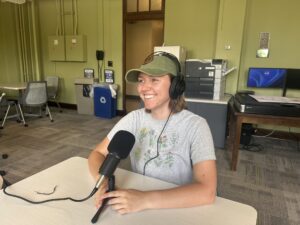
Grace Lentz recording an episode of the Living Landscapes Podcast.
New Podcast Explores the Intersection of Community and Environmental Design in Landscape Architecture
WEST LAFAYETTE, IN (November 15, 2024) – The Living Landscapes podcast, hosted by undergraduate and graduate student staff with the Purdue University Center for Community & Environmental Design (CCED), launches today. This podcast delves into the fascinating world of landscape architecture, exploring how this field can help create thriving communities and sustainable environments. Listeners can expect to learn about innovative design approaches, cutting-edge research, and inspiring stories of community engagement.
The CCED has been providing design and planning support to communities since 1976. The center seeks to partner with Midwest communities to develop solutions addressing social and ecological issues. The CCED also provides design solutions grounded in research, regional analysis, and environmental design. “This is a student-driven initiative based on their desire to share and explore environmental design with the larger community,” says the Director of the CCED, Dr. Aaron Thompson. “I’m excited to provide my staff the opportunity to engage in conversations exploring the many ways that landscape architecture can positively impact the world.”
Living Landscapes is available on Podbean https://tinyurl.com/LivingLandscapesPodcast, or wherever you get your podcasts.
For more information about the Living Landscapes podcast, expressions of interest to work with us, or to learn more about opportunities to partner with the CCED to enhance your community, visit https://www.purdue.edu/hla/sites/thompsonlab/ or contact Dr. Aaron Thompson (awthomps@purdue.edu).
____________________________________________________________________________________________________________________
Episode Descriptions and Resources:
Designing Agriculture I: Introduction to Designing Agricultural Landscapes
This is a new series that focuses on designing agricultural landscapes!
In this episode, Ishraq Awashra, a PhD student in Landscape Systems and Design at Purdue University, joins undergraduate landscape architecture student Amelia Gonzalez to explore the importance of designing agricultural landscapes. They discuss how farms, which cover nearly 40% of the world’s land, are often overlooked in design conversations despite their vital role in food production, jobs, and ecosystem services. The episode highlights the environmental, social, and economic challenges facing agriculture today—from soil degradation and habitat loss to rural community decline. Ishraq and Amelia share ideas from their lab at Purdue, where they are working to rethink how farms are designed, not just for cultivation, but for community and ecological health. They call for a systems-thinking approach that connects farmers, scientists, and designers to create more resilient and intentional agricultural landscapes.
Designing Agriculture II: Things to Consider When Designing Agricultural Landscapes
In the second episode of the Agricultural Landscape Design series, Ishraq Awashra and Amelia Gonzalez dive into the “how” of designing agricultural landscapes. They reflect on the absence of formal definitions and methods in this emerging field and propose a new way forward rooted in landscape architecture. The conversation covers key design principles like spatial layout, production focus, scale, and the human dimension. They emphasize the importance of designing beyond the farm boundary, considering regional and ecological impacts, and integrating scientific research with local and generational knowledge. The episode also critiques the trend of designing farms for aesthetics or wealthy clients, advocating instead for functional, inclusive, and science-based designs that serve everyday farmers and rural communities. Ishraq and Amelia call for a new design language and methodology that centers agriculture, ecology, and people.
Designing Agriculture III: Conversation with Clay Gruber
In this episode, Ishraq Awashra speaks with Clay Gruber, a landscape architect and founder of Clay Gruber Design and co-founder of Rural Futures Collaborative. Clay shares his personal journey from growing up on a cattle ranch in Montana to studying sociology and architecture, and eventually finding his calling in landscape architecture. He discusses how his background shaped his interest in rural design and the need for landscape architects to engage with agricultural communities. Clay introduces his Adaptive Lands Framework—a tool to help landowners understand how ecological and economic decisions impact their land. He emphasizes the importance of working with local knowledge, scientific research, and community values to create resilient, productive landscapes. Clay also talks about the challenges of entering agricultural design as a landscape architect and the need for new tools and methods to support farmers and rural economies.
Explore Clay’s work at Rural Futures Collaborative, and his Adaptive Lands Framework by following the links.
@ruralfuturescollab
https://www.ruralfuturescollab.com/
https://www.ruralfuturescollab.com/rural-notebook/adaptive-lands-framework
Designing Agriculture IV: Conversation with Zach Mermel
In this episode, Ishraq Awashra talks with Zach Mermel, founder of Ola Design Group in Hawaii. Zach shares how his upbringing in Volcano Village, near the world’s most active volcano, inspired his deep connection to nature and his career in farmscape design. With a background in environmental science and regenerative agriculture (complemented by a master’s degree in ecological design from the Conway School), and a passion for giving back, Zach seeks to integrate indigenous knowledge, ecological stewardship, and agricultural productivity in his work. In this conversation, Zach discusses projects that blend native plants with food systems, including designs for nonprofits and community farms. Zach emphasizes the importance of designing for more than just humans—creating landscapes that support biodiversity and cultural heritage. He also shares practical advice for young designers entering the field, encouraging hands-on experience and collaboration with local communities. His work shows how farms can be designed to be productive, resilient, and deeply rooted in place.
Discover Zach’s work at Ola Design Group.
@ola_design_group
Planning | 1. What is Community and Environmental Planning?
Grace Lentz and Colby Smock sit down to introduce the topic of community and environmental planning in order to answer the series’ guiding question: What is the importance of community in environmental planning?
Key reference: FNR-624-W – Environmental Planning (purdue.edu)
Sources:
Wisconsin Extension: https://fyi.extension.wisc.edu/landusetraining/introduction-to-community-planning/#:~:text=What%20is%20Community%20Planning%3F,and%20function%20in%20the%20future
University of Georgia: https://cviog.uga.edu/services-and-research/planning-and-environmental-services/environmental-planning-and-natural-resource-planning.html
__________________________________________________________________
Planning | 2. Community Planning in Action.
Grace talks with Ashley Newson, a Community Planner with the National Park Service, about her work in the Rivers, Trails, and Conservation Assistance Program and her experiences with the planning process.
NPS – Rivers, Trails, and Conservation Assistance Program: https://www.nps.gov/orgs/rtca/index.htm
___________________________________________________________________
Planning | 3. Community and Environmental Planning Research.
Grace and Colby talk about their personal experiences with planning, as well as conclusions they have come to in the quest to answer the question “What is the importance of community in environmental planning?”
Interested in learning more about conservation in Northwest Indiana? Follow: @incoastalconservation on Instagram.
___________________________________________________________________
What is Environmental Design?
Ishraq Awashra, Colby Smock, and Grace Lentz take listeners across the Purdue University campus, engaging fellow students and faculty in a thought-provoking discussion about the meaning of “environmental design.”
___________________________________________________________________
Sustainability | 1. Thinking Locally
Exploring the Path to Sustainable Communities.
This episode explores sustainable communities, asking “What does a sustainable community look like?” Hosts Hannah Kmetz & Colby Smock examine local & global green initiatives, offering insights into sustainability’s multifaceted nature. This episode provides a foundational understanding of key components.
Key References:
Purdue Sports utilizing West Lafayette Go Greener: https://www.purdue.edu/newsroom/purduetoday/2024/Q2/new-initiatives-underway-to-address-food-waste-on-west-lafayette-campus/
Steps to getting a food waste bin: Food Waste | West Lafayette, IN
Sources:
-Purdue LEED Builidngs: Buildings – Physical Facilities – Purdue University
-Master Gardners of Tippecanoe: Master Gardener Association of Tippecanoe County (tippecanoemastergardener.org)
-Go Green Commission West Lafayette: https://www.wlgogreener.com/resources