Purdue’s ‘Exercise Is Medicine’ expands to community with 10-week personalized program
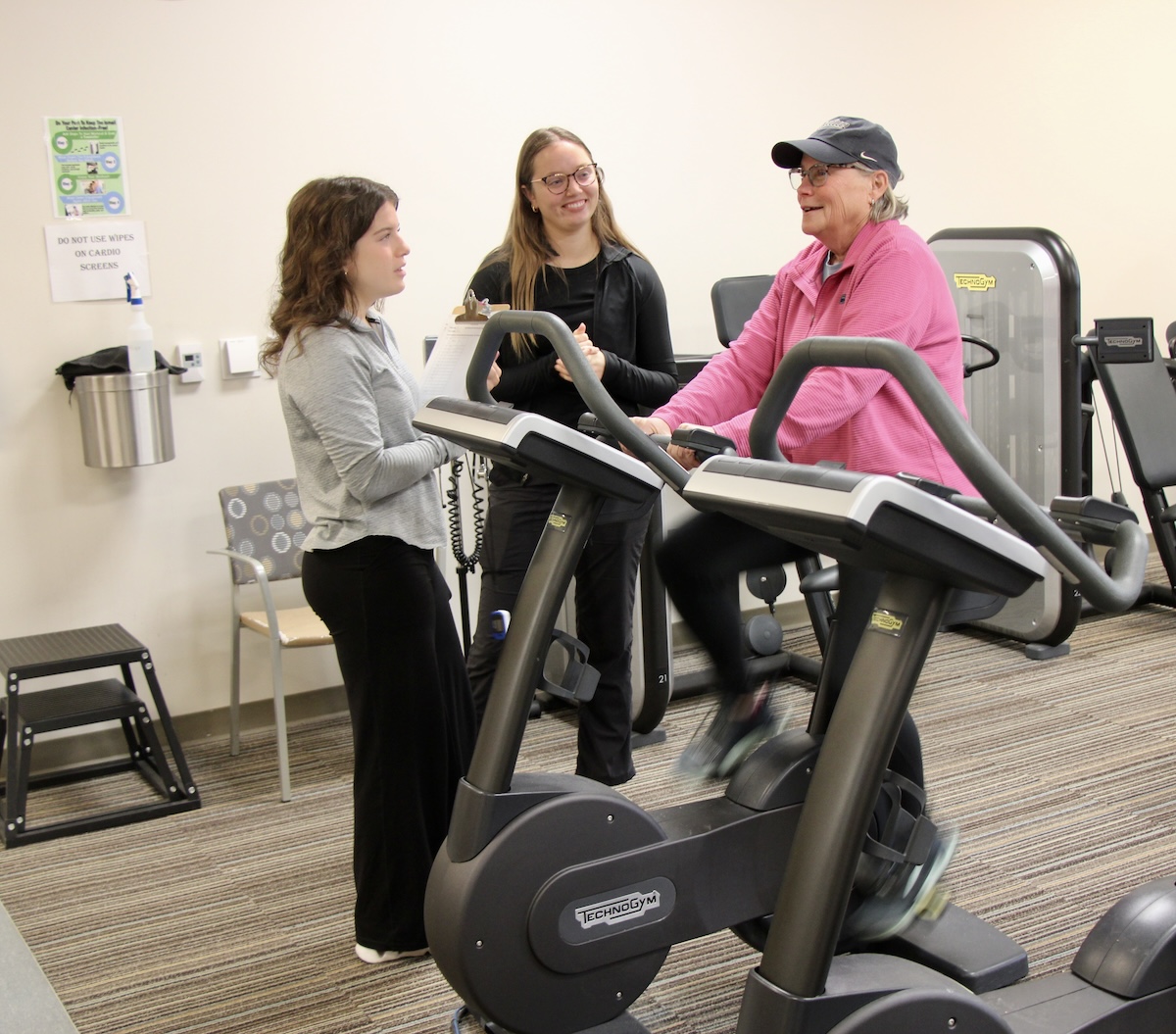
Purdue University Health and Kinesiology students assess the fitness of a client at the A.H. Ismail Center for Preventive and Lifestyle Medicine inside Lyles-Porter Hall.(Tim Brouk)
Written by: Tim Brouk, tbrouk@purdu.edu
Finding an exercise routine that fits a person’s health needs, goals and schedule can be difficult. Purdue University’s Department of Health and Kinesiology is hoping to make that process easier with a new 10-week Exercise Is Medicine program open to Purdue faculty, staff, students and community members.
Those needing help with their fitness and nutrition can sign up now in time for pre-assessments from Sept. 14-25. Pre-assessments check the client’s flexibility, strength, body composition and cardiovascular thresholds. The real sweat starts Sept. 28 and runs, stretches and bench-presses through Dec. 4.

Jason Chrapek
Using the pre-assessments, Jason Chrapek, clinical assistant professor of health and kinesiology and director of the A.H. Ismail Center for Preventive and Lifestyle Medicine, and his staff will customize workouts and guide clients through a custom exercise plan throughout the fall. Chrapek sees the program fitting with the Ismail Center’s mantra, “Exercise is nature’s medicine.”
“There are just mountains of research that shows that exercise is indeed medicine,” Chrapek said. “Exercise has benefits beyond the specific thing you’re working on — you might be working to get your A1C under control as a Type 2 diabetic. At the same time, you can also build strength, which is going to help your joint strength. It’s also going to help your cardiovascular health so you’re less likely to have a major heart attack. Your brain’s going to operate well; your immune system is going to perform better. You’re just going to feel better and have an overall better quality of life.”
Program cost is $155 for non-members or $120 for Ismail Center members. Post-program assessments will be made Dec. 7-11. The data collected then will be compared to the pre-assessment numbers.
Exercise Is Medicine is a program originating from the American College of Sports Medicine (ACSM). Purdue Health and Kinesiology has provided annual Exercise Is Medicine student events such as Exercise Is Medicine Week for years. The new 10-week exercise program opens things up to faculty, staff and the community with Chrapek and his student fitness trainers leading the way. Chrapek spoke about how the program works, why exercise can be considered “medicine” and what he hopes participants will gain from the 10-week experience.
How do you create a personalized, 10-week fitness program from a pre-assessment?
We’ll use that information (from the pre-assessments) to customize their workout plan. Depending on their health history, if they do have any kind of chronic conditions such as diabetes, anxiety disorders or cancer recovery, we can make sure the person is doing the exercises that are going to benefit them the most while taking into account what they want to work on. Are they on a GLP-1 medication? What are their goals?
Do the workouts have to be at the Ismail Center?
If it’s a community member who, let’s say they have a gym in their apartment, we can adjust the workouts accordingly based on what equipment they have available to them. And then they can always reach out to us like, ‘Hey, I’m not sure about this exercise.’ We’ll send them some resources to make sure they’re doing it correctly even though we’re not there with them.
Does the Exercise Is Medicine program have any requirements?
The kind of baseline foundation of the program is meeting the ACSM guidelines for physical activity — that’s 150 minutes weekly of moderate to vigorous physical activity with two days of full-body strength training. If you can meet those metrics, you’re doing about 90% to 95% of what is going to help you get healthier, reach your body composition goals, etc. Then the adjustments we make partially are people’s preference. Some people might really enjoy doing an hour-long run training for a marathon. If they do not like running, breaking up cardio might be a better option for them. Or they have a really busy schedule, and they can only make it into the gym twice a week. Where can we find time to get that other activity in?
What do you hope to see in clients’ post-assessments?
We want to see marked improvements. … We want to see improvements in those numbers because improvements mean a reduction in risk for all those different chronic conditions. Ten weeks is a relatively short time, but you can still see really significant results in that time while also setting yourself up for further success long-term from both a physical and mental perspective. This program is not just about maximizing results in 10 weeks — it’s about laying the foundation and building a sustainable approach for a long and healthy life.
Will this 10-week program return in 2027?
We’re hoping to run it every semester and potentially partner with researchers in different areas of HHS (College of Health and Human Sciences) that may be interested in looking at how exercise can impact all these different chronic health conditions.
Discover more from News | College of Health and Human Sciences
Subscribe to get the latest posts sent to your email.