Purdue Health Sciences alumna strives for ‘Dizzy Free PT’ clients
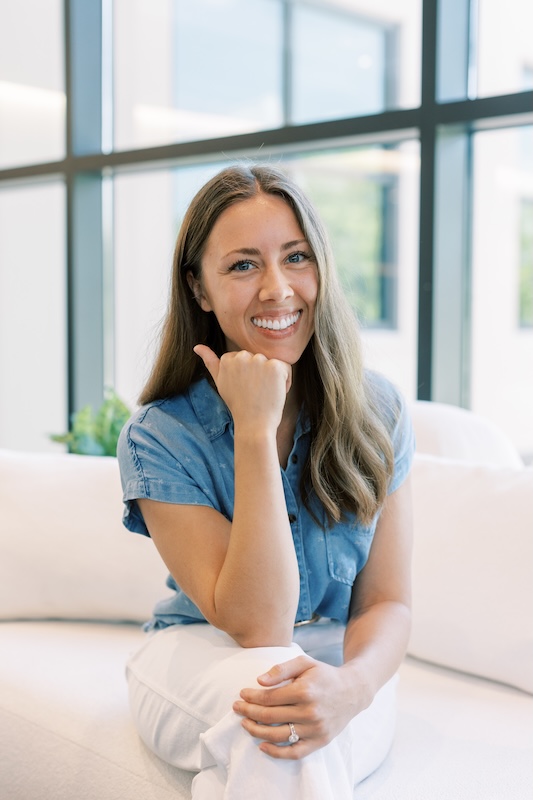
Carly Clevenger
Written by: Tim Brouk, tbrouk@purdue.edu
Finding the right career fit can be dizzying for an undergraduate student. That dizziness can also be a spark of inspiration.
Carly (Francis) Clevenger, a 2016 Purdue University School of Health Sciences alumna, knew she wanted a job in healthcare during her years in the Purdue College of Health and Human Sciences, but which field? A career aptitude test would surely help her find some direction.
“My No. 1 result was bartender,” Clevenger laughed. “Then my No. 2 was theater director, and I’ve never been in theater in my life. So, yeah, it was super interesting. But then somewhere on the list, I had physical therapy and got interested in that.”
After graduation, Clevenger earned a doctorate in physical therapy and earned experience alongside her husband, physical therapist and fellow HHS alum Jordan Clevenger (BS ’16), for physical therapy companies in California and back home again in Indiana. After five years, the Boone Grove, Indiana, native opened her own clinic, Dizzy Free PT, in Fishers, Indiana.
As the name suggests, Dizzy Free PT concentrates on clients’ dizziness, vertigo and imbalance, including symptoms related to vestibular migraine, visual motion sensitivity and benign paroxysmal positional vertigo (BPPV), a common inner ear disorder that causes sudden episodes of a spinning sensation when the position of the head is changed. Clevenger’s mission is to help clients feel steady and get their lives back.
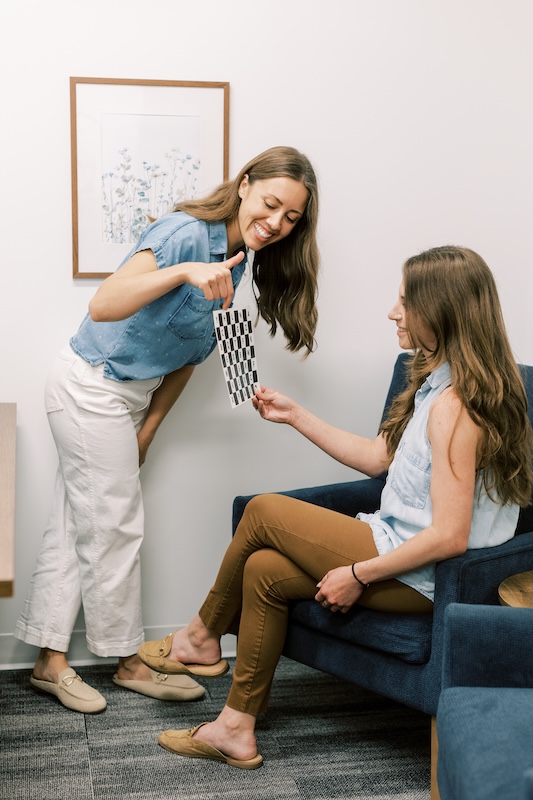
Clevenger shows a client a visual pattern as part of her practice at Dizzy Free PT.(Photo provided)
Is your path from a program like Purdue Health Sciences a common one in physical therapy?
I feel like my route was non-traditional. I reflect on it a lot because a lot of my patients ask because this is so specific. Even within physical therapy I only treat dizziness and vertigo, so it’s very niche within a niche.
I loved Purdue because it kind of helped cultivate that, “Hey, there are these paths we have set in stone but then there are these more broad ways you can go where you can really get creative within it.”
What are some reasons patients come into Dizzy Free PT?
You think of vertigo, and you often think of older adults or people who are falling, and that population is certainly important. But there’s also this underserved middle group — people in their 20s, 30s, 40s, 50s and 60s, who may be dealing with hormonal changes, migraines, previous head injuries or other changes to the vestibular system. Their dizziness doesn’t always feel like the room is spinning. They may describe feeling lightheaded, off-balance, foggy or overwhelmed in busy environments, and sometimes those symptoms have previously been attributed to things like stress or anxiety. That’s where knowing how to assess the vestibular and balance systems becomes really important.
When it comes to these balance systems, you need to know: Do your inner ears have the reflexes they need? Can you turn your head in certain positions? Can your eyes move like they need to track objects? It’s a bunch of just knowing these systems and knowing how they should function and then knowing what it looks like when they’re not.
There are just a lot of nuances in this field that aren’t common knowledge yet, but it’s fascinating because we have so much neuroplasticity — our brains can heal, and we can recover.
What are some exercises that you lead your clients through?
For the spinning, dizzy, dizzy vertigo, it’s more manual techniques. It’s a mechanical issue. Something is out of place, and we have to guide it back, reset it where it needs to be. That’s more of a hands-on approach. But the other stuff, a young woman in her 50s who just started getting lightheaded more often and is off-balance, it’s usually a combination of vestibular and eye movement training, including working on how the eyes and head move and function together. It’s separate from what an eye doctor would treat — like clarity of vision. It’s from an eye movement perspective. There’s one called saccades. It’s your eyes’ ability to jump back and forth between two targets. We do a variety of directions of those. There’s another one, an eye movement called smooth pursuit. You track a moving object with your eyes from a vestibular perspective.
We start in (a sitting position), but then we work up to walking activities, walking eye movements and head movements. Depending on the person, we can incorporate pattern work, like if they have a hard time in busy visual environments or driving, we can really specialize the program based on what the person is having a hard time with.
What’s it like for you when folks show improvement with balance?
It’s incredible because a lot of times, by the time people come to me, they’ve tried a lot of stuff — they’ve gone to their primary; they’ve gone to ENT (ear, nose and throat doctor); they’ve gone to neurology; they’ve tried other therapies. Most people are several years into their journey by the time they get here. At that point, they might not be driving; they might be not attending social activities; they just feel dizzy all the time; they don’t feel good, so I start to see them.
They actually get their life back and are able to spend time with their kids and not be anxious all the time. It’s just so cool.
How has your time at Purdue helped you in your career so far?
Academically, Purdue was very rigorous, and it prepares you in that sense. It’s challenging in a really good way, but then there’s also all the inclusivity and programs. I loved Boiler Gold Rush. I loved Purdue Dance Marathon, and I loved all these things where you can just be yourself, make friends and dive into what you love. That balance was super helpful. You can carve your own path.
Clevenger recently wrote a book on benign paroxysmal positional vertigo (BPPV). “Your Guide to BPPV” dispels confusing and inaccurate information about the condition that affects or will affect one in 42 people. The 232-page title conversationally covers vertigo’s physiological experience and what recovery looks like.
“I’m sitting down explaining it to a friend,” Clevenger said. “I included a lot of patient stories and real-life examples throughout too, so people can actually relate what they’re reading to what they’re experiencing.”
Discover more from News | College of Health and Human Sciences
Subscribe to get the latest posts sent to your email.